Select Language:
2025’s Global Import Powerhouses: Countries Leading International Trade
United States Tops the Chart with Over $3.4 Trillion in Imports
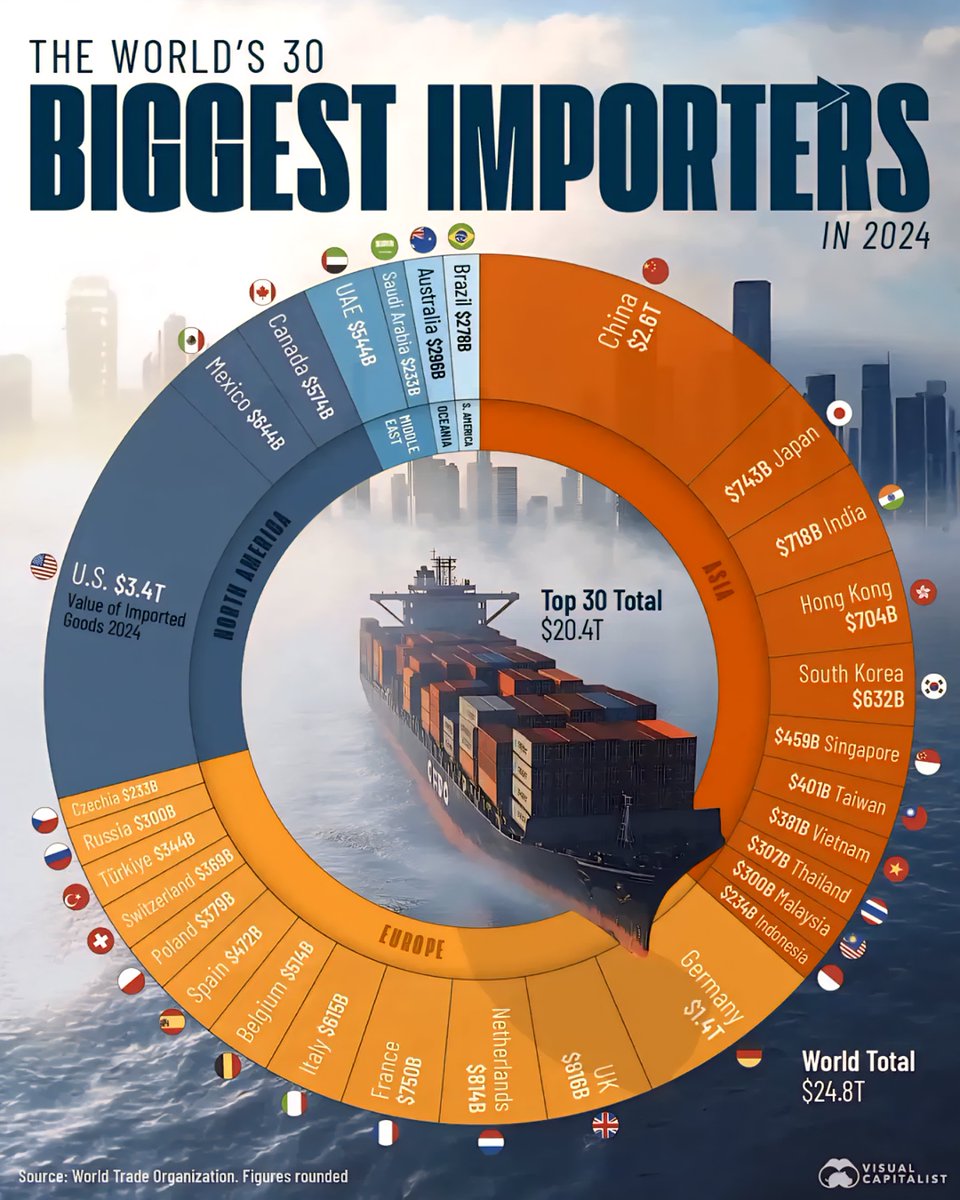
The United States maintains its position as the world’s largest importer in 2025, with imports reaching approximately $3.4 trillion. This hefty figure underscores America’s continued demand for goods ranging from consumer electronics and automobiles to industrial machinery. The robustness of U.S. consumption, combined with its diverse manufacturing sector, drives this high level of import activity. The country’s expansive consumer market and persistent reliance on foreign products ensure it stays at the forefront of global importers.
China Remains a Major Player with $2.6 Trillion in Imports
China, the second-largest importer globally, recorded imports valued at roughly $2.6 trillion. Despite its export strength, China’s high domestic demand for raw materials, energy, and high-tech components fuels its import volume. The ongoing infrastructure development and urbanization projects across the country sustain its need for foreign goods, cementing China’s critical role in global supply chains.
Germany Continues Its Dominance in Europe with $1.4 Trillion
As Europe’s economic heavyweight, Germany’s imports reached approximately $1.4 trillion this year. The nation’s manufacturing sector heavily relies on imported machinery, automotive parts, and raw materials. Germany’s strategic positioning as an industrial hub and its extensive export network make it one of the top global importers.
Netherlands and the UK Closely Follow, With $814 Billion and $816 Billion Respectively
The Netherlands, a key logistics and distribution hub in Europe, imported goods totaling about $814 billion in 2025. Its port facilities and trade infrastructure facilitate the movement of goods across the continent. Meanwhile, the United Kingdom’s imports topped $816 billion, reflecting economic resilience despite ongoing market adjustments post-Brexit.
France, Italy, and Belgium Cement Their Positions as Major European Importers
France has imported roughly $750 billion worth of goods, driven by energy, luxury items, and machinery. Italy’s imports reached $615 billion, mainly from machinery, textiles, and chemicals. Belgium, with its strategic port access, imported about $514 billion, making it a crucial gateway for European imports.
Spain and Poland Show Consistent Growth
Spain’s import activities stood at $472 billion, fueled by high consumer demand and industrial needs. Poland’s imports hit $379 billion, reflecting its growing role as a manufacturing and logistics hub within Eastern Europe.
Switzerland, Turkey, and Russia Maintain Key Import Roles
Switzerland imported approximately $369 billion, primarily in pharmaceuticals, machinery, and precious metals. Turkey’s imports totaled $344 billion, supporting its industrial growth and infrastructure projects. Russia’s imports reached about $300 billion, mainly in energy equipment, pharmaceuticals, and machinery.
The Asian Giants: Japan, India, and Hong Kong Lead the East
Japan remains a significant importer with $743 billion, mainly in energy, chemicals, and machinery. India’s imports, totaling $718 billion, reflect its rapid economic growth and expanding middle class. Hong Kong continues as a global trade hub with $704 billion in imports, largely spanning electronics, jewelry, and luxury goods.
South Korea, Singapore, and Taiwan Showcase Asian Trade Strength
South Korea imported $632 billion, focusing on semiconductors and industrial machinery. Singapore, a major trading nexus, handled $459 billion in imports, particularly in electronics and refined petroleum. Taiwan, with $401 billion, primarily imported semiconductors, machinery, and plastics.
Southeast and East Asian Nations also make notable contributions
Vietnam (with $381 billion), Thailand ($307 billion), and Malaysia ($300 billion) are increasingly important in global supply chains, supplying manufactured goods, electronics, and components. Indonesia contributed $236 billion, mostly in energy resources and raw materials.
Latin American and Middle Eastern Import Activities
Mexico’s imports totaled $644 billion, mainly in automotive parts, electronics, and manufactured goods, reflecting its close economic ties with the U.S. But also significant is Canada with $571 billion, including machinery, vehicles, and energy products. The UAE imported around $544 billion, driven by luxury goods, electronics, and energy equipment, reaffirming its role as a Middle Eastern trade hub. Saudi Arabia, with exports heavily oil-dependent, imported $323 billion in machinery and electronics.
Australia and Brazil’s Market Dynamics
Australia’s imports reached approximately $296 billion, focused on machinery, vehicles, and energy supplies. Brazil, the largest economy in South America, imported about $278 billion, mainly in machinery, chemicals, and fuel.
Overall Summary
The total global import volume in 2025 surpasses $20.4 trillion, adding to the global trade value of nearly $24.8 trillion. These figures highlight the interconnectedness of modern economies and the rising influence of emerging markets.
Source: World Trade Organization (Figures rounded) via Visual Capitalist
This detailed breakdown underscores the ongoing trends in international trade, emphasizing how geopolitical shifts, technological advancements, and consumer demands shape the import landscape in 2025. Countries continue to adapt their trade strategies, playing vital roles in the broader economic ecosystem.
 ChatGPT
 Perplexity
 Gemini AI
 Grok AI