
Select Language:
PUBLISHED
May 03, 2026
KARACHI:
As the global energy crisis worsens, electricity bills skyrocket, and a widespread yet divided consensus against fossil fuels emerges, there’s an increasing push in the developed nations to transition to cleaner energy sources. Meanwhile, in the developing world, many are reaching similar conclusions—not purely out of environmental concern, but out of economic necessity. Pakistan is no exception. The idea of switching to solar power is on many minds. Some can afford it now, others plan to wait until they save enough or until policy conditions improve.
Asad from Karachi, the southern port city blessed with abundant sunshine, is among those contemplating solar energy. Over recent months, especially as the energy crisis continues pounding consumers, he has repeatedly jotted down numbers on a scrap of paper. The calculations are straightforward, but acting on them is complicated—especially for someone watching every rupee, with little room for error. Rising tariffs and frequent load-shedding have made the switch seem logical—payback periods seem reasonable, and long-term savings appealing. Yet, when he decided to proceed, the realities around him had shifted, making the move less feasible.
The net metering policy he had based his calculations on had transitioned to a net billing system. The previously generous buyback rate for surplus electricity was slashed, sometimes to less than a third of its former value. The financial logic that once made solar investment attractive no longer held. Instead of placing an order, Asad hesitated, redoing his calculations and reconsidering his options.
His experience reflects a rising uncertainty among Pakistani consumers who, until recently, drove solar adoption. Middle-income households like his can still afford the upfront expense, but policy shifts have begun to diminish the incentives that spurred earlier adoption. Beyond this group, a larger segment faces the same challenges—higher electricity costs, rising fuel prices, and unreliable supply—yet remains excluded from solar benefits.
Over the past few years, solar capacity in Pakistan has increased markedly. According to The Guardian, installations expanded rapidly between 2021 and 2025, sometimes accounting for a notable share of the national energy mix. However, this shift has been driven more by consumer demand than government policy. Faced with rising costs and unreliable power, households and businesses have sought ways to regain control over their energy use.
Just as solar adoption was picking up momentum, new policies introduced hurdles—import restrictions, extra taxes, and changes to net metering rules—altered the economics. For some, the payback period has lengthened, making the investment less attractive. For others, entry costs have increased significantly.
Interestingly, other countries have taken different routes: many reduced or eliminated taxes once solar gained popularity to further encourage adoption. Pakistan, by contrast, has seen costs rise at a time of increased demand.
Simultaneously, relief remains elusive. Fuel prices stay unpredictable, electricity bills continue rising, and most households feel mounting pressure. Although global supply disruptions aren’t directly tied to Pakistan, their ripple effects are felt locally. The country heavily depends on imported fuels, so international shifts influence costs here too.
While more people turn to solar to cope with these pressures, the energy system itself has not kept pace, slowing progress and causing uneven growth.
This raises key questions: If solar is expanding, why does Pakistan remain so reliant on imported energy? What barriers prevent solar from advancing further? And who truly benefits from this transition—are some left behind?
Dependence on Imports
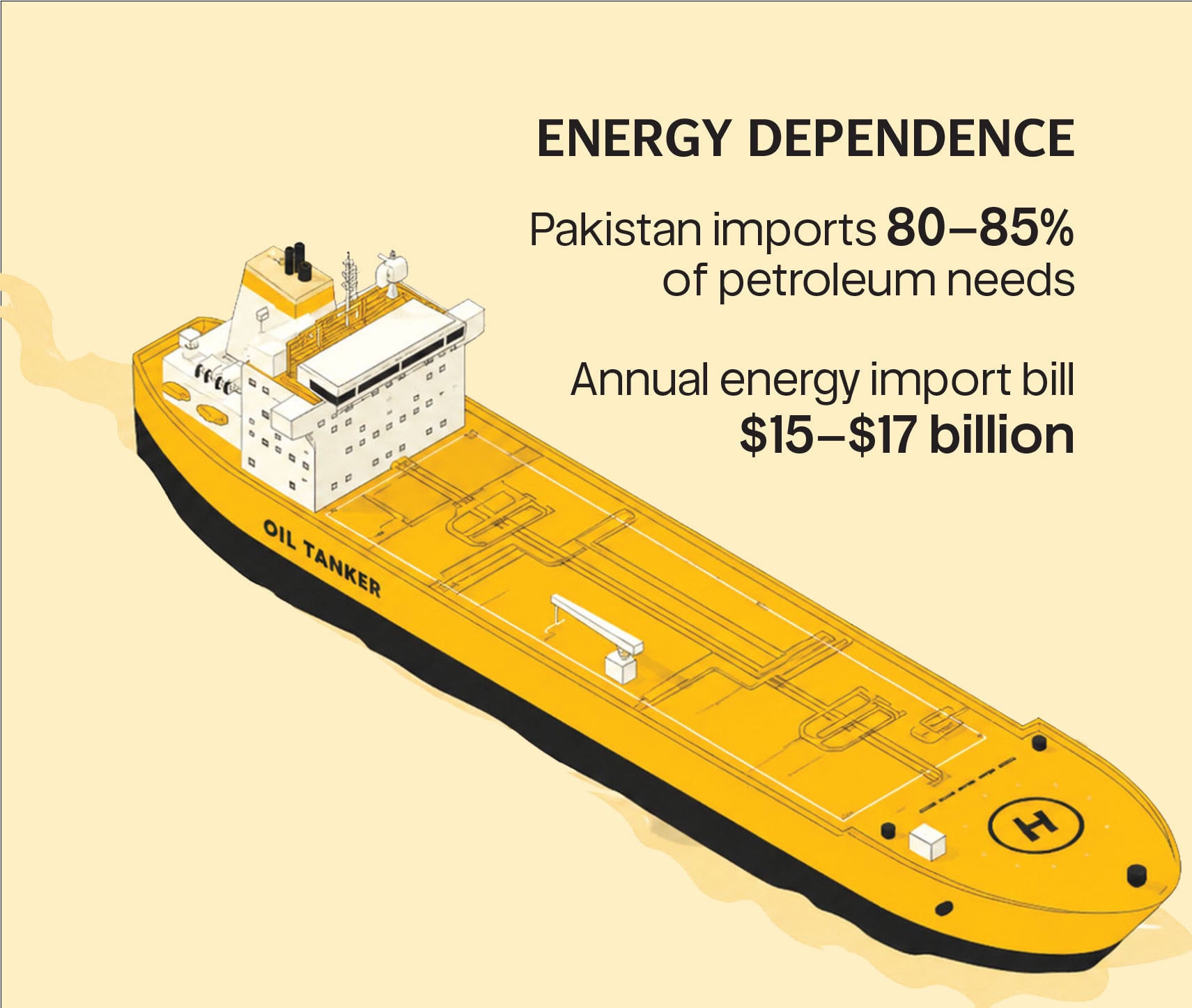
Despite the talk of a solar revolution, Pakistan’s reliance on imported energy persists and continues to expose economic vulnerability.
The country has made some strides in integrating renewables, and solar has become more visible recently. Still, when viewed in the broader energy context, the overall shift remains limited.
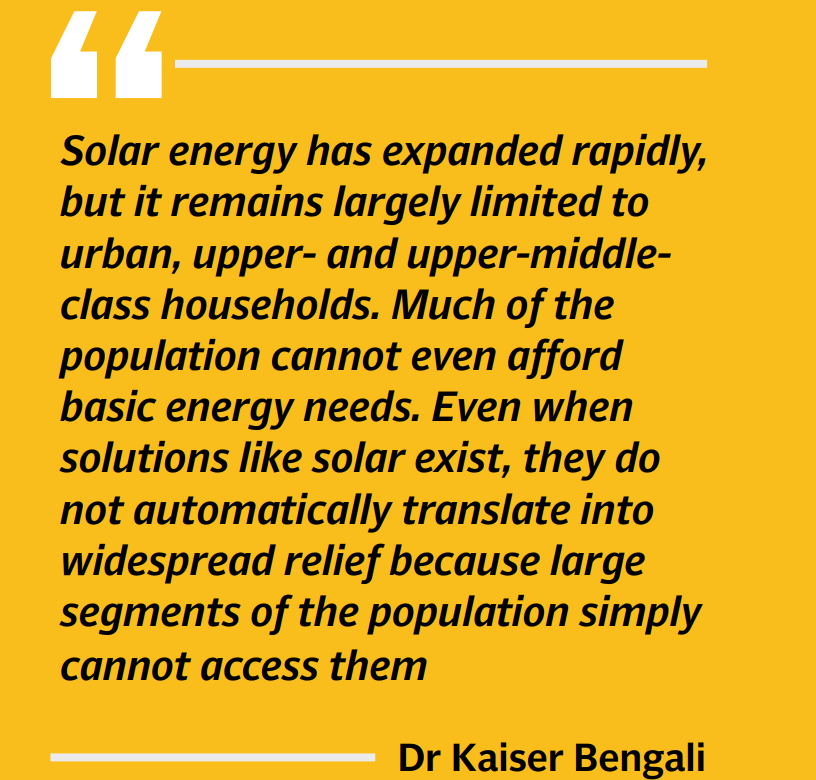
Expert economist Dr. Kaiser Bengali, who has extensively studied energy and development issues, notes that the core problem remains unchanged: “Over the past 25 to 30 years, we’ve increased our dependence on imports. Though renewable energy has grown, its share remains minimal—almost negligible in the overall energy landscape. Solar mainly benefits urban, upper-middle-class households.”
He emphasizes that not just the volume of solar capacity, but who benefits from it, is critical. “Affordability remains a major barrier. Many cannot even meet basic energy needs, let alone afford solar systems or backup solutions.”
This imbalance sustains the existing structure: even as some consumers turn to solar, Pakistan’s energy system continues to rely heavily on imported fuels. External shocks—global price swings or regional instability—still hit the country swiftly.
When asked whether Pakistan can cut its fuel import costs in the next five to ten years, Bengali highlights factors beyond internal control. “Much depends on global geopolitics, like conflicts in the Middle East,” he states. “But our vulnerability stems from our own dependency. If we used fewer imported fuels, external shocks would impact us less.”
Similarly, SDPI energy researcher Dr. Khalid Waleed sees the current transition as incomplete. “Pakistan’s shift to solar is real but not fully systemic,” he says. “What we’re witnessing is mainly a market response to high tariffs, unreliable supply, and fuel price volatility—more of a hedge than a deliberate policy move.”
He warns that this approach risks creating a fragmented system—shifting reliance from fuels to imported panels, inverters, and storage, without fostering domestic industrial capacity.
Economic constraints further complicate matters. “With over Rs2 trillion in circular debt in the power sector and limited fiscal space, policymaking tends to prioritize short-term fixes over long-term restructuring,” Waleed adds.
Overall, Pakistan’s dependence on imported fuels remains a key vulnerability. “Reducing this reliance would lessen external impacts,” Bengali reiterates, underscoring that the current system still leans heavily on imports, limiting the transformative potential of solar power.
This complex reality means solar is expanding, but the underlying system remains largely unchanged. The question then becomes: if solar continues to grow, why does the wider energy infrastructure look the same? Why does fossil fuel continue to dominate, and what’s really changing beneath the surface?
System Resistance to Change
If solar capacity is increasing so rapidly, one would expect a corresponding shift in the overall energy system. But that hasn’t happened.
Most visible are rooftop and small commercial solar projects in urban centers. Behind the scenes, however, the core structure remains intact.
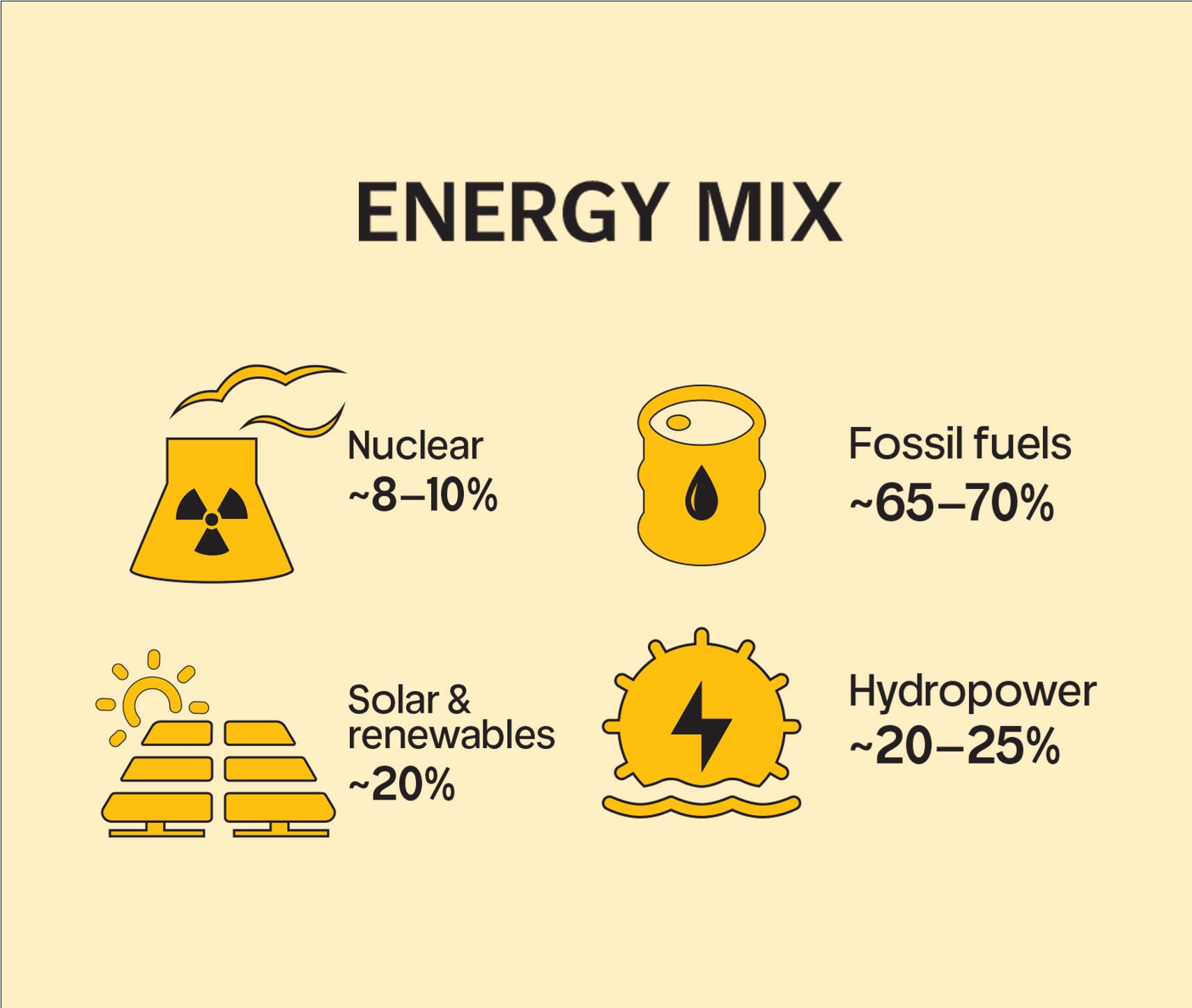
Professor Kaleem Ullah, from the US-Pakistan Center for Advanced Studies in Energy at UET Lahore, confirms that Pakistan’s centralised, fossil-intensive power grid has not fundamentally changed. “As of March 2025, thermal power still accounts for roughly 56% of capacity and remains the main source of electricity,” he notes.
Persistent systemic issues include high transmission and distribution losses, rising circular debt—around Rs2.39 trillion—and underutilized capacity—only about a third of installed power being effectively used. “Solar growth has occurred, but the core architecture remains unaltered,” he says.
This disconnect explains why solar’s visible expansion doesn’t translate into systemic transformation. Although solar can reduce reliance on fossil fuels in theory, in practice, the entire energy economy remains intertwined with conventional fuels—oil, gas, coal—not just within the power sector but also in transportation, industry, and household uses.
“The toughest sectors to transition are transportation, heavy industry, and residential gas,” Kaleem states. “While solar can replace daytime electricity quickly, it cannot easily substitute diesel fuel for transport or natural gas for heating.”
Thus, even as solar adoption rises, the system’s foundation—built on different assumptions—limits how far the transition can go.
This prompts a vital question: if solar is burgeoning but broader system changes are lagging, what exactly is causing the slowdown? Is it costs, policies, or fundamental systemic constraints?
Growth but Limited Scale
If solar is expanding and providing benefits to households and businesses, then why isn’t this growth translating into a broader systemic shift?
The answer involves multiple factors—policy contradictions, pricing issues, and the inherent design of the energy system.
SDPI’s Waleed suggests that the main obstacle isn’t the absence of policies but conflicting objectives within existing ones. “Regulatory barriers are rooted more in policy contradictions,” he explains. “On one side, there’s a push for renewables, while on the other, efforts to protect utilities’ revenues and uphold long-term power purchase agreements.”
This tension results in inconsistent policy signals. For example, each additional rooftop solar installation reduces demand on the grid, which raises per-unit costs due to fixed capacity payments—a feedback loop that discourages full-scale adoption.
Consequently, the transition is uneven. Middle- and upper-income households tend to adopt solar more readily, whereas lower-income groups remain dependent on increasingly expensive grid power.
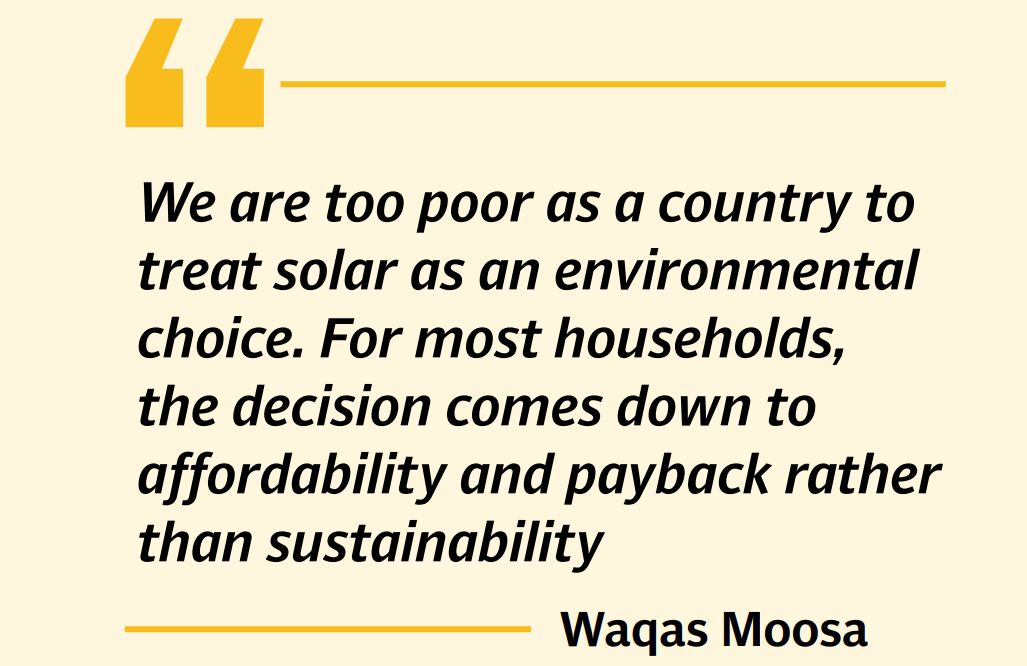
Market analyst Waqas Moosa notes that recent demand surges—especially after import restrictions disrupted supply chains in 2022—resulted in a backlog of demand that is now stabilizing. “Demand is still there,” he says, “but it is being shaped by policy and cost constraints.”
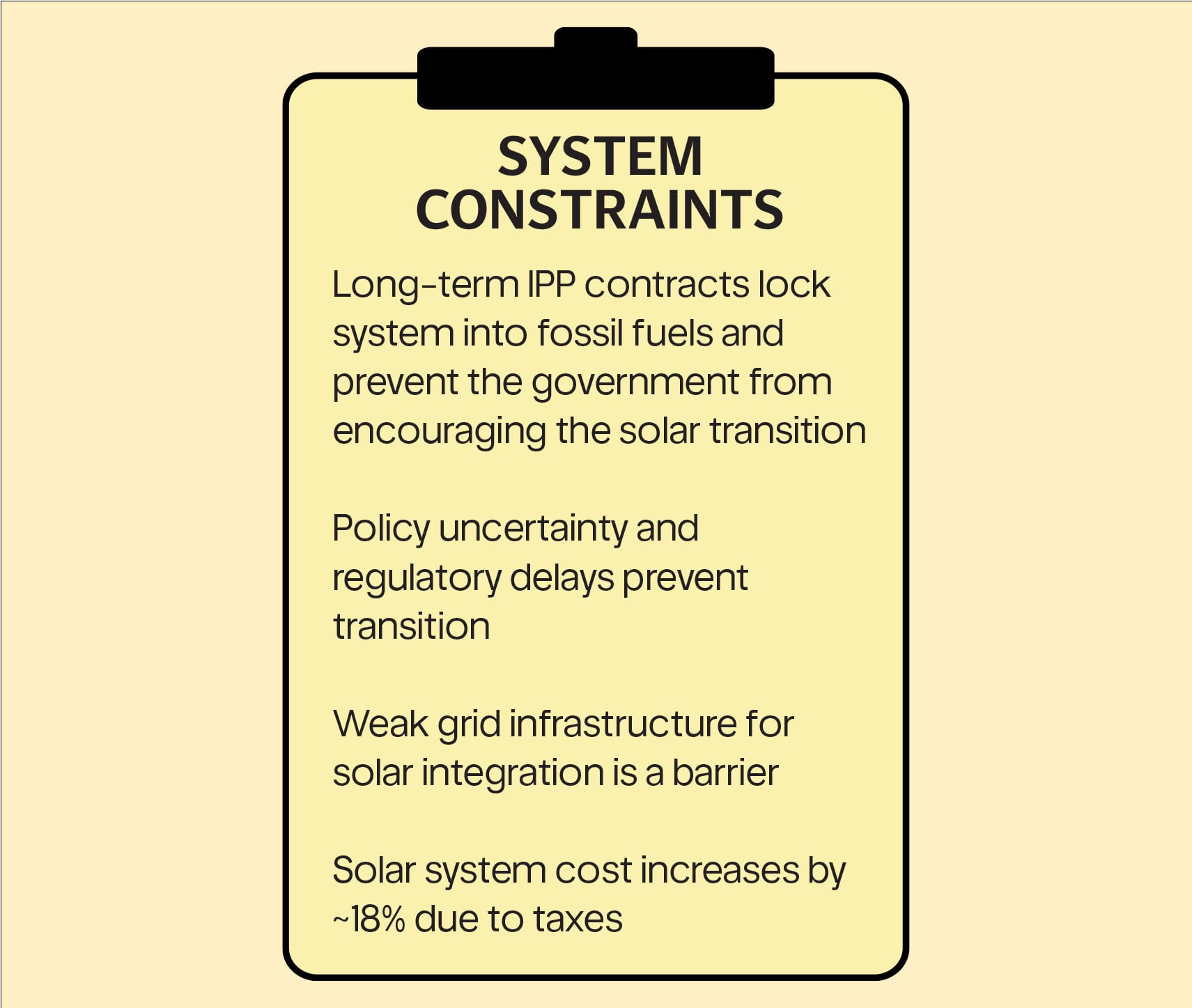
Component costs, for instance, remain high—an 18% import tax inflates the price of solar parts, pushing a system that should cost around Rs1 million closer to Rs1.2 million, a substantial hurdle for many households.
Efforts to streamline processes—such as removing licensing fees—have marginal impact. Moosa points out that delays are often caused by central approvals, with application processing still bogged down by bureaucratic inefficiencies dating back to 2015, when regulation was first introduced and then shifted to DISCOs.
Financing is another major barrier. “Solar is a high-cost investment requiring access to credit,” he says. “Currently, support for financing, especially for middle-income households and small businesses, remains limited.”
Altogether, the demand for solar exists, technology is available, and the economy’s logic still supports it. But systemic issues—cost, policy inconsistency, and infrastructure—continue to hold back broader, faster deployment.
The System Isn’t Prepared
While policy and market factors restrict solar growth, a deeper problem lies in the structure of Pakistan’s energy system itself. It hasn’t been designed to fully integrate large-scale solar.
A key issue is Pakistan’s reliance on long-term contracts with existing fossil fuel plants. Kaleem Ullah explains, “Many legacy Independent Power Producer (IPP) deals are based on dollar indexation, guaranteed returns, and capacity payments, regardless of whether the plants operate or not.”
These contracts mean that even if solar decreases daytime costs, the fixed payments for old plants remain, preserving the high cost burden. “Capacity payments have ballooned into trillions of rupees—consumers end up paying for capacity that isn’t always used,” Kaleem notes. “This structure adds renewable energy on top of a system that’s already expensive, without reducing the underlying costs.”
This creates resistance within the system—rather than welcoming solar, existing incentives hinder its growth.
Technical infrastructure is another bottleneck. “The biggest challenge isn’t sunlight availability,” Kaleem asserts. “It’s the grid’s capacity to absorb, transmit, and balance solar power effectively.”
Transmission constraints, weak distribution networks, and slow upgrades limit how much solar the grid can handle. While rooftop and small-scale projects grow quickly, scaling up at the national level remains difficult—mainly because the grid has not kept pace.
These issues aren’t solely technical; financial limitations are equally critical. Waleed emphasizes that the same fiscal constraints that affect policy also restrict investments in system upgrades like transmission and grid flexibility.
“Households face high initial costs, and at the government level, limited fiscal space hampers the necessary infrastructure development,” he explains. “This results in a situation where consumer-led growth is happening without sufficient institutional or infrastructural support to sustain it on a large scale.”
The core challenge isn’t just adding solar capacity; it’s whether the system can accommodate that growth in a way that meaningfully transforms energy production and delivery. If the system remains misaligned, the question arises: who benefits, and who’s left out?
Who Gains from Solar?
As solar continues to grow, another crucial issue surfaces—who actually benefits? Initially, the most visible beneficiaries are wealthier households and companies that can afford the upfront expenses.
However, Moosa warns that focusing solely on early adopters can be misleading. “Typically, wealthier groups are the first to adopt new technology,” he notes. “The important question is how benefits will spread over time.”
He emphasizes that impact matters more than just distribution. “For some, solar means savings. For others—particularly those with unreliable or no access to electricity—it can be transformative—allowing night-time study, proper food storage, and improved daily life.”
Nevertheless, inequality persists. Waleed points out that current trends risk deepening existing divides. “Solar adoption is disproportionately skewed toward middle and upper-income households, leaving poorer consumers tied to an increasingly costly grid,” he says.
This dynamic shifts how costs are shared across the system. “As more people switch to solar, those remaining on the grid shoulder a larger portion of fixed costs,” he explains—raising concerns about equity.
Additionally, Moosa warns of a “utility spiral”: as wealthier consumers leave the grid for solar, the remaining users face higher charges, potentially pushing the most vulnerable further into energy poverty.
This underscores that the transition isn’t just about technology—it’s also about system design and fairness. While some gain savings and flexibility, others are excluded or forced to bear increasing costs.
Ultimately, for solar to be truly inclusive, systemic reforms are necessary. Without them, the shift risks replicating existing inequalities, benefiting a limited segment while leaving many behind.

Addressing the System Before Scaling Up Solar
The core insight is clear: solar isn’t lacking momentum. Demand exists, technology is available, and economic reasons support adoption. What’s missing is systemic alignment.
Waleed asserts that future growth—aiming for a 50-60% renewable share—requires a shift in planning philosophy. “The focus should be on increasing system flexibility—deploying large-scale batteries, modernizing transmission, and digitalizing grid operations,” he suggests. “Confronting the legacy system is crucial—early retirement or repurposing inefficient plants can free capacity and cut costs.”
Progress is complex, and hurdles remain. “Pakistan’s renewable targets are aspirational under current conditions,” Kaleem warns. “Solar will grow, especially with storage, as consumers seek more reliable options.”
The fundamental barriers—weak grids, outdated thermal contracts, financial difficulties, and policy inconsistency—limit the scale of potential transformation. “We can make solar larger,” Kaleem agrees, “but to do so as a dominant source, we must first fix our institutions and infrastructure.”
In the meantime, immediate measures can help make benefits more accessible—for example, passing on cheaper daytime electricity costs to all consumers. Waqas Moosa emphasizes that the advantage of lower daytime rates should be reflected in tariffs, ensuring even non-solar households benefit.
The overarching reality is that solar will continue to expand. The question is whether the existing energy system can adapt swiftly enough—not just to accommodate growth, but to enable a meaningful transformation that benefits the entire economy.
 ChatGPT
 Perplexity
 Gemini AI
 Grok AI