
Select Language:
A recent study has uncovered an unexpectedly simple way to address one of the primary challenges facing next-generation solar cells. Researchers from Korea University and the University of Surrey demonstrated that merely bringing two specialized solar materials into contact can significantly enhance both their efficiency and longevity—without the need for additional chemicals or coatings.
This breakthrough, published in Nature Energy, centers on perovskite solar cells, which have gained worldwide interest due to their lower production costs and easier manufacturing compared to traditional silicon panels. Over the past few years, the efficiency of these cells has rapidly improved, making them strong contenders in the solar industry. However, their tendency to degrade quickly—especially when exposed to heat and moisture—has limited their commercial viability.
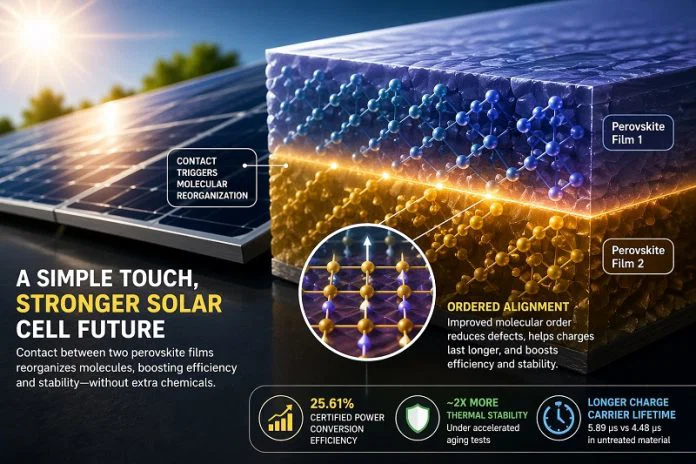
The new method addresses this issue through a straightforward approach. Instead of altering the material’s composition, scientists simply placed two different perovskite films in contact with each other. This contact initiated a natural interaction at the boundary, leading to a more organized and stable internal structure throughout the entire layer—not just on the surface.
This refined structure enhances the performance of the solar cells. When sunlight strikes the material, it produces tiny charged particles that carry energy. In less stable materials, these particles tend to lose energy rapidly as heat. But in the improved material, they last longer and move more efficiently, resulting in higher electricity output. The innovative design achieved a power conversion efficiency of 25.61%, a notably high mark confirmed through independent testing.
The process, dubbed “contact-triggered cationic interaction” (CCI), involves the rearrangement of internal charged particles upon contact, which reduces tiny defects that can cause energy loss. Using advanced nanoscale imaging techniques, the team visualized these changes directly, confirming that the alignment and structure improved exactly as anticipated.
Additionally, this new structural stability translates into greater resistance to damage. Stress tests simulating real-world conditions revealed that the treated materials required about twice as much heat energy to break down compared to untreated samples. This indicates that solar panels built using this technique could last significantly longer under everyday conditions.
The real elegance of this discovery is its simplicity. By controlling how two layers of material touch and interact, scientists can simultaneously boost both the efficiency and durability of perovskite solar cells. Scaling this approach could accelerate the adoption of perovskite technology, offering a more affordable and capable way to produce clean energy in the future.
 ChatGPT
 Perplexity
 Gemini AI
 Grok AI