Select Language:
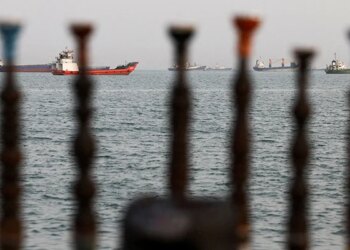
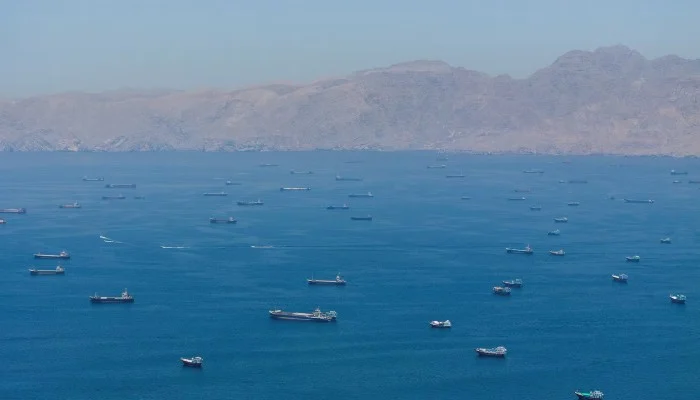
A drone shot captures vessels anchored in the Strait of Hormuz, viewed from Musandam, Oman, on May 25, 2026. — Reuters
- The U.S. launches targeted strikes against an Iranian military site, downing several drones.
- A U.S. official describes the response as cautious and defensive.
- President Trump denies any agreement with Iran and Oman regarding navigation through the Strait of Hormuz.
The U.S. military reported conducting new defensive operations against an Iranian drone operation threatening American forces and commercial ships in the Strait of Hormuz. This comes just hours after President Donald Trump dismissed reports of a potential deal to restore shipping traffic in the waterway.
An anonymous U.S. official told Reuters on Wednesday that the military shot down four Iranian attack drones and attacked a ground control station in Bandar Abbas before a fifth drone could be launched. A ceasefire agreement between the U.S. and Iran has been in place since early April.
“These actions were deliberate, solely defensive, and aimed at preserving the ceasefire,” the official stated.
Iran’s Tasnim news agency cited a military source claiming the Islamic Revolutionary Guards Navy fired warning shots at a U.S. oil tanker attempting to transgress the strait, causing it to turn back. The source also indicated that the U.S. responded with strikes on open ground around Bandar Abbas, with no reports of casualties or damage.
Later reports from Iranian media indicated that four ships trying to pass early Thursday were turned back after warning shots in their directions.
Additionally, the U.S. conducted strikes in southern Iran on Monday, claiming they were defensive. Iran called these actions a “gross violation” of the ceasefire.
Oil prices, which had fallen over 5% on Wednesday, rebounded after reports of these strikes. U.S. crude futures rose nearly 2% to $90.38 per barrel early Thursday in Asian trading.
Trump asserts no country will control the strait
During a cabinet meeting on Wednesday, which was open to the media, Trump dismissed an Iranian state TV report claiming Iran had obtained an unofficial draft for an agreement to restore shipping to pre-war levels within a month, with Iran and Oman jointly managing traffic.
Trump emphasized that no single country would dominate the waterway, hinting at a potential threat to Oman, a longstanding U.S. ally.
“No one is going to control the strait,” Trump said. “It’s international waters, and Oman will act like everyone else, or we’ll take action. They get it, and they’ll be fine.”
The White House and Oman’s embassy did not immediately comment. Iran’s UN mission was also unavailable for comments.
Later, the U.S. Treasury announced that the Persian Gulf Strait Authority, Iran’s official body responsible for managing passage, was added to the list of sanctioned entities threatening U.S. national security.
The Iranian report also claimed that the U.S. would lift its blockade of Iranian ports and withdraw military forces from the region, but the White House dismissed these reports as “complete fabrications.” Iran has not responded publicly.
The U.S. has approximately 15,000 troops involved in enforcing a blockade of Iran, with thousands more stationed at regional bases. U.S. naval vessels continue routine transits, stopping at ports like Oman, although the number of daily crossings has decreased by 88% since the initial strikes in late February.
President Trump has also urged countries like Pakistan, Saudi Arabia, Qatar, Turkey, Egypt, and Jordan to join the Abraham Accords, normalizing relations with Israel as part of efforts to end the conflict—but these nations have declined.
Iranian officials say the proposed draft deal would involve the U.S. withdrawing military forces from the area, though the White House dismisses this as untrue. Negotiations on Iran’s nuclear program are expected to proceed separately, which some analysts view as a sticking point for Trump’s supporters. Iran insists its nuclear pursuits are peaceful.
U.S. Secretary of State Marco Rubio has stated confidently that Iran will never develop a nuclear weapon.
On Wednesday, Iran’s Revolutionary Guards announced that 23 ships, including oil tankers and commercial vessels, had transited the strait over the past 24 hours—far fewer than the usual 125-140 vessels before recent hostilities began.
Despite ongoing tension, the international law governing the Strait of Hormuz grants all vessels the right to passage, though recent military actions have reduced daily traffic significantly.
 ChatGPT
 Perplexity
 Gemini AI
 Grok AI