Select Language:
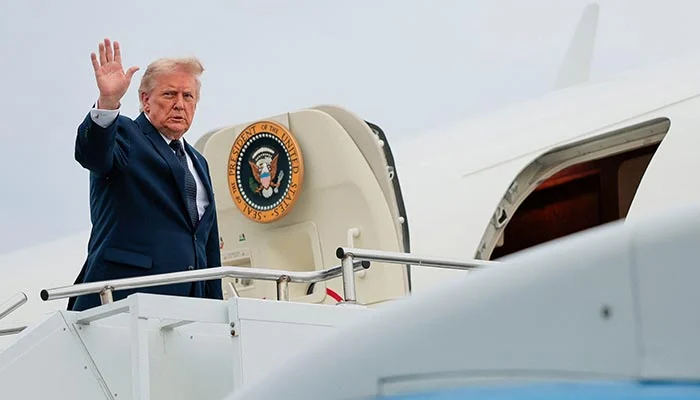
U.S. President Donald Trump took off from Morristown Airport in New Jersey, heading to Joint Base Andrews in Maryland aboard Air Force One on May 22, 2026, with Reuters capturing the moment.
Trump remarked that his team had been advised not to rush into any agreement, emphasizing that time was in their favor. He stated, “I have told my representatives not to hurry when it comes to reaching a deal. The blockade will stay in place until everything is finalized, signed, and certified.”
Earlier, he mentioned that negotiations were close to completion, pending final details between the U.S., Iran, and other involved nations. Iranian news agency Tasnim reported that important parts of a potential agreement, including the issue of frozen Iranian assets, remain unresolved.
Regarding Iran’s nuclear activities, Secretary of State Marco Rubio told The New York Times that regional backing for a deal exists, but such an agreement cannot be made in haste—like “72 hours on a napkin.” Rubio noted that seven or eight regional countries support the approach and that the process is moving forward. He also highlighted that a quick resolution might be possible, but Trump reiterated caution, asserting, “If I strike a deal with Iran, it will be a proper one, yet negotiations are still ongoing.”
Israeli Prime Minister Benjamin Netanyahu, a strong Trump supporter, affirmed that both leaders agreed any final deal must fully eliminate Iran’s nuclear threat.
Iranian officials confirmed that a draft agreement exists, but they stressed that discussions on Iran’s nuclear program—despite the longstanding U.S. demand for an end to uranium enrichment—have been postponed for 60 days following any deal. President Masoud Pezeshkian conveyed that Tehran remains committed to assuring the world it does not seek nuclear weapons, though it’s uncertain if this pledge will be formalized in the final text.
Iran’s Fars news agency reported that sanctions on oil, gas, petrochemicals, and related products would be temporarily lifted during negotiations to allow Iran to sell its exports freely.
Leaders from Saudi Arabia, the UAE, Qatar, Egypt, Jordan, Bahrain, Turkey, and Pakistan participated in a call with Trump on Saturday to discuss the potential agreement. Pakistan, which facilitated direct US-Iran talks in April, expressed hope to host more negotiations soon. Prime Minister Shehbaz Sharif mentioned that Army Chief Field Marshal Asim Munir, who recently traveled to Tehran, also joined the discussion. This dialogue is seen as a critical step toward advancing peace efforts and establishing lasting stability in the region.
 ChatGPT
 Perplexity
 Gemini AI
 Grok AI