Select Language:
- Rubio states that US immigration reforms are not targeted at India.
- He mentions that every country has its share of foolish individuals.
- Jaishankar emphasizes that legal mobility should remain unaffected under US regulations.
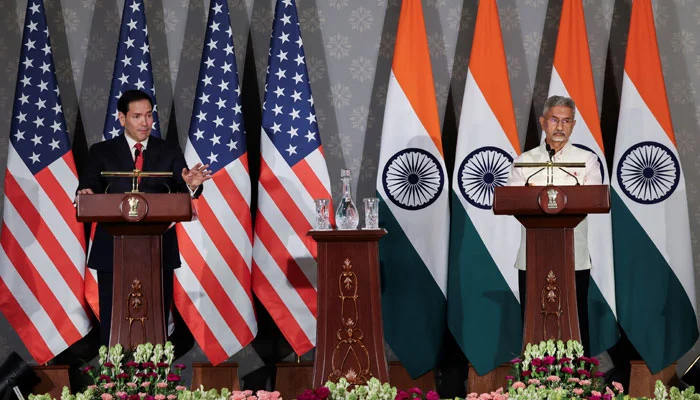
NEW DELHI: India raised concerns on Sunday regarding a recent US visa crackdown, a rare critique even while expressing general alignment with Secretary of State Marco Rubio on other contentious topics.
During his first visit to India, Rubio indicated that the two democracies shared common positions on major issues, putting aside recent tensions over trade, China, and Iran.
Indian Foreign Minister Subrahmanyam Jaishankar acknowledged that both nations have a “convergence of national interests” but publicly addressed Rubio’s concerns about visa policies implemented by President Donald Trump.
Jaishankar highlighted that he “informed Secretary Rubio about challenges faced by legitimate travelers regarding visa processing.”
“While we collaborate to prevent illegal and irregular migration, we expect that lawful mobility will not be negatively impacted,” he added, underscoring the importance of visas for U.S.-India technological cooperation.
Trump has made efforts to restrict non-Western immigration, significantly increasing hurdles and fees for H-1B visas used predominantly by Indian tech professionals, leading to a sharp decline in applications.
Following up on recent policies, the Trump administration announced that even lawfully present applicants for permanent residency must leave the U.S. for processing, potentially splitting families for long periods.
His stance stems from critics who claim Indian workers displace skilled American workers, arguing they take jobs Americans could fill and often earn higher wages.
Last month, Trump reposted a far-right commentator who called India a “hellhole” and falsely claimed Indian immigrants lack proficiency in English.
Commenting on racist comments about Indians in the U.S., Rubio remarked, “Every country has its share of foolish individuals.”
“Our nation has been enriched by people who come here,” Rubio, whose parents are Cuban immigrants, stated.
He clarified that these immigration policies are not specific to India but are responses to broader migration issues in the United States.
Shared on All Fronts
Rubio, undertaking a rare extensive four-day, four-city visit to India, called the country “one of our most important strategic partners in the world.”
“It’s based on our shared values. We are the two largest democracies,” he said.
“Our nations are strategically aligned on all the critical issues shaping the future — tackling the major challenges of the modern era,” Rubio asserted.
This level of partnership declaration would have been notable two decades ago, as Washington prioritized strengthening ties with India, a nation with over a billion people.
However, recent shifts in US foreign policy under Trump have disrupted previous assumptions. He temporarily imposed tariffs on India, visited China with a friendly tone last week, and has shown support for Pakistan, which has positioned itself as a mediator in Iran-related conflicts.
Pakistan has also praised Trump’s diplomacy during last year’s brief conflict with India, which was triggered after unprovoked Indian strikes following an attack in Indian-administered Kashmir.
Prime Minister Narendra Modi of India was critical of Trump for not crediting him with ending the conflict.
 ChatGPT
 Perplexity
 Gemini AI
 Grok AI