Select Language:
Countries Leading the Way in Non-Marital Birth Rates in 2025
-
Colombia Tops the Chart with an Astonishing 87% of Babies Born Outside Marriage
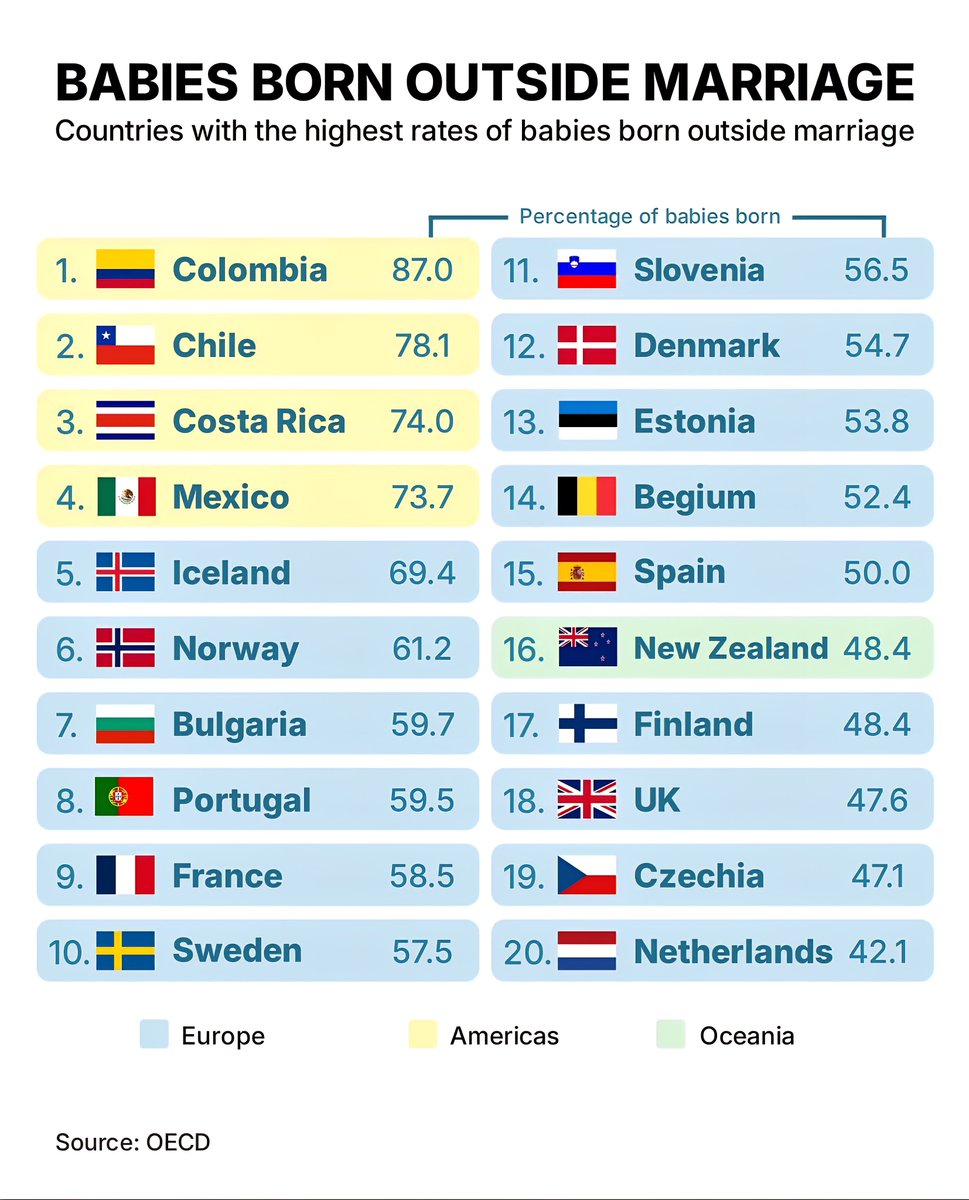
Colombia continues to hold the record as the nation with the highest percentage of births outside marriage, reaching an impressive 87%. This indicates a significant cultural shift in attitudes towards traditional marriage, reflecting increasingly liberal perspectives on family life. Social factors, urbanization, and changing gender roles contribute to this trend, making non-traditional family arrangements more commonplace across Colombian society. -
Chile and Costa Rica Follow Closely with Over 75% and 74% of Births Outside Marriage
Chile has seen a dramatic rise, with 78.1% of children born to unmarried parents. Costa Rica is not far behind, with 74%. These countries exemplify Latin America’s evolving social landscape, embracing diverse family structures and challenging conventional norms about marriage and parenthood. The trend is also linked to increased female workforce participation and shifting societal expectations. -
Mexico and Iceland Demonstrate Divergent but Significant Trends
Mexico reports that nearly 74% of babies are born outside of marriage, highlighting changing attitudes in a traditionally Catholic country. Meanwhile, Iceland features a still-high rate of 69.4%, reflecting progressive social policies and open attitudes toward various family configurations, including single parenthood. -
European Countries Show Steady Growth in Non-Marital Births
Norway at 61.2%, Bulgaria (59.7%), Portugal (59.5%), France (58.5%), and Sweden (57.5%) all exhibit high rates of children born outside of marriage. These nations have embraced policies promoting gender equality and reproductive rights, facilitating a cultural environment where non-marital childbirth is normalized. -
Slovenia and Denmark Reflect European Trends Towards More Inclusive Family Models
With 56.5% (Slovenia) and 54.7% (Denmark), these countries exemplify broader European acceptance of various family arrangements. Such data underscores the shift toward recognizing diverse forms of parental partnership beyond marriage. -
Baltic and Western European Countries Continue to Lead
Estonia (53.8%), Belgium (52.4%), and Spain (50%) show that nearly half or more of newborns in these nations are born outside of marriage. The trend signifies societal acceptance and reflects broader demographic shifts, including delayed marriage and increased cohabitation. -
New Zealand, Finland, and the UK Maintain Notable Non-Marital Birth Rates
At 48.4%, New Zealand and Finland are among the frontrunners of the Anglophone world, with the UK close behind at 47.6%. These figures highlight ongoing social liberalization and changing perceptions of traditional family structures in these societies. -
Czechia and the Netherlands Represent Central and Western Europe’s Changing Landscape
Czechia reports a 47.1% rate, while the Netherlands has 42.1%. These numbers illustrate that even in countries with historically conservative views on marriage, societal attitudes are shifting toward acceptance of non-traditional family models. -
Implications of Rising Non-Marital Births for Society and Policy
The substantial increase in children born outside marriage across these countries signifies not just changing social norms but also influences policy development concerning parental rights, child welfare, and social support systems. Governments are adapting to accommodate diverse family structures, recognizing their role in fostering healthy environments for children and parents alike. -
The Future Outlook: A Trend That Might Continue to Expand
As societal values evolve and reproductive technologies become more accessible, it is likely that these figures will continue their upward trajectory. Countries with already high rates will further embrace diverse family arrangements, reshaping the global understanding of family in the decades ahead.
Source: OECD 2025
 ChatGPT
 Perplexity
 Gemini AI
 Grok AI