
Select Language:
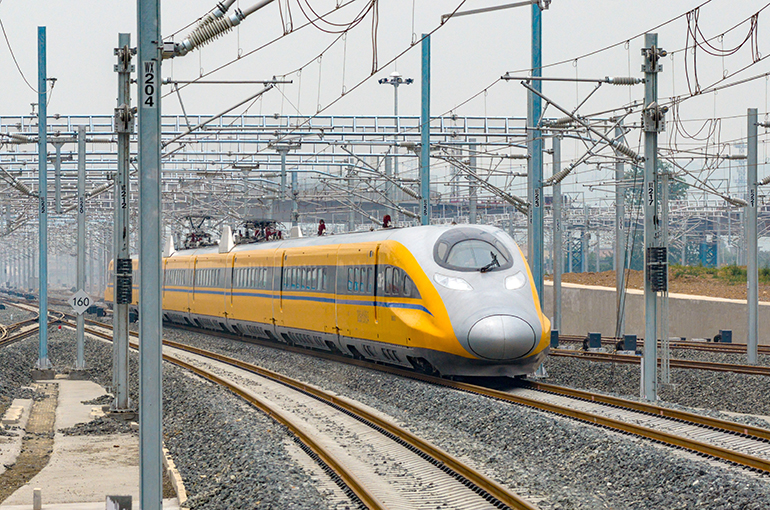
Two significant high-speed rail corridors in central and western China have entered acceptance inspections and trial runs, with plans to start operations later this year. These developments will establish direct high-speed connections, traveling at 350 kilometers per hour, between three major inland urban clusters for the first time.
The Yichang-Xingshan segment of the Shanghai-Chongqing-Chengdu high-speed railway and the Xi’an-Shiyan high-speed line will fill crucial gaps in the regional rail network. This will enable direct connectivity among the Guanzhong Plain, the middle Yangtze River region, and the Chengdu-Chongqing metropolitan area, according to several regional economic analysts.
The Shanghai-Chongqing-Chengdu line spans approximately 2,100 kilometers, linking Shanghai, Chongqing, and Chengdu in Sichuan Province. It is designed for speeds of up to 350 kilometers per hour, with certain sections planned for future upgrades allowing speeds of 400 kilometers per hour. The project’s total investment is roughly 593 billion yuan (approximately $87.2 billion).
These new rail links are anticipated to enhance regional cooperation, significantly reduce travel times, and foster industrial synergy across central and western China.
Travel Times to Be Significantly Shortened
The Xi’an-Shiyan high-speed route, covering 257 kilometers across the Qinling Mountains from Shaanxi to Hubei, will cut the travel time between these two cities from about six hours to roughly one hour upon completion.
Travel times between Xi’an and Wuhan will also be shortened from around five hours—by existing high-speed services—to under three hours, eliminating the need for detours through Zhengzhou. This new connection aims to improve mobility and integration between northwest and central regions of China.
The Yichang-Xingshan segment of the Shanghai-Chongqing-Chengdu line, covering 109 kilometers, will reduce the travel time from Yichang to Xingshan from about two hours to just 20 minutes. Additionally, the journey from Yichang to Chongqing will be shortened to less than three hours.
Yao Shujie, director of the Institute of Economic Research at Liaoning University, explained that the lack of transportation infrastructure has long been a bottleneck restricting coordinated growth among the Xi’an, Wuhan, and Chengdu-Chongqing hubs.
With the opening of these high-speed rail lines, geographical barriers and infrastructure gaps are being eliminated, creating an efficient, convenient one-to-four-hour commuting zone among the three key regions, Yao noted.
Infrastructure Expansion to Strengthen Industry Cooperation
Qin Zunwen, vice president of the China Society of Urban Economy, highlighted that the primary achievement of the Yichang-Xingshan and Xi’an-Shiyan projects is connecting previously isolated routes, reducing speed disparities, and overcoming geographical obstacles.
These projects will enable the middle reaches of the Yellow River to better connect with the Hanjiang Ecological Economic Belt and the Yangtze River Economic Belt, transforming central and western China from an “inland hinterland” into an “open frontier,” Qin said.
Lin Fei, vice president of the Anhui Association of Development Studies, added that Xi’an’s strengths in scientific research, military industries, and aerospace are poised to foster deeper industrial innovation partnerships with Wuhan’s sectors such as optoelectronics, high-end equipment manufacturing, and biomedical industries.
Meanwhile, manufacturing industries in smaller cities like Shiyan and Xiangyang are expected to become more integrated within the industrial chain centered around Wuhan, Lin explained.
 ChatGPT
 Perplexity
 Gemini AI
 Grok AI