Select Language:
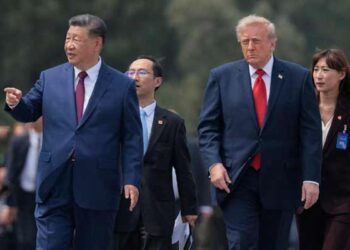
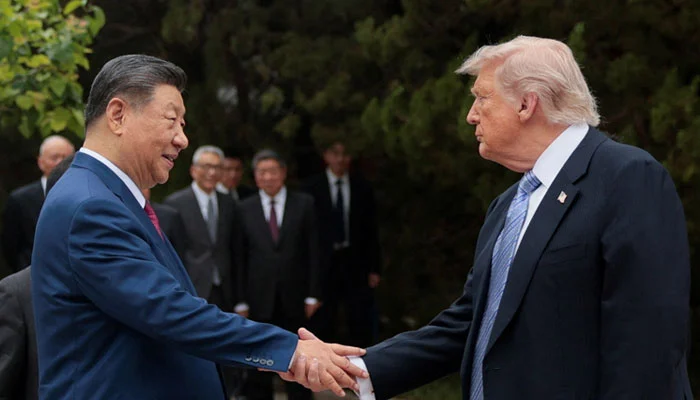
U.S. President Donald Trump departed Beijing on Friday following discussions, a visit to a temple, and tea with Chinese President Xi Jinping. Their conversations covered a range of topics, from trade to the Middle East.
Below are five key points from the two-day high-level summit:
Were any agreements made?
Trump claimed to have secured “fantastic trade deals” with Xi, who mentioned reaching a “consensus.” However, neither side has issued formal statements or released specific details. Trump aimed for significant Chinese purchases of American aircraft and agricultural products, a priority for his domestic supporters. After leaving Beijing, he told reporters aboard Air Force One that China would be “buying billions of dollars worth of soybeans.” He also said China agreed to buy “over 200 planes from Boeing, with a promise of 750 planes… if they do a good job with the 200, which I am confident they will.” Trump added in an interview with Fox News that Xi had also agreed to purchase more American oil. The Chinese foreign ministry did not confirm or deny any purchase agreements when questioned shortly after Trump’s departure. Notably, tariffs—expected to be discussed in extending a trade truce from last October—were omitted from the agenda, with Trump stating that the issue had not come up.
Addressing the Strait of Hormuz
China has labeled the ongoing U.S. confrontation with Iran as “illegal” and has repeatedly called for its cessation. Beijing has been discreetly acting as a mediator, hosting Iran’s foreign minister a week before Trump’s visit and engaging with several Gulf nations. Trump reported that during Thursday’s talks, Xi agreed to assist in reopening the critical Strait of Hormuz, which Iran has largely blocked since the U.S. and Israel began strikes against Iran on February 28. The White House stated, “The two sides agreed that the Strait of Hormuz must remain open to support the free flow of energy.” China, directly impacted by the strait’s blockade, has long supported the safe transit through it, as over half of China’s imported sea-borne crude comes from the Middle East. When pressed, China’s foreign ministry declined to comment on whether Xi had committed to help reopen the waterway.
Taiwan? No comment
In surprisingly direct comments, Xi warned Trump during their first bilateral meeting that mishandling the Taiwan issue could push their two nations into conflict, deeming it the most critical obstacle to US-China relations. Some analysts viewed this as an attempt by Beijing to seek concessions or alter Washington’s longstanding position on Taiwan. Trump responded that Xi asked whether the U.S. would defend Taiwan if conflict arose, to which he replied, “I don’t talk about that.” U.S. Secretary of State Marco Rubio reaffirmed that “U.S. policy on Taiwan remains unchanged.”
A notable milestone
Throughout the trip, Trump spoke highly of Xi, calling him a “friend” and a “great leader,” and extended an invitation for Xi to visit the United States in September. Xi, however, did not mirror Trump’s public warmth but offered a gesture of goodwill by saying he would send some Chinese rose seeds to the White House, after Trump expressed admiration for the flowers at the exclusive Zhongnanhai compound. Xi referred to the visit as a “milestone,” introducing a new framework of “constructive strategic stability” to guide U.S.-China relations for the next three years. Peking University professor Dong Wang said this represents a “major strategic repositioning,” emphasizing coexistence and shared interests, even amid disagreements over technology and geopolitics. The term is seen as progress compared to previous terminology like “strategic competition,” especially during Biden’s administration. Following Trump’s departure, China’s state news agency Xinhua reported that top diplomat Xi is expected to visit the U.S. this fall.
 ChatGPT
 Perplexity
 Gemini AI
 Grok AI