
Select Language:
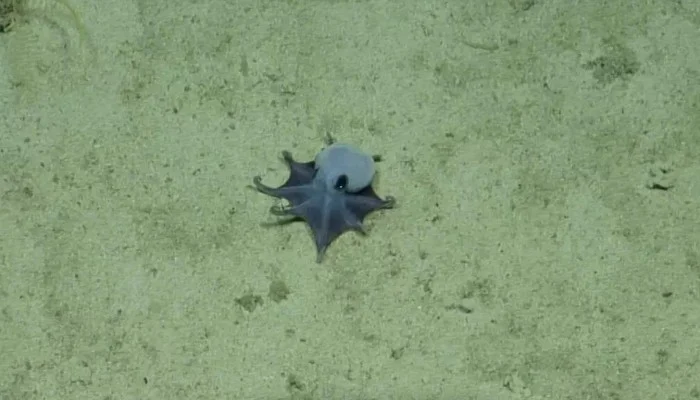
A mysterious new octopus species has been found deep beneath the waters near the Galápagos Islands. The discovery was made by scientists operating a submersible vessel, which encountered a tiny, vibrant blue octopus no larger than a golf ball at nearly 1,800 meters (about 5,900 feet) below the ocean’s surface.
Witnesses on the team from the Charles Darwin Foundation described the moment with excitement, noting how small and strikingly blue the creature was. “It’s tiny! It’s blue!” one scientist exclaimed during footage captured from the sub.
The research team announced the discovery on Monday, revealing that this species is a new addition to marine biodiversity. Octopus expert Janet Voight, called upon to identify the animal, initially saw photos of the specimen, which was later preserved and sent to her for examination.
“When I received it, I was blown away—it’s absolutely beautiful,” Voight shared. She was struck by the fact that the closest known relative of this octopus, in terms of shape, is found off the coast of Uruguay, on the other side of South America, in a different ocean.
Typically, to identify a new octopus species thoroughly, scientists dissect specimens to study their mouthparts, beak, and teeth. However, with only one specimen available, Voight decided against cutting into it. Instead, her team used CT scans to produce detailed 3D images, revealing internal structures without damaging the animal.
“Spending a day examining something no other person has ever seen—there’s nothing quite like it,” said Stephanie Smith, head of the X-ray laboratory at the Field Museum of Natural History in Chicago.
The newly identified species, named Microeledone galapagensis, is notable not only for its bright blue color, which is relatively rare in nature. It appears to be a diminutive member of the Megaleledonidae family, which generally includes larger octopuses that inhabit waters around Antarctica.
Voight explained that its short arms, arranged in a single row of suckers, set it apart from most typical octopuses. The skin on its back is smooth, and the color varies between the top and underside: a light blue on top and a dark purple underneath. She speculates that this coloration pattern is a defensive adaptation. When hunting, the octopus might use its dark coloration to cover prey emitting light, helping it avoid attracting predators while it hunts.
Interestingly, discovering new deep-sea octopus species isn’t uncommon, especially in the less-explored regions of the ocean floor. As Voight pointed out, the vast majority of the ocean remains unmapped—if you laid all the land on Earth end to end, it wouldn’t even cover the Pacific Ocean.
Her last observation of a new octopus species was off the coast of Costa Rica earlier this year. The first sighting of this particular blue octopus occurred back in 2015 near Darwin Island, named after the naturalist Charles Darwin, who famously studied the Galápagos Islands. Voight’s findings and description of this remarkable species were published in the journal Zootaxa.
 ChatGPT
 Perplexity
 Gemini AI
 Grok AI