Select Language:
After the U.S. Supreme Court blocked former President Trump’s so-called “reciprocal tariffs,” orders for home appliances started returning to China from Southeast Asia, according to Chinese manufacturers interviewed by industry sources.
Recently, U.S. clients have placed large bulk orders for millions of small electric fans destined for Chinese factories. Li Mingyang, general manager of Luckyway Home Appliances, mentioned that some of these orders had already shifted back to China in the latter half of last year, though initially in smaller quantities.
Following the Supreme Court’s decision in February, despite immediate increases in global tariffs by the previous administration, the tariff rate on Chinese electric fans exported to the U.S. decreased to 14.7% from 24.7%. This narrowing of the tariff gap between Chinese and Vietnamese-made fans at U.S. borders has made China a more attractive sourcing option again.
Since Southeast Asian manufacturing costs for electric fans are still roughly 10% to 15% higher than in China, it became inevitable that order flow would move back. A small home appliance exporter based in eastern China confirmed that some orders previously transferred to Southeast Asia are now returning, as Vietnam’s production costs are slightly above Chinese levels.
In Thailand, supply chain costs are also 10% to 15% higher than in China. A company producing ice makers said that after the U.S. lifted reciprocal tariffs, they halted capacity expansion plans at their Thai facility, instead reallocating existing production capacity to serve markets across Southeast Asia, South Asia, and other regions.
Though labor costs are higher in China’s southeastern coastal areas compared to Southeast Asia, China’s comprehensive industrial ecosystem, skilled workforce, high efficiency, and robust quality control, combined with the reduced U.S. tariffs, have contributed to the strategic return of some small home appliance orders to China, explained Wen Jianping, founder and president of a data analytics firm.
Data from the General Administration of Customs showed China’s exports of small home appliances to the U.S. reached $1.1 billion in April, marking a 3.9% increase year-over-year. However, the first four months of the year saw a 21% decline compared to the same period last year, totaling around $3.8 billion.
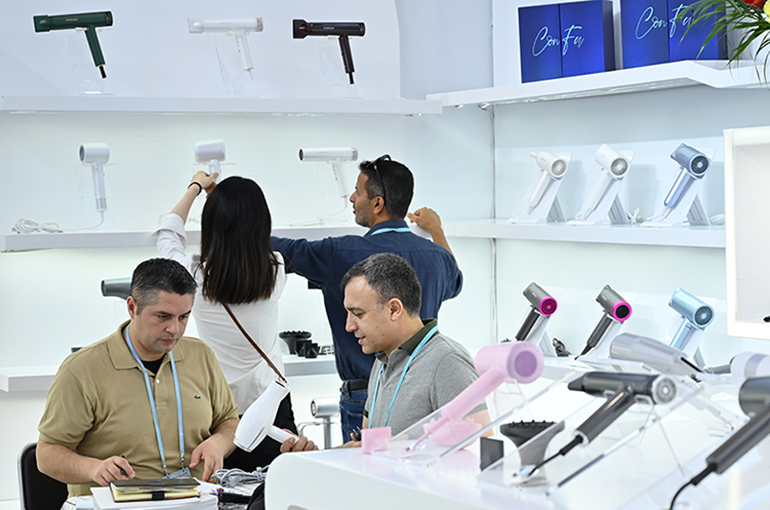
In April, the export value of ceiling and pedestal fans with a power output of no more than 125 watts surged by 100% and 18%, respectively, compared to the previous year. Exports of rice cookers, electric ovens, hair dryers, and electric irons also experienced significant rebounds.
These increases suggest U.S. buyers are regaining confidence in China’s stable supply chain and their appreciation for Chinese product quality and timely delivery, Li noted. Previously, frequent tariff changes led U.S. buyers to order only small, short-term quantities. Now, with clearer tariff expectations, major U.S. retailers and importers are making sizeable, long-term orders.
Luckyway’s fan and air fryer production facilities in Zhongshan, Guangdong Province, are operating at full capacity, driven by strong export demand in the second quarter, Li reported.
Manufacturers with factories in both China and Southeast Asia have begun adjusting their order allocations—core components, advanced processing, and urgent high-quality orders are kept in China, while simpler, low-end assembly work is being outsourced to Southeast Asia, industry sources indicated.
Order placement is also being influenced by specific product category tariff advantages. For example, Chinese-made induction cookers, electric kettles, and rice cookers are still subject to U.S. Section 301 tariffs and are mostly produced in Southeast Asia to take advantage of lower duty costs.
Experts suggest that Chinese manufacturers need to strategically adjust their production plans across both regions, factoring in all costs involved. Yang Yuechao, senior marketing director of overseas sales at KingClean Electric, emphasized that long-term planning is necessary given the ongoing uncertainties related to U.S. tariff policies, which make expanding capacity in Southeast Asia a crucial aspect of future strategy for small home appliance producers.
 ChatGPT
 Perplexity
 Gemini AI
 Grok AI