Select Language:
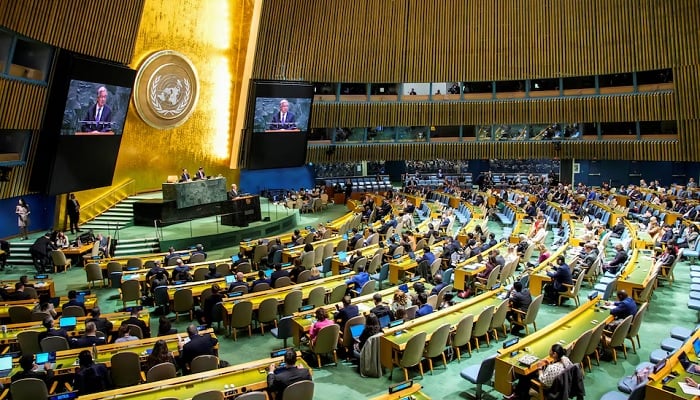
UN Secretary-General Antonio Guterres addresses delegates during a meeting on the Nuclear Non-Proliferation Treaty at the United Nations headquarters in New York City on April 27, 2026. — Reuters
– Experts warn that repeated failures diminish the treaty’s credibility.
– Activists blame nuclear-armed nations for stalling progress.
– The treaty remains in place, but disagreements among member states persist.
Talks at the UN aimed at reaffirming nuclear nonproliferation and disarmament goals concluded on Friday without success, after four weeks of negotiations held amid low expectations, according to the head of the conference, Do Hung Viet of Vietnam. He noted that, despite efforts, the conference was unable to reach an agreement on its core issues and announced that he would not recommend the draft for adoption.
The negotiations focused on the Treaty on the Non-Proliferation of Nuclear Weapons (NPT), a critical instrument in controlling nuclear arms, amid fears of a new arms race. Previous review conferences in 2015 and 2022 also failed to produce consensus. Participants debated a heavily revised and diluted text, which was ultimately not adopted.
Analysts suggest that even without a renewed review agreement for the third consecutive time, the NPT still exists, yet its legitimacy has been undermined. Richard Gowan of the International Crisis Group commented that the text has become increasingly disconnected from contemporary conflicts and proliferation risks — notably North Korea and Iran.
The latest draft seen by AFP showed a statement that Iran must “never” develop nuclear weapons. However, this clause was in brackets, indicating ongoing disagreements. Additionally, concerns about North Korea’s nuclear activities and calls for denuclearization of the Korean Peninsula were absent. The draft also omitted any direct appeal for the US and Russia to negotiate a successor to the expired New START treaty, which limits their arsenals.
Despite these omissions, the document still referenced risks like Russia, China, and the US potentially resuming nuclear testing, arsenal growth, and threats to nuclear infrastructure, according to Heloise Fayet of the French Institute of International Relations.
The reasons behind the failure remain unclear. Seth Shelden of ICAN emphasized that most nations are working in good faith toward disarmament, but a small number of nuclear-armed states and their allies are hindering progress by expanding arsenals and complicating disarmament efforts, inching the world toward catastrophe.
According to SIPRI, the nine nuclear-armed states—Russia, the US, France, the UK, China, India, Pakistan, Israel, and North Korea—had a total of 12,241 nuclear warheads as of January 2025, with 90% held by the US and Russia. Some countries are modernizing their arsenals or increasing their stockpiles.
The NPT, which came into force in 1970 and has nearly universal signatories except for Israel, India, and Pakistan, seeks to prevent proliferation, promote disarmament, and facilitate peaceful nuclear cooperation.
 ChatGPT
 Perplexity
 Gemini AI
 Grok AI