Select Language:
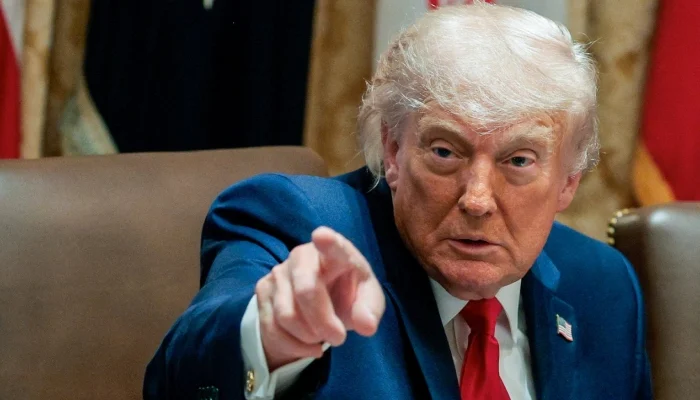
President Donald Trump points his finger during a cabinet meeting in the White House Cabinet Room in Washington, D.C., on May 27, 2026. — Reuters
Trump discussed options in a two-hour meeting held in the Situation Room. No definitive decision was made after the White House talks on Friday. Iran states it aims to reach a respectful framework to end the ongoing dispute.
An Iranian state media outlet challenged several of Trump’s assertions about the deal, with officials describing his comments as a mix of truth and falsehoods. Sources informed AFP that negotiations had paused, awaiting Trump’s approval following weeks of stalled discussions over a conflict that has destabilized the Middle East and impacted the global economy.
Trump participated in a two-hour meeting in the White House Situation Room on Friday but did not finalize a decision. A White House spokesperson told AFP, “President Trump will only agree to a deal that benefits America and meets his non-negotiable conditions,” reaffirming that “Iran must never develop nuclear weapons.”
Trump publicly announced the meeting via social media, reiterating key demands that Iran commit to never pursuing nuclear weapons and reopen the strategic Strait of Hormuz shipping lane.
Iranian Foreign Ministry spokesperson Esmaeil Baqaei responded, telling state media that Iran had “moved beyond the language of ‘must’” 47 years ago. He stated ongoing communications, but clarified that “no final agreement has been reached yet.”
In a call with Qatar’s Emir, President Masoud Pezeshkian expressed Iran’s willingness to establish a “dignified framework” to end the conflict, according to IRNA.
Trump claimed that Iran would remove mines from the Strait of Hormuz and end its blockade of the waterway without tolls, while the U.S. would lift its sanctions on Iranian ports. He added that both nations would work together to remove and destroy Iran’s enriched uranium, with no monetary exchanges happening “until further notice.”
However, Iran’s Fars news agency cited sources asserting that Tehran was insisting on the “immediate release of $12 billion in frozen Iranian assets” before progressing in negotiations. Regarding the Strait of Hormuz reopening, sources claimed that “such a clause does not exist in the current draft” and that Trump’s statement about destroying Iran’s nuclear materials is “entirely unfounded.”
Baqaei also told Iranian state TV there are currently “no negotiations” ongoing concerning Iran’s nuclear program, with Iran’s top diplomat accusing the U.S. of delaying a deal with its stance on talks.
A resident of Tonekabon, north of Tehran, named Ali, remarked that regardless of the agreement, more conflicts are likely. “Both sides are saying what they need to to satisfy their supporters. It’s hard to tell who is telling the truth,” he said, age 49.
Optimism about diplomatic progress briefly surged on Thursday after U.S. officials expressed hope for an agreement. Markets for energy commodities experienced volatility as investors gauged the prospects of a deal that could restore shipping through the strategic Strait of Hormuz.
Both Washington and Tehran have accused each other of breaching the truce in the Strait this week, with the U.S. conducting strikes on Bandar Abbas and Iran retaliating with fire.
Iranian state media reported that 24 ships had passaged the strait in the past 24 hours, coordinating with the Revolutionary Guards and the foreign ministry. Still, Iran warned that “ships from hostile nations will face a serious response” from its military.
On the Lebanon front of the conflict, Israeli Prime Minister Benjamin Netanyahu announced that Israeli forces had advanced deeper into Lebanon. Hezbollah claimed responsibility for drone attacks on military targets in northern Israel, including troop gatherings and bases, and alleged attacks on Israeli forces near the historic Beaufort fortress close to Nabatieh.
These incidents occurred as Israeli and Lebanese military representatives held “productive” security talks in Washington, according to Pentagon Deputy Elbridge Colby. Israel continued heavy bombardments in southern Lebanon, resulting in the Lebanese health ministry reporting 11 deaths, including a rescue worker.
A ceasefire between Israel and Hezbollah, supposed to be in place since April 17, has yet to be observed, with both sides accusing each other of violations and justifying continued hostilities. Lebanon entered the conflict in early March when Hezbollah launched rocket attacks on Israel in retaliation for the killing of Iran’s Supreme Leader in recent US-Israeli strikes, which prompted Israeli military responses and a ground invasion.
 ChatGPT
 Perplexity
 Gemini AI
 Grok AI