
Select Language:
Russia announced on Thursday that it has delivered nuclear ammunition to storage sites in Belarus and displayed parts of its strategic nuclear capabilities. This move comes amidst rising tensions with European NATO allies over the Ukraine conflict and increased drone activity in the Baltic region.
Moscow is currently conducting some of its largest nuclear drills in years, involving approximately 64,000 personnel. The drills focus on preparing and potentially using nuclear forces in response to aggression. The three-day exercise, kicking off Tuesday across both Russia and Belarus, involves the Strategic Missile Forces, the Northern and Pacific Fleets, long-range aircraft, and units from the Leningrad and Central military districts.
As part of the maneuvers, Russia showcased a Borei-class nuclear submarine, Il-38 anti-submarine aircraft, a MiG-31 fighter armed with a Kinzhal hypersonic missile, and RS-24 Yars intercontinental ballistic missiles. President Vladimir Putin emphasized that nuclear weapon use would be a “last resort,” but highlighted the importance of maintaining a nuclear triad as vital for safeguarding sovereignty and strategic stability.
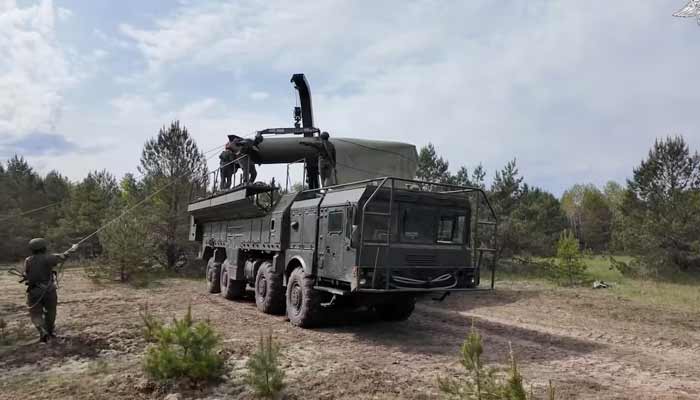
In Belarus, a missile unit is training to handle special munitions for the mobile Iskander-M tactical missile system, including loading weapons onto launch vehicles, Russia stated. Most of these exercises use dummy warheads, with the defense ministry releasing footage of a military truck traveling openly with minimal security, as well as images of submarines, aircraft, and ships involved in the drills.
These activities come at a time when Moscow insists it is engaged in an existential struggle with the West over Ukraine. Throughout the conflict, Putin has repeatedly reminded the world of Russia’s nuclear strength as a warning to Western countries not to escalate their support for Kyiv. Critics from Ukraine and parts of the West dismiss these displays of force as reckless saber-rattling.
Meanwhile, tensions in the Baltic region are escalating. Moscow has accused Baltic nations of allowing Ukrainian drones to fly over their airspace toward northern Russia, an assertion NATO has denied. These Baltic states, strong supporters of Ukraine, counter that Russia is directing Ukrainian drones into their airspace from their own territories, targeting Russia.
The Kremlin criticized Lithuanian Foreign Minister Kestutis Briedis’ recent remarks, calling them “near madness” after he suggested NATO should demonstrate to Moscow that it can penetrate Kaliningrad, a heavily militarized Russian exclave nestled between Lithuania and Poland on the Baltic coast. With a population of about one million, Kaliningrad hosts Russia’s Baltic Fleet and remains a strategic point of tension in the region.
 ChatGPT
 Perplexity
 Gemini AI
 Grok AI