Select Language:
- Rubio had a private meeting with Prime Minister Narendra Modi during his visit to India.
- The US Secretary of State described India as a “great ally and partner.”
- Rubio mentioned that the US is exploring ways to increase oil sales to India.
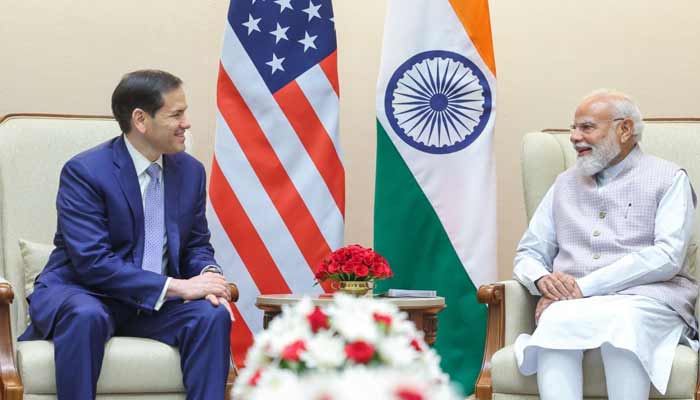
On Saturday, US Secretary of State Marco Rubio visited India and met with Prime Minister Narendra Modi in a private session, aiming to strengthen their relationship shortly after a productive summit between Washington and China. During his first trip to both Asian powers, Rubio spent over an hour in closed-door talks with Modi in New Delhi, according to a US official.
Rubio, known for his devout Catholic faith, began his four-day, four-city journey by visiting Mother Teresa’s charity headquarters in Kolkata, where he paid respects at her tomb. Wearing a yellow garland over his suit and accompanied by his wife Jeanette, Rubio was seen smiling before a group of nuns dressed in the classic white and blue saris associated with the late humanitarian.
He discussed issues such as helping the homeless, the terminally ill, and those suffering from leprosy, Sister Marie Juan of Missionaries of Charity told reporters after their one-and-a-half-hour meeting. She added that Rubio was happy to pray, and they were pleased to receive him.
US Ambassador to India Sergio Gor, also a Catholic, later commented that the partnership between the two countries is rooted in shared values, not just policies.
Before departing on Tuesday, Rubio plans to participate in a meeting of foreign ministers from the Quad alliance—comprising Australia, India, Japan, and the US—a coalition seen as a counterbalance to China’s influence in the Indian Ocean. China has long viewed the Quad with suspicion, accusing it of trying to encircle China, and has previously criticized India for participating.
Rubio’s visit occurs amidst shifts in US foreign policy priorities under former President Trump, who recently visited China and praised the reception from President Xi Jinping, despite limited concrete agreements. Trump also revived the concept of a “G2” partnership between the US and China, a notion that had fallen out of favor amid concerns from US allies about marginalization in dealings with China.
While Trump seldom emphasizes human rights, some of his political base are concerned about the treatment of Christians under Prime Minister Modi’s Hindu nationalist government. Since Modi’s rise in 2014, there have been reports of increased violence and vandalism targeting religious minorities, particularly Christians, though the government dismisses these claims as exaggerated or politically motivated.
Rubio highlighted India as a “great ally” and explained that the US is considering ways to boost oil exports to the country. India’s rapidly growing economy depends heavily on energy imports and has been affected by the US-Israeli sanctions on Iran, which led Iran to block the Strait of Hormuz, causing global oil prices to spike. Despite having deep ties with Iran, India has also expanded its relationship with Israel, with Modi visiting Israel just days before Iran’s reactionary response.
The recent conflicts have also seen India’s traditional adversary Pakistan reemerging as a key US partner, with Pakistan positioning itself as a mediator—its military chief flying to Tehran this week. Historically, the US allied with Pakistan during the Cold War but has shifted focus toward India as the larger democratic partner amid China’s rise. Trump has recently improved relations with Pakistan, which has praised his diplomacy during last year’s brief conflict with India, and even entered into a cryptocurrency partnership connected to the President’s family. Trump’s stance became more complex when Modi didn’t credit him for ending that conflict, leading to tariff increases on India, though some tariffs were later reduced through trade negotiations.
 ChatGPT
 Perplexity
 Gemini AI
 Grok AI