
Select Language:
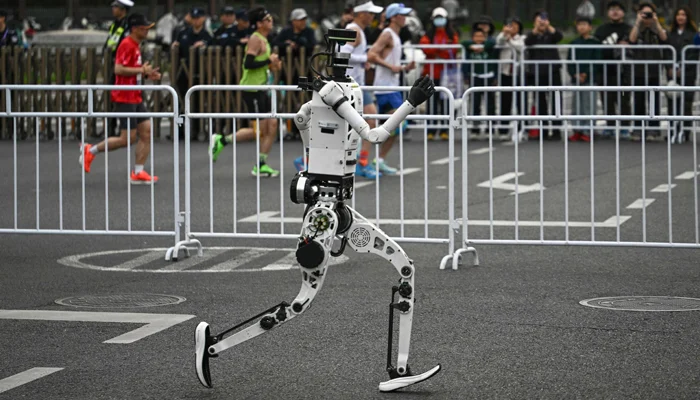
A humanoid robot, racing against human runners, broke the world record at a Beijing half marathon on Sunday, highlighting China’s rapid technological progress.
Spectators watched from the sidelines in Yizhuang, south Beijing, as the robots and human competitors raced in separate lanes to prevent accidents.
Some robots displayed incredible agility, moving like renowned sprinters such as Usain Bolt, while others demonstrated more basic movements.
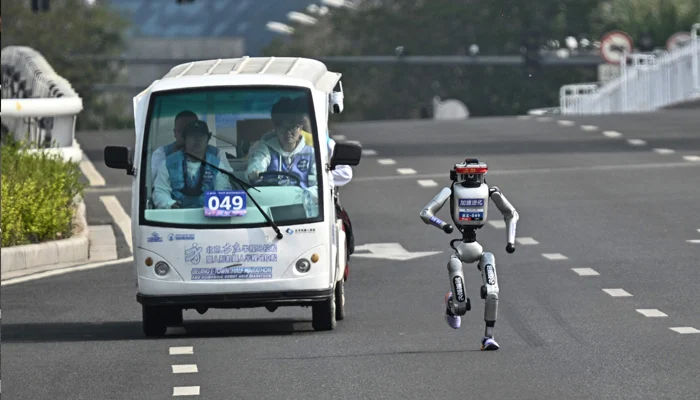
The top-performing humanoid, powered by an autonomous navigation system and sponsored by Chinese smartphone brand Honor, finished the approximately 13-mile (21-kilometer) course in 50 minutes and 26 seconds, averaging about 25 km/h, according to CCTV.
This time far exceeds the fastest human finishers and even beats the men’s world record of 57:20 set by Ugandan runner Jacob Kiplimo.
Compared to last year, when robot runners struggled and took over two hours to complete the course, progress has been extraordinary. Entries have grown from around 20 last year to over 100 this year, reflecting increasing popularity in the sector.
“Really impressive”
Han Chenyu, a 25-year-old student observing from behind a safety barrier, quickly took out her phone and snapped a photo as the leading robot passed by.
She shared with AFP that she’s excited about technological advancements and finds the race “really cool.”
She added, however, that as someone who works for a living, she occasionally worries about what rapid technological growth might mean for employment, especially with artificial intelligence becoming more sophisticated.
In recent years, humanoid robots have become a common sight in China’s media and public spaces.
Xie Lei, 41, who watched the race with his family, believes robots could become integrated into daily life within a few years, assisting with tasks such as household chores, elderly companionship, basic caregiving, or even dangerous roles like firefighting.
The goal of the humanoid half marathon is to promote innovation and demonstrate the latest technologies involved in creating and operating such machines.
China’s robotics and embodied AI investments hit 73.5 billion yuan (roughly $10.8 billion) in 2025, according to a government study, signaling industry strength.
“For thousands of years, humans have been top of the food chain. But now, just in terms of autonomous navigation, robots are already starting to surpass us in certain sports,” Xie remarked.
“It’s a bit sad for humanity, but at the same time, recent advances in technology inspire our imagination.”
 ChatGPT
 Perplexity
 Gemini AI
 Grok AI