Select Language:
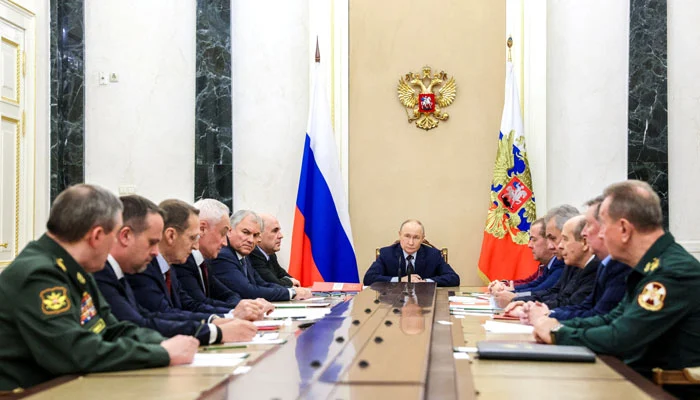
Russian President Vladimir Putin convenes a Security Council meeting in Moscow on November 5, 2025, as shown in the accompanying image. During the session, Putin directed officials to prepare a plan for potential nuclear testing—a significant move since Russia hasn’t conducted such tests since the Soviet Union dissolved in 1991. This decision comes in response to President Donald Trump’s recent announcement that the U.S. would resume testing nuclear weapons, indicating a worrying escalation in global nuclear tensions between the two superpowers.
Putin instructed the Foreign Ministry, Defense Ministry, intelligence agencies, and civilian authorities to gather additional information, analyze the situation at the Security Council, and develop a coordinated proposal for possibly beginning nuclear tests. Relations between Moscow and Washington have sharply declined in recent weeks, partly due to frustrations over the Ukraine conflict. Trump canceled a scheduled summit with Putin and imposed new sanctions on Russia, marking a departure from previous diplomatic efforts.
At the Security Council meeting, parliamentary speaker Vyacheslav Volodin asked how Moscow should respond to the U.S. testing plans—an off-script question that elicited prepared and urgent responses from top officials. Defense Minister Andrei Belousov suggested that the recent U.S. rhetoric indicated the need to prepare for full-scale nuclear tests immediately, citing Russia’s Novaya Zemlya testing site as a potential location. General Valery Gerasimov, head of Russia’s military, emphasized that delay could narrow Moscow’s window to respond effectively, noting that nuclear test preparations could take from several months to years depending on the type of test.
In the context of global nuclear capabilities, only North Korea has conducted nuclear tests this century—in 2017—highlighting the destabilizing potential of a resumption of testing by established nuclear powers. Experts warn that such actions could trigger a chain reaction among the world’s nuclear states, increasing the risk of conflict.
Kremlin spokesman Dmitry Peskov noted that Putin has not set a deadline for completing the proposals but emphasized that Russia will take the necessary time to assess U.S. intentions fully. Meanwhile, Trump has not clarified whether his order relates to nuclear explosive testing or missile flight tests involving nuclear-capable warheads. Russia recently tested its nuclear-powered Burevestnik cruise missile, as well as nuclear drills involving the Poseidon super-torpedo, underscoring its ongoing development of nuclear delivery systems that do not require explosive tests—though the environmental risks remain a concern.
 ChatGPT
 Perplexity
 Gemini AI
 Grok AI