Select Language:
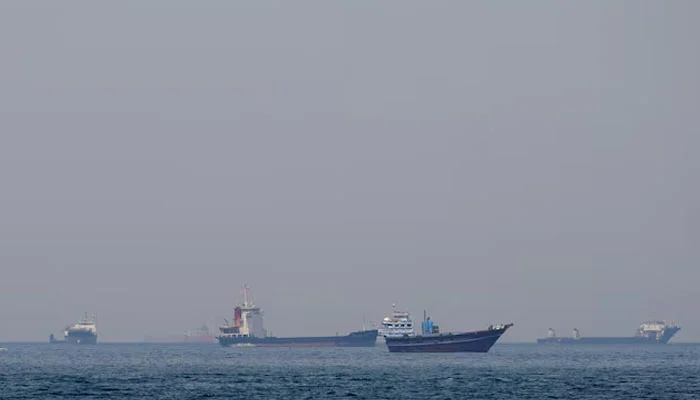
A fleet of ships and boats is visible in the Strait of Hormuz off Musandam, Oman, captured on April 20, 2026 — Reuters.
– The Pentagon reports that U.S. forces boarded a tanker carrying Iranian oil.
– State that maritime enforcement efforts against illegal networks will persist.
– Iranian officials, including Ghalibaf, emphasize that a ceasefire remains meaningful only if no violations, such as blockades, occur.
TEHRAN: President Donald Trump authorized the U.S. Navy on Thursday to target and destroy any Iranian vessels laying mines in the Strait of Hormuz, escalating tensions amid a fragile ceasefire as disruption from the Gulf stand-off begins to impact the global economy.
This announcement followed an incident where the U.S. naval fleet boarded a vessel in the Indian Ocean transporting Iranian oil, and Iranian authorities claiming Tehran has received its first earnings from tolls imposed on ships passing through the strait.
With peace talks in Pakistan hanging in the balance, airlines, driven by soaring fuel costs, canceled flights, and oil prices surged again. Additionally, the closely-watched S&P Global PMI index indicated that business activity across the eurozone contracted for the first time in over a year.
President Trump tweeted, “I have ordered the United States Navy to shoot and kill any boat, small boats included, that lays mines in the waters of the Strait of Hormuz.”
Iran responded by vowing to keep the strait nearly closed unless the U.S. Navy lifts its blockade on Iranian ports, dismissing Trump’s demands to reopen Hormuz and relinquish its enriched uranium.
In retaliation, the U.S. imposed a blockade on Iranian ports. On Thursday, the Pentagon announced via social media that U.S. forces conducted a maritime interdiction, boarding the sanctioned, stateless vessel M/T Majestic X, which was transporting Iranian oil in the Indian Ocean. Footage showed U.S. military personnel rappelling onto the deck of a large tanker.
The Pentagon affirmed its commitment to continue enforcing maritime laws globally to disrupt illegal networks and interdict vessels providing material support to Iran wherever they operate.
While active hostilities have decreased since the ceasefire’s start, tensions over Hormuz persist as both sides seek economic advantages. President Trump announced an indefinite ceasefire to allow for further negotiations.
Iranian Parliamentary Speaker Mohammad Bagher Ghalibaf stated, “A full ceasefire only holds meaning if it isn’t broken through a naval blockade,” adding that reopening the strait is impossible while Iran’s ceasefire violations continue.
Deputy Hamidreza Hajibabaei revealed that Iran had received its first revenue from tolls on ships passing through Hormuz, a crucial route that accounts for about 20% of the world’s oil and gas flow, along with other vital commodities.
Analysts suggest that Iran’s hardliners, particularly those linked to the Islamic Revolutionary Guards Corps, believe that their blockade offers enough economic leverage to pressure Washington to retreat from its main demands during peace talks.
Some experts, such as Danny Citrinowicz of the Tel-Aviv Institute for National Security Studies, criticized both Israel and the U.S., asserting that they misread Iran’s resolve.
“Tehran has shown it is willing to endure economic hardship to stand firm on its core national interests. There’s little reason to expect this stance will change now,” he said on social media. “Instead of capitulating, Iran is set to escalate.”
A briefing from the Soufan Center indicates Iran’s hardliners argue that sustained high energy prices and shortages worldwide will increase pressure on Trump to accept Iran’s terms, end the conflict, and withdraw U.S. forces from the region.
Conversely, U.S. policymakers believe that the blockade of Iran’s seaborne trade—its primary means of exporting oil—will swiftly cripple Iran’s economy, compelling Tehran to accept their conditions.
Regarding peace negotiations, President Trump mentioned on Wednesday to the New York Post that talks could potentially restart in Pakistan within two or three days, although Iran has yet to confirm participation, and Vice President JD Vance has postponed travel to Islamabad.
Iran’s Revolutionary Guards announced on Wednesday that they forced two ships to shore from the Strait of Hormuz.
The U.S. Central Command previously indicated that, before Thursday’s developments, forces enforcing the blockade had directed 31 vessels to turn back or return to port.
Following the Iran-related ceasefire, the U.S. helped broker a separate truce between Israel and Lebanon, including Hezbollah. Despite this, Israeli strikes on Wednesday resulted in the deaths of five more people, according to Lebanese media.
Lebanese officials expect a second round of talks in Washington on Thursday, during which Beirut will seek a one-month extension of the ceasefire. Since the conflict’s start, Israeli strikes have killed over 2,450 Lebanese civilians, according to local authorities.
 ChatGPT
 Perplexity
 Gemini AI
 Grok AI