
Select Language:
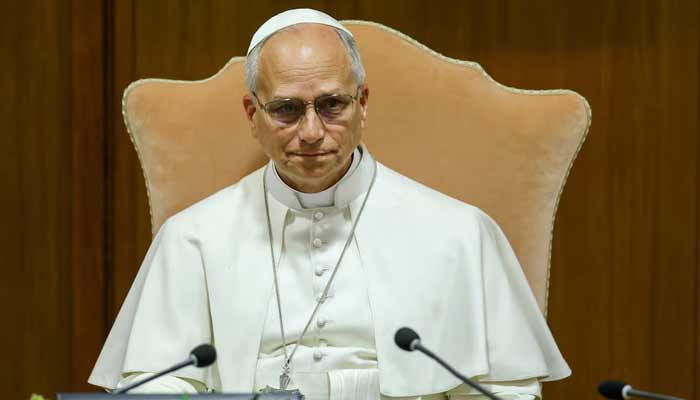
Pope Leo XIV called on governments to slow their roll and implement strict regulations on AI development in his first major statement, warning that artificial intelligence could spread false information, escalate conflicts, and push the world toward endless warfare.
During a Vatican event unveiling his first encyclical, Leo expressed worry that some autonomous weapons systems have advanced so far that they are almost impossible for humans to control or manage. Chris Olah, a co-founder of Anthropic—one of the top AI companies globally—attended the event alongside the pope.
Leo, who has taken a more assertive stance recently—particularly after criticizing the Iran war and drawing criticism from U.S. President Donald Trump—delivered passionate appeals to global leaders in his lengthy encyclical.
He emphasized that AI data ownership shouldn’t be exclusively private, urged policymakers to safeguard workers’ rights, protect children from technology, and called for a reduction in competition among AI firms.
“What is needed is active political engagement capable of decelerating the rapid progress,” Leo stated in the document titled “Magnifica Humanitas” (Magnificent Humanity).
He advocated for the creation of strong legal standards, independent oversight, well-informed users, and a political process that doesn’t shirk responsibility.
Encyclicals, the Church’s highest teachings from the pope to its 1.4 billion members, have taken nearly a year to prepare, and this one, nearly 43,000 words long, was eagerly awaited since Leo’s election just over a year ago.
The document also strongly criticizes the notion of “just war,” declaring it outdated, and condemns the violence of recent conflicts. Leo lamented the decline of multilateral organizations and pointed out that the profit motives of the arms industry fuel wars.
“Over the past 60 years, we’ve witnessed conflicts marked by brutal atrocities affecting civilians on a massive scale,” he wrote, emphasizing that humanity is falling into a destructive culture of power, where peace has become a fragile pause between conflicts.
At the Vatican, Olah acknowledged the challenges faced by AI companies like his, noting the pressure to prioritize profits over ethics and the need for external scrutiny.
Leo also condemned the “just war” doctrine, historically used by the Church to justify military actions, and called for its abandonment. “This doctrine, which has often been used to justify any war, is now obsolete,” he stated, adding that resorting to violence reflects a moral impoverishment and often has disastrous civilian consequences.
He expressed concern that leaders might initiate wars to divert attention from domestic issues, warning that armed conflict might sometimes be used cynically as a distraction or control tool.
Leo stressed that AI used in warfare must adhere to strict ethical boundaries, explicitly stating it should not be entrusted with lethal decision-making.
Drawing from centuries of social justice teachings, he cited Leo XIII’s 1891 encyclical advocating better treatment for workers during the Industrial Revolution, and drew parallels to current issues, condemning modern “new forms of slavery”—such as children and adolescents forced into dangerous labor to mine rare earth elements for tech devices used in AI production.
“This moral crisis calls into question the consciousness of our times,” the pope said.
He also issued a formal apology for the Church’s historical role in transatlantic slavery, acknowledging it as a “wound in Christian memory,” and asked for forgiveness—highlighting the ongoing moral responsibilities of the Catholic Church.
 ChatGPT
 Perplexity
 Gemini AI
 Grok AI