Select Language:
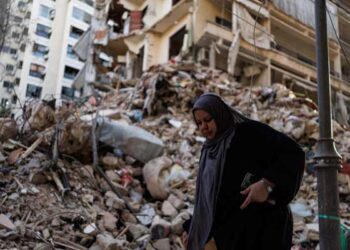
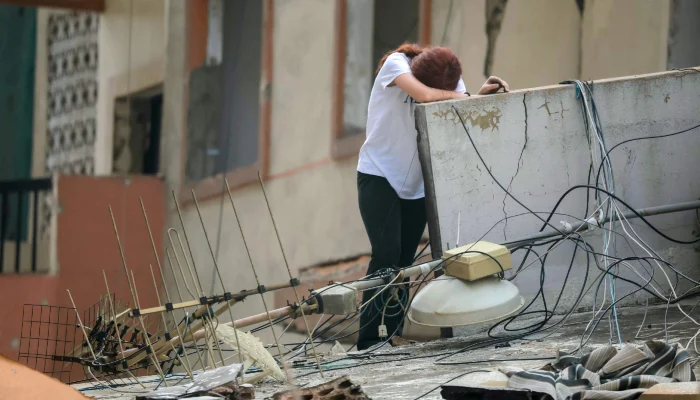
A woman displaced by conflict reacts after returning to her damaged home in Beirut, Lebanon, on April 18, 2026. — AFP
Khodr Sahmarani stood bewildered beside the rubble of his home in southern Lebanon, a white bandage wrapped around his forehead, staring at the wreckage where his brother, nephew, and two neighbors lost their lives.
“I was upstairs, then I was underground. I yelled, ‘Where are you? Where are you?’, but there was no response,” he recounted after surviving an Israeli airstrike on Nabatiyeh just hours before the ceasefire began at midnight Thursday.
The afternoon attack destroyed what residents identified as a five-story building, leaving a chaotic jumble of broken concrete in the battered city.
Nabatiyeh rescue worker Mohammad Sleiman told AFP that they recovered one body from the strike site Thursday night and three more on Friday morning.
Sahmarani, 57, said rescuers “pulled me out of the rubble.”
On Thursday, Israel and Lebanon agreed to a ten-day ceasefire to negotiate an end to six weeks of conflict between Israel and Hezbollah, the Iran-backed group.
The fighting saw extensive Israeli airstrikes across Lebanon, along with ground operations in the south.
Lebanese officials estimate that nearly 2,300 people have been killed since the conflict started on March 2, with widespread destruction in towns like Nabatiyeh.
President Joseph Aoun stated Friday that “direct negotiations” with Israel are vital, with the government aiming to “solidify a ceasefire, secure the withdrawal of Israeli forces from occupied southern territories, recover prisoners, and resolve remaining border disputes.”
Hezbollah stopped its military actions after the ceasefire took effect but warned it remains ready to act in case Israel breaches the truce.
Nabatiyeh’s streets were almost deserted on Friday, many buildings in the city center either damaged or destroyed. A few kilometers outside the city, a small group of Hezbollah supporters cheered as cars from Beirut passed by, flashing victory signs and waving yellow flags of the party.
Intensive Israeli strikes continued up to moments before the midnight deadline, with reports of casualties still emerging.
Sahmarani, tearful and bloodshot-eyed, expressed despair: “It was the last hours. If this was the start of a war or the middle of it, I could accept it. But this? This was the final hours.”
Neighbor Fadel Hassan Zahri said those killed were longtime friends. “I wouldn’t eat or drink without them,” he shared, upset with the Lebanese government’s willingness to negotiate peace or normalize relations with Israel.
“I’ve lived honorably all my life… We don’t normalize with Israel,” Zahri declared.
Sahmarani admitted he has nowhere else to go. He fears returning to the rubble of his home tonight, perhaps finding a ledge or some cramped corner to sleep in.
“Where should I go now? Who will even care about me?” he questioned, expressing deep mistrust of Lebanese authorities.
“Let our leaders pursue normalization; no one listens to them or recognizes them.”
He asked bitterly, “For whose sake? Why should I lose everything I have built?”
 ChatGPT
 Perplexity
 Gemini AI
 Grok AI