Select Language:
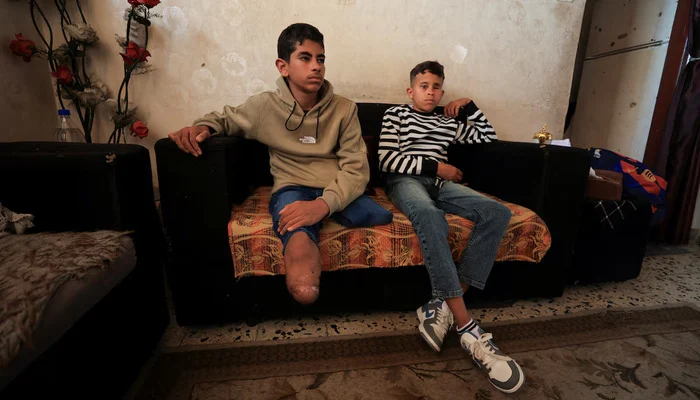
Fourteen-year-old Fadel Al-Naji, once an avid soccer player, now mostly stays at home in Gaza City after both his legs were amputated in an Israeli drone strike last September. He sits quietly on a sofa, one empty pant leg hanging loose, the other tucked into his waist, next to his 11-year-old brother Amir, who lost an eye in the same attack.
His mother, Najwa Al-Naji, shares old videos on her phone of Fadel juggling a ball, describing him as increasingly withdrawn and isolated. She hopes prosthetic limbs can be fitted for him, but supplies are scarce in Gaza, where nearly 5,000 amputees, including many children like Fadel, struggle due to Israeli restrictions on essential materials like plaster of Paris.
Israeli rules, citing security reasons, limit imports of many construction and medical items, affecting access to prosthetic components. Although plaster of Paris isn’t explicitly listed as a dual-use item, other plastic parts needed for prosthetics are restricted, leaving aid organizations and medical centers with limited supplies and outdated equipment.
Gaza’s amputee population, already substantial before the conflict, now has a higher per capita rate than Cambodia—long notorious for landmine-related amputations—according to aid group Humanity & Inclusion. In response, medical centers have resorted to reusing old prosthetics from war casualties or crafting makeshift limbs from plastic piping and wood, which carry risks of infection or further injury.
The promised aid under the October ceasefire and the U.S. Trump administration’s plan to provide full assistance with minimal interference remain unfulfilled. The reopening of the Rafah border crossing to Egypt, crucial for evacuations and supplies, has been inconsistent. Israel continues to restrict items it deems dual-use, including construction materials, while claiming to allow medical supplies to enter Gaza.
The Israeli military agency COGAT states it facilitates medical equipment imports but blocks materials that could aid Hamas’s military build-up. Meanwhile, organizations like the International Red Cross report that plaster supplies are nearly exhausted, with only minimal stock left for the coming months, leaving prosthetic manufacturing severely limited. Local hospitals have run out of supplies altogether, capable only of maintaining existing prosthetics.
Since early 2025, Humanity & Inclusion has managed to fit just 118 temporary prostheses in Gaza, with dwindling supplies from their last shipment in December 2024. The lack of proper limbs hampers recovery, prolongs trauma, and increases the risk of additional injuries from ongoing Israeli strikes, which have resulted in over 750 Palestinian deaths since the ceasefire.
Some amputees are on waiting lists, awaiting surgeries like stump revisions or the fitting of prosthetic limbs. Hazem Foura, a 40-year-old ex-office worker, lost his left leg above the knee in a December 2024 bombing that he says was an Israeli attack on his home. Now unable to work, he pleads, “I’m not asking for luxury items—just a limb so I can regain my humanity.”
Without access to proper prostheses, amputees face not only physical and emotional setbacks but also heightened vulnerability amidst continuing hostilities. Only a handful of prosthetists remain in Gaza, and for children who need frequent adjustments as they grow, the lack of specialized care compounds their suffering.
Heba Bashir, a technician with Humanity & Inclusion, explains, “Losing a limb isn’t just about the physical loss; it’s about losing hope and independence. For children, it means losing the future they deserve.”
 ChatGPT
 Perplexity
 Gemini AI
 Grok AI