Select Language:
The SCO summit has sparked concern across Europe and caught the attention of the United States. There were compelling reasons behind this reaction.
Primarily, President Xi Jinping indirectly criticized the US without naming any adversary, emphasizing security concerns and signaling that the SCO might eventually establish its own IMF and military alliance, distancing itself from Western influence.
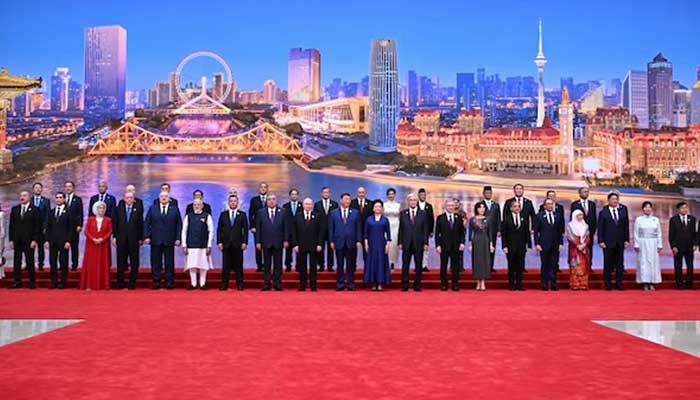
To understand the summit’s broader implications and its historical victory over Japanese aggression, I asked His Excellency Yang Yundong, the Chinese Consul General in Karachi, a few questions.
Q: Last week, China hosted the SCO summit, gathering leaders and representatives from over 20 countries and 10 international organizations to celebrate the national victory over fascism and Japanese aggression. What message did this send to the West, especially the US?
A: The Tianjin SCO summit was a crucial event for China during its presidency. Leaders from numerous nations attended and adopted the Tianjin Declaration. President Xi Jinping shared key proposals, like maintaining unity amid diversity, mutual benefits, openness, justice, and practical cooperation, while also advancing the Global Governance Initiative (GGI).
He emphasized that SCO should lead as a stabilizing force in a volatile global environment, promoting openness, economic inclusiveness, and civilizational exchanges. Xi made it clear that SCO must oppose hegemony and power politics, champion genuine multilateralism, and support a move toward multipolarity and democratic international relations. These ideas received widespread support and recognition worldwide.
Q: During the victory parade, the world saw advanced weaponry, with President Xi Jinping stating, “China will not be intimidated by bullies; it will always move forward.” Were these gestures directed at Washington?
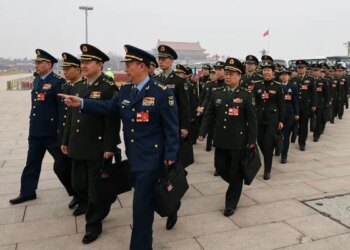
A: China organized a grand military parade marking the 80th anniversary of the victory in the Chinese War of Resistance Against Japanese Aggression and the broader Anti-Fascist War. The goal was to remember history, honor heroes, cherish peace, and foster a better future. History teaches us that humanity rises and falls together. Only by nations treating each other equally—living in peace and supporting one another—can we ensure security, eradicate war’s root causes, and prevent past tragedies.
Today, humanity faces a choice between peace and conflict, dialogue and confrontation, win-win cooperation and zero-sum games. China is committed to peaceful development and will strengthen its military to safeguard sovereignty, unity, and territorial integrity, supporting national rejuvenation and global peace.
Q: President Xi discussed a “Global Governance Initiative,” indicating that global governance faces a new crossroads. He called for opposition to hegemonism and power politics and the practice of true multilateralism. Does this signal a move toward an SCO military alliance?
A: The world is experiencing regional unrest, slow economic growth, backlash against globalization, and governance gaps. In this context, discussions on reforming and improving global governance are increasingly important.
Xi Jinping outlined core principles for the GGI: respecting sovereignty, abiding by international law, practicing multilateralism, focusing on people-centered approaches, and taking concrete actions. The GGI adds to China’s global contributions, alongside three major initiatives focused on development, security, civilization, and governance—each reinforcing the others to bring stability in a turbulent world.
China promotes an independent, peace-oriented foreign policy based on “partnership over alliance,” fostering international cooperation to support peace and shared development.
Q: Russian President Vladimir Putin believes SCO has revived true multilateralism, creating a new Eurasian political and economic system that considers the interests of many nations without prioritizing one at others’ expense. Is that accurate?
A: Since its founding 24 years ago, SCO has remained committed to openness, transparency, and partnership, avoiding military blocs and rejecting Cold War mentalities. It advocates for comprehensive, sustainable security that’s universal—security for some shouldn’t come at others’ expense, nor should nations seek absolute security by compromising others’ safety.
Respecting sovereignty, independence, and territorial integrity, along with non-interference in internal affairs, is central. The SCO aims to ensure global stability and promote security that benefits all, not just a select few.
Q: At the SCO summit, China proposed establishing a new SCO Development Bank. It also announced plans to provide $280 million in aid and $1.4 billion in loans to member countries. Is this an attempt to create an SCO version of the IMF or World Bank, reducing dependence on the US dollar and US sanctions?
A: The SCO’s goal is regional stability and development, and strengthening economic cooperation among members. The proposed development bank aims to support infrastructure, connectivity, and livelihood projects—an entirely normal, mutually beneficial initiative. It’s an independent effort to serve regional needs, not a geopolitical move aimed at undermining the dollar or US sanctions.
China advocates for a fairer international financial system that reflects the voices of emerging markets and developing nations. Our financial cooperation within SCO seeks regional well-being, free from geopolitical agendas.
Q: Following this summit, the US leader claimed that ‘India and Russia seem lost to the deep and dark China.’ Is China a “Deep State” or “Dark State,” as claimed by former President Trump?
A: Under the Communist Party’s leadership, China is pursuing modern development to rejuvenate the nation and improve people’s lives. At the same time, China actively contributes to global peace and progress. We abide by an independent, peace-oriented foreign policy and aim to build a community with a shared future for humanity. Our actions are transparent and uphold historical and factual integrity.
Q: Regarding India, the US suggests India is hedging, balancing between its Quad partnership with the US and its participation in SCO. Can India be viewed the same way?
A: Some countries view international relations with a zero-sum mindset, but today’s world is multipolar. It’s natural for nations to develop friendly ties with multiple partners based on their interests. Guided by the Shanghai Spirit—trust, mutual benefit, equality, respect for diversity, and shared development—SCO remains open and inclusive, not targeting any third party.
We welcome India’s active participation and hope it contributes constructively to regional stability, without aligning against others.
Q: The U.S. trade office reports that in 2024, US trade with India reached about $212 billion, up over 8% from the previous year. Does this indicate that India’s engagement with China is a bargaining chip against Washington?
A: China and India are both crucial developing countries and parts of the Global South. We are ready to work with India, following shared principles, to deepen high-level exchanges, foster trust, enhance cooperation, manage differences, and ensure steady bilateral growth. Development between China and India isn’t aimed at any third party, nor should it be influenced from outside.
 ChatGPT
 Perplexity
 Gemini AI
 Grok AI