Select Language:
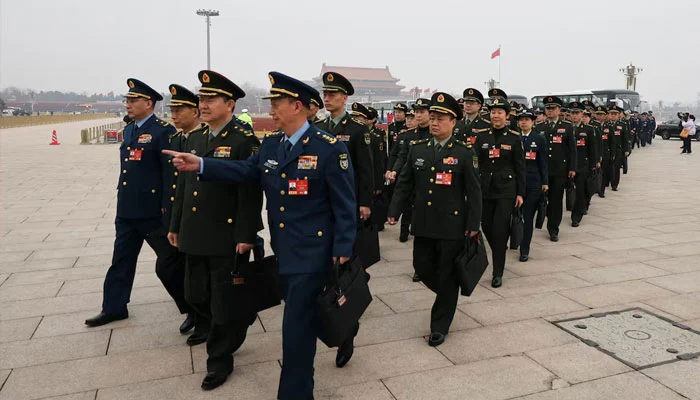
China is set to increase its defense budget by 7% in 2026, marking the smallest rise in five years but still exceeding overall economic growth estimates and other Asian nations amid rising regional tensions, notably over Taiwan. Security experts and military officials in the region are closely monitoring these budget plans as China aims to modernize its armed forces by 2035, expand deployments throughout East Asia, and conduct a major purge of senior officers to combat corruption.
Premier Li Qiang announced during the opening of the annual parliamentary session that China will advance its combat readiness and speed up the development of “advanced combat capabilities.” He also reaffirmed the country’s goal of reunification with Taiwan, emphasizing that all efforts will be made to safeguard China’s sovereignty, security, and development interests. President Xi Jinping continues to hold ultimate authority over military decisions.
The 7% increase follows three consecutive years of 7.2% growth, the lowest since 6.8% in 2021. This budget supports China’s ongoing efforts to develop new missiles, naval ships, submarines, and surveillance technologies. Experts from institutions like the S. Rajaratnam School of International Studies suggest that this level of military spending aligns with China’s long-standing strategy of balancing economic growth with national defense, maintaining consistent growth as a percentage of GDP roughly matching overall economic expansion and inflation.
This year’s defense buildup coincides with a significant purge within the upper military echelons, a rare event in recent decades. Notably, General Zhang Youxia, a close Xi ally, was placed under investigation in January, while General He Weidong was expelled last October. The high-profile anti-corruption campaign has led to a reduction in the number of top military leaders, leaving only two members on the Central Military Commission outside Xi Jinping, including newly promoted Vice Chairman Zhang Shengmin.
Despite these internal upheavals, Beijing remains committed to the Communist Party’s absolute control over the military. Premier Li stressed that the country will continue to enhance political loyalty within the armed forces and make significant progress toward the PLA’s centennial goals. Many analysts believe that the upcoming anniversary of China’s founding next year may lead to increased military activities, especially around Taiwan, which China considers part of its territory despite its democratic governance.
Li Jinping reiterated China’s firm stance against separatist movements and external interference regarding Taiwan, vowing to oppose “Taiwan independence” efforts. While Taiwan’s government maintains that only its people can decide their future and has not noted any major policy shifts from China, officials remain concerned about the sizable and growing defense budget. Taipei’s Mainland Affairs Council spokesperson Liang Wen-chieh pointed out that even in a challenging economic environment with sluggish private consumption, China’s large military investments pose a threat to Taiwan.
On the international stage, Li Peked down a recent warning about the global security landscape, shifting from “increasingly complex and severe” to a more moderate description of its international environment. Meanwhile, Japan’s government expressed concern over China’s opaque defense expenditures and its increasingly assertive behavior in regional waters. Japan pledged to continue efforts to maintain stable and constructive relations with China despite ongoing disagreements over territorial disputes and security threats.
Although the recent anti-corruption purges disrupted some military command structures temporarily, they are expected to bolster China’s military modernization efforts over time. As Chinese defense spending continues to outpace other Asian countries, the country’s share of regional military expenditure rose to nearly 44% in 2025, up from about 37% in 2010-2020, according to the International Institute for Strategic Studies. China’s annual military budget, around $277 billion, accounts for roughly a quarter of the U.S. defense outlay of over $1 trillion, although China provides limited detail on its defense spending breakdown.
 ChatGPT
 Perplexity
 Gemini AI
 Grok AI