Select Language:
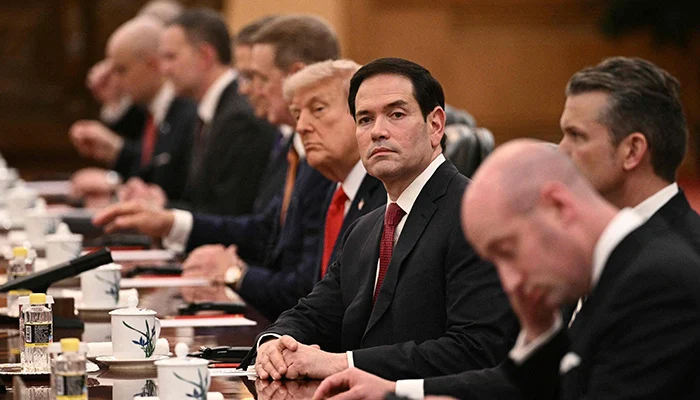
During President Donald Trump’s inaugural trip to China, Secretary of State Marco Rubio accompanied him to Beijing after a diplomatic maneuver involving a change in the Chinese transliteration of his name, despite existing sanctions from Beijing. Rubio, who faced sanctions twice while serving as a U.S. senator for his vocal criticism of human rights issues, was initially prevented from entry under his original transliterated name. To facilitate his travel without officially lifting sanctions, Chinese officials began transliterating the first syllable of his surname with a different Chinese character for “lu.” This linguistic adjustment was viewed as a practical diplomatic solution, allowing China to uphold sanctions while still engaging with Rubio as the newly appointed Secretary of State. Before the visit, China announced it would not block Rubio, now 54 and making his first trip to China, from entering on Air Force One with Trump—marking the first U.S. presidential visit to the Asian nation in nearly a decade. Chinese embassy spokesperson Liu Pengyu explained that the sanctions target Rubio’s words and actions during his time as a senator concerning China. Two diplomats indicated that this name change was a quick way for China to circumvent the sanctions, which barred Rubio from entry under his previous spelling. A State Department official confirmed Rubio’s travel with Trump but did not elaborate further. Since taking on his new role, Rubio, known for his outspoken criticism of communism, has supported Trump’s efforts, who has described Xi Jinping as a friend and prioritized strengthening trade relations with China.
 ChatGPT
 Perplexity
 Gemini AI
 Grok AI