Select Language:
On May 7, the competition between Chinese and South Korean display manufacturers intensified at the Society for Information Display Display Week 2026 in Los Angeles, as industry analysts emphasized that the next two to three years will be pivotal in establishing leadership in the global OLED market.
The rivalry has moved beyond traditional display performance to include the integration of artificial intelligence applications and next-generation manufacturing technologies. As China’s 8.6-generation OLED production capacity gradually comes online, local companies are expected to expand their share of the worldwide OLED market and reshape industry dynamics.
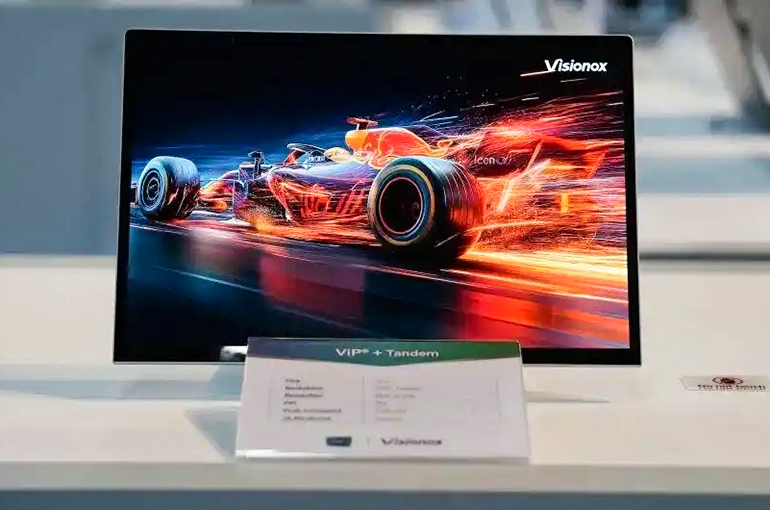
At the event, Chinese companies showcased advances in medium-sized and foldable OLED displays. Visionox introduced wearable and notebook displays that combine ViP and Tandem technologies, highlighting a 4K medium-sized notebook display that offers more accurate color reproduction than comparable Fine Metal Mask OLED screens, with a 10 percent reduction in power consumption during daily use and longer battery life. TCL China Star Optoelectronics Technology (TCL CSOT) revealed its first 28-inch printed OLED foldable portable desktop display, measuring just 4.48 millimeters thick when unfolded.
South Korean firms also presented new OLED innovations aimed at high-end and AI-enabled applications. Samsung Display unveiled a wide-gamut OLED screen with brightness reaching up to 3,000 nits, along with a 500 PPI OLED panel embedded with sensors capable of monitoring heart rate and blood pressure, incorporating privacy protection features.
LG Display demonstrated advancements centered on “OLED evolution in the AI era,” including a 1,200-nit automotive Tandem OLED display, offering lower power consumption and longer lifespan, set for mass production later this year and potentially adaptable for laptops. The company also introduced a lighter, thinner 16-inch Tandem OLED panel designed for AI laptops, which promises extended battery life.
China’s OLED Capacity Expansion Significantly Alters Industry Outlook
Li Yaqin, general manager of Sigmaintell, stated that the global OLED panel market exceeded USD 46.2 billion in 2025. She explained that technological development in OLEDs over the next several years will see increased competition across various segments, helping to broaden OLED applications and enhance market recognition. More top consumer electronics brands are expected to adopt OLED panels, with Apple’s MacBook Pro set to be the first to feature the technology this year.
“In the long run, we remain optimistic about the growing adoption of OLED technology across various applications in the small- and medium-sized display markets,” Li said.
Zhou Hua, chief analyst at CINNO Research, noted that Chinese OLED panel market size reached approximately CNY 100 billion (USD 13.8 billion) last year for the first time, accounting for around 30 percent of the global OLED market share.
Zhou pointed out that competition between China and South Korea in the OLED space is increasingly centered on AI integration and emerging applications. While China’s expanding 8.6-generation OLED capacity is expected to significantly increase local companies’ global market share, the industry still faces hurdles such as yield improvements, profitability, and strengthening upstream supply chain support.
The upcoming two to three years will be crucial for the rivalry between the two countries in OLED development, Zhou emphasized.
 ChatGPT
 Perplexity
 Gemini AI
 Grok AI