Select Language:
China’s DeepSeek unveiled a preview of its highly anticipated new flagship artificial intelligence model shortly after OpenAI announced GPT-5.5, illustrating the rapid progress of the global AI competition.
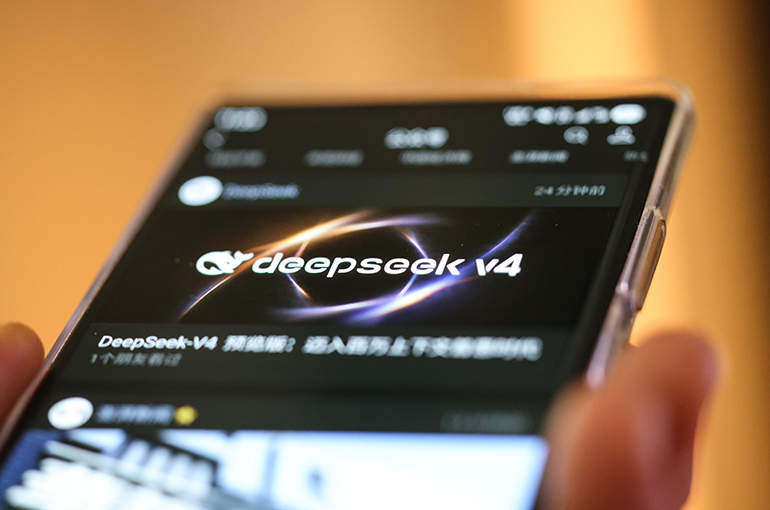
The startup based in Hangzhou announced the preview of DeepSeek-V4 around midday today. The model operates on Chinese computing infrastructure through a partnership with Huawei Technologies and its Ascend platform, highlighting China’s efforts to decrease reliance on foreign chips.
DeepSeek made its international debut last January with a ChatGPT-style model that demonstrated strong reasoning skills while significantly reducing operating costs. Silicon Valley investor Marc Andreessen called it an “AI Sputnik moment” due to its innovative approach.
The new version, DeepSeek-V4, is available in two editions—Pro and Flash—matching the expert and fast modes available on the company’s website and app. The Pro version boasts 1.6 trillion parameters with 49 billion active, trained on 33 trillion tokens of data. The Flash version has 284 billion parameters, 13 billion active, and was trained on 32 trillion tokens.
The model can handle a context window of up to one million tokens and has achieved top-tier results within China and among open-source models in terms of agentic capabilities, world knowledge, and reasoning, according to media reports.
The company announced that a one-million-token context window will now become a standard feature across all official DeepSeek services. The V4 model features a new attention mechanism that compresses tokens, combined with DeepSeek Sparse Attention, which substantially lowers computing and memory demands compared to traditional methods.
Pricing details reveal that the input cost for V4-Pro is approximately 15 cents per million tokens, with an output cost of about $1.80. The V4-Flash version costs roughly 2 cents for input and $2 for output per million tokens.
However, they acknowledged that the Pro version’s current service capacity is limited by high-end computing power constraints. The company expects costs to decrease after deploying Huawei’s Ascend-based Atlas 950 SuperPoD—a high-performance, liquid-cooled AI computing cluster—at scale in the second half of the year.
Prior to the launch, reports indicated that DeepSeek had begun its initial external fundraising efforts. Additional funding will help secure more computing resources, speed up model development, and enable the company to offer more competitive compensation to attract top talent.
The release of DeepSeek-V4 did not include a multimodal version, prompting speculation that limitations in computing power and funding may have delayed its development, even as multimodal capabilities become standard among leading AI models.
 ChatGPT
 Perplexity
 Gemini AI
 Grok AI