Select Language:
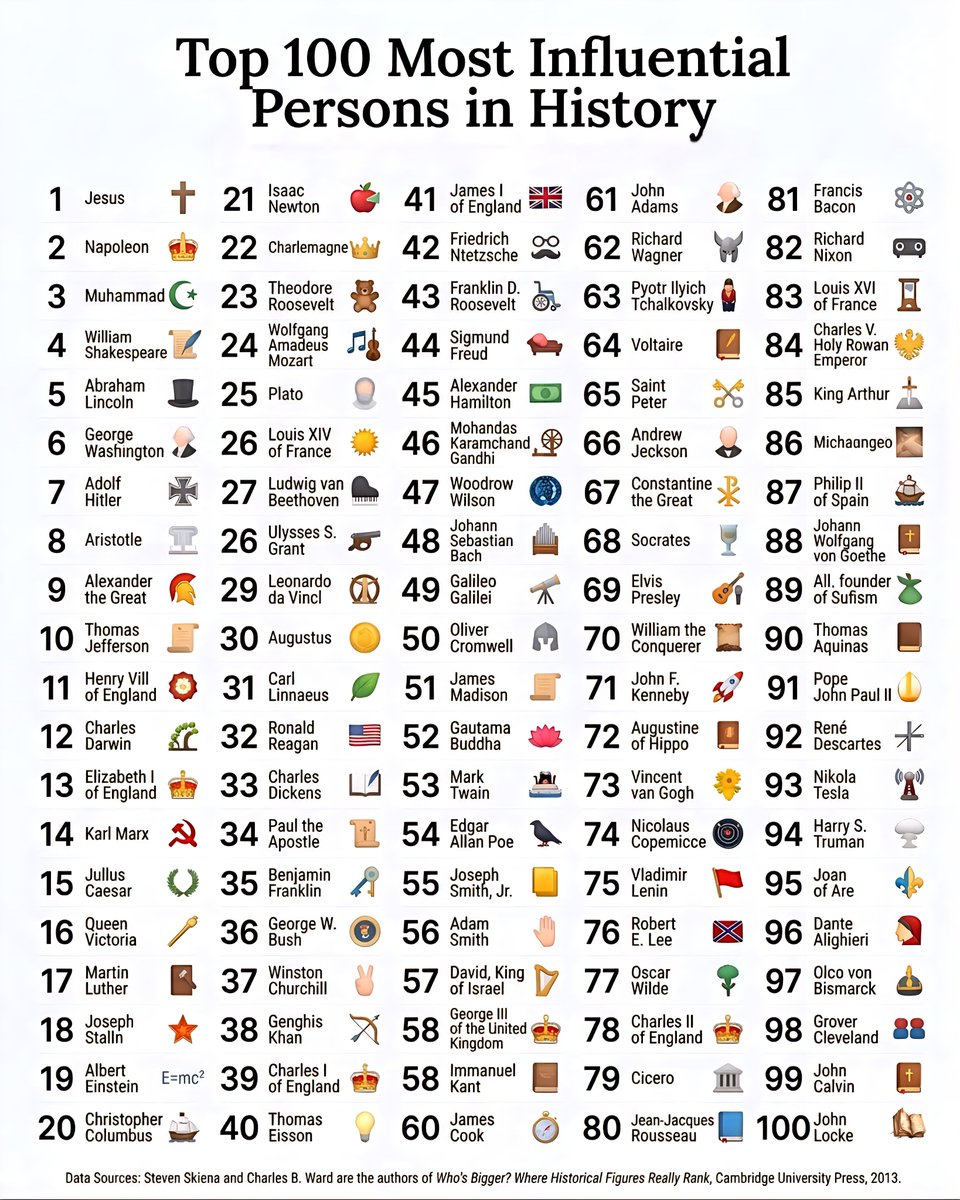
The Most Influential Figures in History: A 2025 Perspective
Jesus Christ: The Central Figure of Christianity
Topping the list is Jesus Christ, whose teachings and life have profoundly shaped Western civilization and beyond. His influence extends through religion, morality, art, and culture, with billions of followers worldwide and a legacy that continues to impact societal values today.
Napoleon Bonaparte: The Architect of Modern Europe
French military leader and emperor Napoleon Bonaparte revolutionized warfare and politics in Europe. His strategic innovations and legal reforms, notably the Napoleonic Code, left lasting legacies influencing legal systems and military tactics across the globe.
Muhammad: The Prophet Who United a Faith
The founder of Islam, Muhammad’s teachings sparked the development of a major world religion. His influence extends into cultural, political, and spiritual realms, shaping societies and civilizations for over a millennium.
William Shakespeare: The Bard of Avon
Renowned as one of the greatest writers in the English language, William Shakespeare’s plays, poetry, and sonnets have enriched literature and drama. His impact persists in language, storytelling, and theatrical arts around the world.
Abraham Lincoln: The Leader Who Preserved a Nation
As the 16th President of the United States, Abraham Lincoln’s leadership during the Civil War and his advocacy for abolition have left a profound mark on American history and civil rights movements worldwide.
George Washington: The Founding Father
George Washington, the first president of the United States, set foundational precedents for democratic governance and leadership, shaping the nation’s political identity.
Adolf Hitler: The Dictator Who Changed History
A controversial figure, Adolf Hitler’s rise to power and policies led to World War II and the Holocaust. His influence serves as a stark reminder of the dangers of totalitarianism and hatred.
Aristotle: The Philosopher of Virtue
Ancient Greek philosopher Aristotle’s contributions to logic, ethics, politics, and science laid the groundwork for Western intellectual thought.
Alexander the Great: The Conqueror of Nations
Alexander’s empire-building spread Greek culture across continents and initiated the Hellenistic era, influencing philosophy, art, and governance.
Thomas Jefferson: Author of the Declaration
As the principal author of the Declaration of Independence, Jefferson’s ideals about liberty and democracy continue to inspire modern governance.
[Image: Portrait of influential world leaders and thinkers—highlighting their enduring legacy.]
Other Notable Figures Shaping History
- Queen Victoria: Queen of the British Empire, symbolizing the Victorian era’s expansion and cultural influence.
- Martin Luther: Catalyst of the Protestant Reformation, profoundly changing Christianity and European society.
- Joseph Stalin: Soviet leader whose policies affected global politics during the 20th century.
- Albert Einstein: Theoretical physicist whose theories revolutionized our understanding of the universe.
- Christopher Columbus: Explorer whose voyages opened new world routes and facilitated European colonization.
- Isaac Newton: Mathematician and physicist whose laws of motion and gravitation transformed science.
- Leonardo da Vinci: Renaissance genius whose art and inventions symbolize creativity and innovation.
- Genghis Khan: Mongol conqueror whose empire reshaped Eurasian history.
- Mahatma Gandhi: Anti-colonial leader advocating nonviolent resistance, inspiring civil rights movements globally.
- Pope John Paul II: Influential religious figure promoting peace and human dignity.
The Role of Creativity and Innovation
Historical figures like Wolfgang Amadeus Mozart, Ludwig van Beethoven, and Johann Sebastian Bach have deeply influenced music and culture, shaping artistic expression for centuries.
Political and Military Leaders
From Napoleon to Winston Churchill, these leaders navigated wars, diplomacy, and governance, leaving legacy footprints that are studied and debated to this day.
Visionaries and Thinkers
Philosophers such as Immanuel Kant and Jean-Jacques Rousseau continue to influence modern political thought, ethics, and societal development.
The list of history’s most influential figures demonstrates how individual contributions—whether in leadership, innovation, or philosophy—shape civilizations and the course of human history. Their legacies remind us of the power of ideas, courage, and creativity in transforming the world.
Source: Steven Skiena and Charles B. Ward, “Who’s Bigger? Where Historical Figures Really Rank,” Cambridge University Press, 2013.
Disclaimer: Views are based on historical assessments and ongoing scholarly debates.
 ChatGPT
 Perplexity
 Gemini AI
 Grok AI