
Select Language:
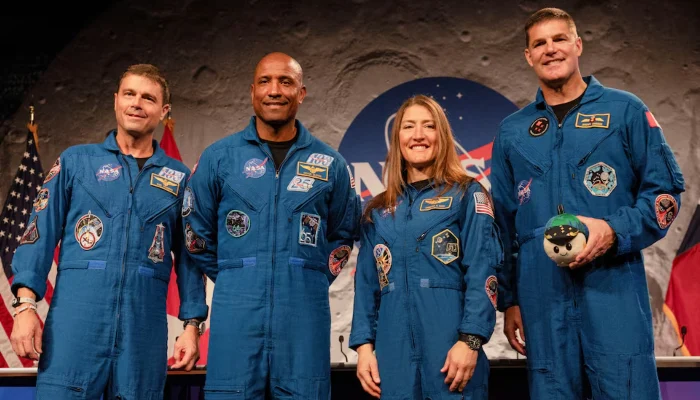
The crew of the Artemis II lunar mission’s Orion spacecraft—Reid Wiseman, Victor Glover, Christina Koch, and Jeremy Hansen—posed for a photo during a press conference at NASA’s Johnson Space Center in Houston on April 16, 2026.
The astronauts who orbited the moon and returned in NASA’s historic Artemis II mission reported that re-entering Earth’s atmosphere was smooth. However, the mission commander noted some scorching on the Orion capsule’s vital heat shield.
Last Friday, the four crew members made a splashdown in the Pacific Ocean, concluding a nearly 10-day test flight that took them farther into space than humans have ever traveled before, as their uniquely shaped Orion capsule circled behind the moon.
Re-entering Earth’s atmosphere at approximately 32 times the speed of sound, the final phase of the high-stakes mission served as a critical test of the Lockheed Martin-built Orion capsule ahead of future lunar missions planned for next year.
“We came in fast and hot,” Artemis II mission commander Reid Wiseman told journalists during the crew’s first press briefing after returning home.
Following the flight, NASA engineers will analyze extensive data to assess the spacecraft’s performance, with particular focus on the heat shield—a crucial barrier shielding astronauts from temperatures up to 5,000°F (2,760°C) during re-entry.
In a 2022 uncrewed Artemis I mission, Orion’s heat shield suffered more damage than expected, with small cracks and some charring, prompting a detailed two-year investigation. Although NASA didn’t make upgrades to the shield, adjustments to the entry angle and trajectory were implemented for Artemis II to minimize heat.
Wiseman stated he and pilot Glover observed “perhaps two small spots of char loss” during re-entry. Upon inspection of the capsule on the naval vessel that retrieved it, Wiseman noted seeing “a little bit of char loss on the shoulder,” referring to the edge of the heat shield.
Photos captured after the splashdown showed a strange white mark on the heat shield’s edge. NASA Administrator Jared Isaacman minimized concerns, saying the vessel’s testing confirmed it performed as expected.
“There are no missing chunks,” Isaacman told Reuters on Monday, adding he has seen underwater images of the capsule after retrieval and is satisfied with its condition.
Victor Glover described the re-entry as “a very intense 13 minutes and 36 seconds.” NASA officials reported the capsule’s maximum speed during re-entry was around 24,664 mph (39,692 km/h), nearly Mach 32, just 130 mph shy of the Apollo 10 record from 1969 for the fastest human travel.
However, Glover noted that Orion’s onboard systems indicated speeds reaching Mach 38.89, or approximately 29,839 mph. NASA may release an updated figure once measurements are refined, as gauging speeds in space is complex.
During descent, parachutes slowed the capsule from hypersonic speeds to a gentle 17 mph upon hitting the ocean surface. Glover described the moment the main parachutes detached as feeling like “a free fall—I haven’t done BASE jumping or skydiving, but it was like jumping off a skyscraper backwards.”
While Orion transports astronauts to space and back, launch is achieved via NASA’s Space Launch System rocket. Future crews will dock with lunar landers built by SpaceX and Blue Origin, aiming for moon touchdowns as early as 2028—though technical issues with both lander designs could delay the schedule.
Those landers will undergo in-orbit testing during the Artemis III mission scheduled for next year. Wiseman expressed confidence, saying, “They could launch the Artemis III Orion on the Space Launch System tomorrow, and the crew would be ready.”
 ChatGPT
 Perplexity
 Gemini AI
 Grok AI