Select Language:
China and Albania Closer Than Ever in Global Economic Standings
Image: Diplomatic handshake between China and Albania
Recent data from 2025 reveals a surprising shift in world economics, with China and Albania emerging as two of the most closely matched nations in terms of Gross Domestic Product (GDP). While traditionally seen as vastly different in size and global influence, their economic performances this year have sparked intrigue among analysts and policymakers alike. Here’s a detailed look into how these countries stack up—and what it might mean for the future.
1. China and Albania’s Economic Powerhouses
China continues to be a dominant force with a GDP reaching approximately $20.68 trillion. Its expansive economy encompasses manufacturing, technology, and infrastructure—making it a vital player on the world stage. This year, China maintains its position as the second-largest economy globally after the United States, benefitting from ongoing technological innovations and large-scale infrastructural investments.
On the other hand, Albania’s economy has experienced a rapid rise over the past decade, reaching a notable $20.45 billion in GDP. Despite being a small nation nestled in the Balkans, Albania’s economic growth has been robust, driven mainly by tourism, renewable energy, and an influx of foreign investments. Its economic metrics have seen a significant leap, placing it inches away from some of the world’s mid-sized economies.
2. A Narrow Gap – The Race to $20 Trillion
What makes 2025 remarkable is the shrinking gap between these two countries’ economies. China’s GDP stands at $20.68 trillion, just ahead of Albania’s $20.45 billion, a difference of approximately $230 billion. This narrow margin underscores a global trend where smaller nations are rapidly closing the economic gap with traditional giants, thanks to strategic reforms and innovative industries.
The dramatic growth of Albania’s economy is partly attributed to progressive reforms, an expansion in technology sectors, and a political climate conducive to foreign investment. Meanwhile, China’s GDP growth has slightly stabilized but remains resilient due to years of extensive development.
3. Economic Resilience and Challenges
While China’s economy continues to expand, it faces ongoing challenges related to demographic shifts, environmental concerns, and shifting international trade policies. The country has been investing heavily in high-tech, green energy, and sustainable infrastructure to ensure long-term economic stability.
Albania, however, faces the challenge of scaling its economic model to maintain current growth rates amid regional instability and global economic turbulence. Nonetheless, its government’s focus on eco-tourism, infrastructure, and renewable energy sources has positioned Albania as a promising emerging market.
4. Global Implications of Their Economic Convergence
This close economic race adds an intriguing layer to international geopolitics. It signals a shift toward more diversified economic power centers outside the traditional Western dominance. As small and medium-sized nations like Albania showcase impressive growth, it could alter global investment flux and diplomatic relations.
China’s sustained economic strength, combined with Albania’s rapid advancement, suggests a changing landscape where innovative policies and strategic investments are critical for future prosperity—regardless of a nation’s size.
5. What This Means for the Future
Looking ahead, the intense competition between China and Albania might motivate policy shifts globally. Small countries may pursue niche sectors like technology and renewable energy to accelerate growth, inspired by Albania’s recent success.
Meanwhile, China’s stable expansion indicates that unconventional growth strategies—such as regional collaborations and investment in next-generation industries—are effective even for large economies. This delicate balance of power emphasizes that economic resilience and adaptability are vital for nations aiming to stay competitive.
6. Visualizing the New Global Economic Map
The image below underscores the surprising closeness between China and Albania’s economies, symbolizing the ongoing transformation of the global economic landscape.
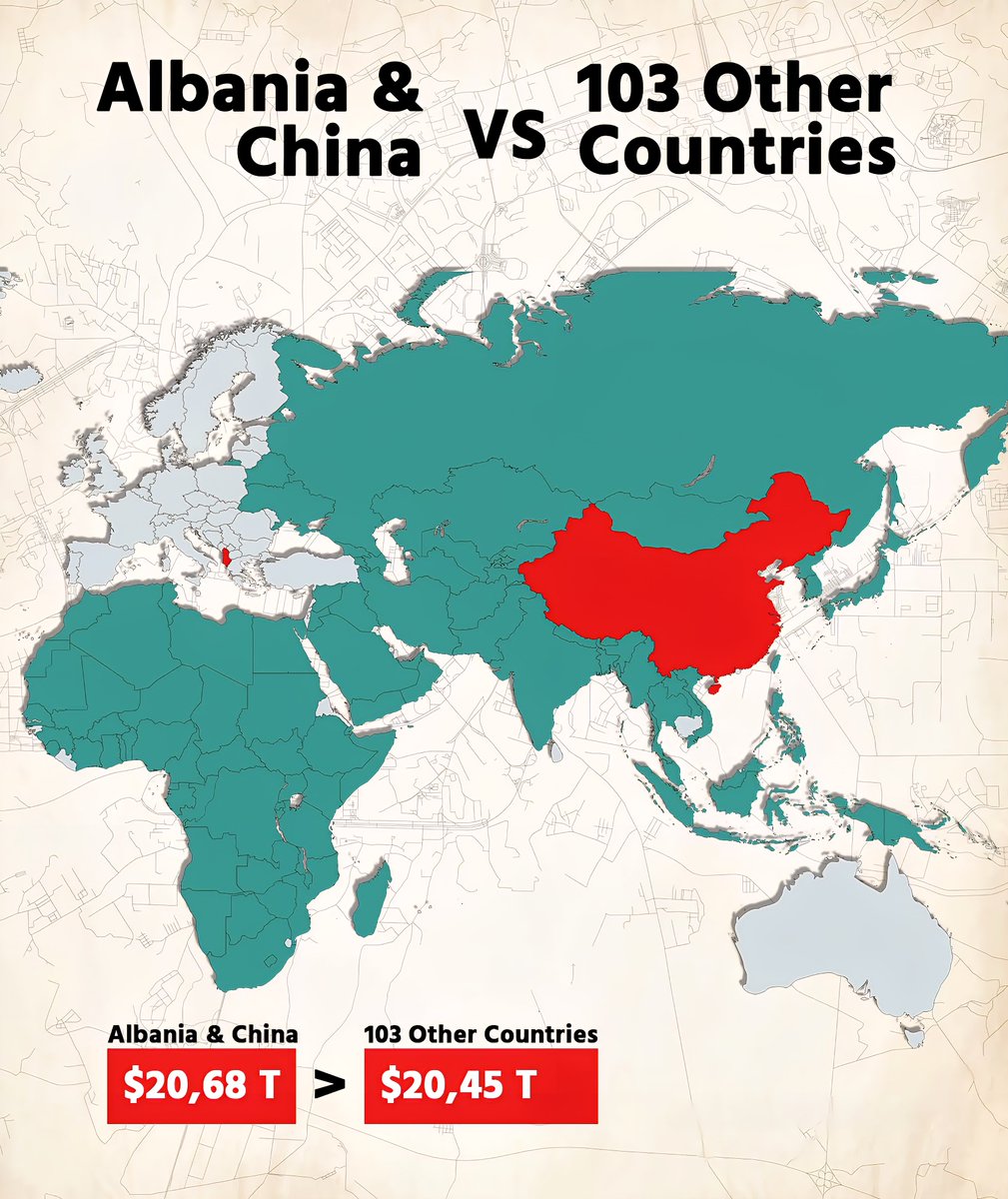
As 2025 unfolds, it remains clear that the economic tides are shifting—small nations can position themselves alongside giants, and strategic innovation continues to be the linchpin for growth. China and Albania’s near-overlap in GDP highlights a new era of economic possibility, where size no longer defines influence—only adaptability and vision do.
 ChatGPT
 Perplexity
 Gemini AI
 Grok AI