Select Language:
Britain’s government plans to introduce legislation next month aimed at bringing the country closer to the European Union, amid tensions caused by the Iran conflict that are straining the UK’s so-called special relationship with the United States.
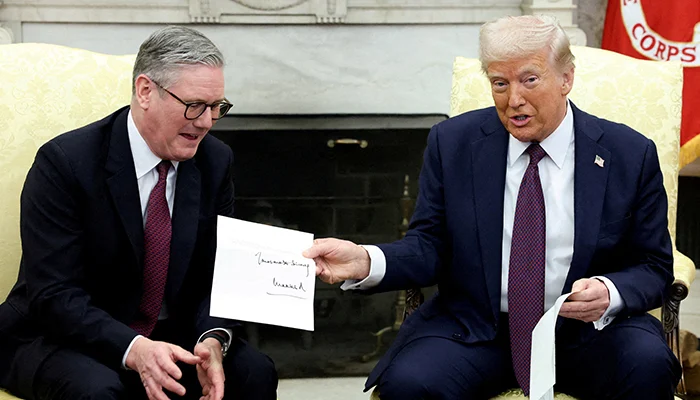
President Donald Trump’s unpredictable behavior and repeated insults toward America’s historic ally are fueling Prime Minister Keir Starmer’s efforts to strengthen ties with the EU, a shift that comes nearly a decade after the UK narrowly voted to leave the bloc.
Evie Aspinall, director of the British Foreign Policy Group think tank, explained to AFP, “Our government is already inclined to move closer to the EU, and the situation in Iran offers a chance to accelerate that process.”
Starmer’s government is drafting an EU “reset” bill permitting ministers to adjust UK standards to keep pace with evolving EU single market rules—referred to as “dynamic alignment.” The legislation will be announced by King Charles III on May 13 during his upcoming address outlining the government’s legislative plans, an anonymous government official told AFP.
Since his Labour Party’s victory in the 2024 general election, overthrowing the Conservatives who had pushed Brexit, Starmer has repeatedly called for a deeper economic and security relationship with Europe. Recently, he emphasized this point during a meeting with Dutch leader Rob Jetten, stating, “The UK and the EU partnership must be capable of tackling today’s challenges.”
The EU remains the UK’s largest trading partner, and the International Monetary Fund warned this week that the UK will experience the most significant economic fallout among advanced economies due to the Iran crisis.
“Certainly, Iran has made this [EU relationship] more urgent,” the UK official added. “We must build economic resilience across the continent.”
While initially refusing to participate in the US and Israel’s strikes on February 28, Starmer later permitted American forces to operate from UK bases for limited defensive purposes. His decision to appoint former Jeffrey Epstein associate Peter Mandelson as ambassador to Washington faced domestic criticism, yet he has also been praised for standing firm against Trump’s frequent provocations.
Recently, Trump threatened to revoke the UK-US trade deal in a phone interview with Sky News, citing his tariffs’ impact on Britain. The ongoing unpredictability of Trump’s approach is believed to have strengthened the UK’s desire to forge a closer relationship with the EU, according to trade policy expert David Henig.
Starmer’s government aims to introduce the EU-alignment legislation within months, possibly coinciding with the tenth anniversary of the Brexit referendum in June 2016. The measure will give MPs the opportunity to approve mechanisms for adopting EU rules—sometimes without full votes—especially in areas like trade agreements easing food and plant exports and plans to integrate the UK into the EU’s internal electricity market.
Negotiations on a youth mobility scheme are also expected to be finalized ahead of a joint summit scheduled for late June or early July in Brussels. However, Starmer has ruled out rejoining the single market or returning to free movement policies.
The Liberal Democrats advocate for a different approach, pushing for Britain to negotiate a customs union with the EU despite Starmer’s stance. Calum Miller, foreign affairs spokesman for the Liberal Democrats, told AFP, “We need to strengthen relations with reliable partners who share our values.”
Brexit remains a contentious issue, with hard-right Reform UK, led by Eurosceptic Nigel Farage and polling as the leading party, criticizing the upcoming legislation as a betrayal of the Referendum’s narrow decision to leave. Nonetheless, recent surveys indicate growing regret among Britons about leaving the EU—an opportunity Starmer hopes to leverage amid rising living costs, which UK Finance Minister Rachel Reeves partly blames on Trump’s handling of the Iran conflict.
Aspinall commented, “When relationships with the U.S. are strained, it’s easier for the public to accept a closer tie with the EU.”
 ChatGPT
 Perplexity
 Gemini AI
 Grok AI