Select Language:
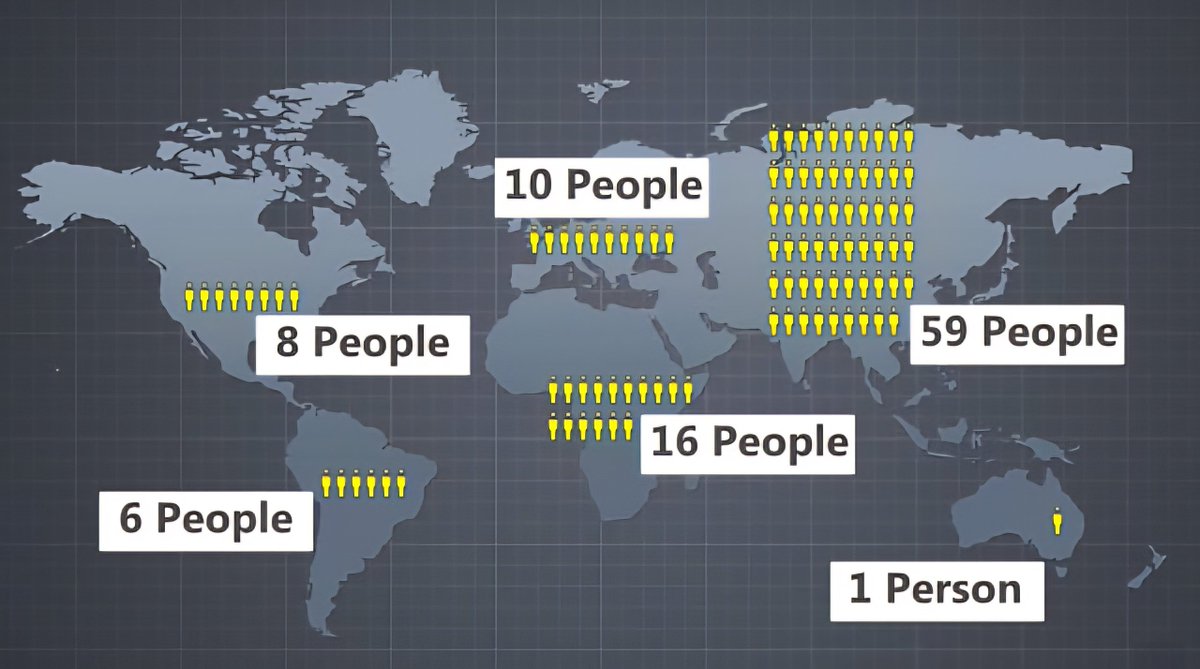
Imagining the World in a Group of 100 People
1. Diversity in Culture and Origin
Within a community of 100 individuals, diversity is striking: approximately 60 would be from Asia, highlighting the continent’s population dominance, while about 14 would be from Africa, reflecting its rapid demographic growth. The Americas and Europe would include roughly 12 and 10 people, respectively, showcasing the broad geographical spread. This snapshot emphasizes the global mosaic of cultures, languages, and traditions that shape our collective identity.
2. Access to Education and Literacy
Out of 100 people, about 86 would be able to read and write, but there remains a disparity. Seven individuals would lack basic literacy skills, predominantly in impoverished regions. This statistic underscores ongoing global efforts to improve education but also the importance of targeted initiatives to eliminate illiteracy and empower communities through knowledge.
3. Economic Disparities
Economic inequality remains glaring. Nearly 10 of these individuals would live in extreme poverty, surviving on less than a dollar a day, which illustrates the persistent challenge of poverty worldwide. Conversely, about 12 people would have high incomes, highlighting the stark income gaps that fuel social and economic disparities across nations.
4. Access to Clean Water and Healthcare
In this group, approximately 10 people would lack access to safe drinking water, a fundamental human right. Meanwhile, roughly 5 individuals would face barriers to essential healthcare services, exposing ongoing health inequities. These issues call for intensified global efforts to ensure equitable access to vital resources.
5. Gender and Age Distribution
The majority of the group—about 52—would be women, reflecting the slightly higher female-to-male ratio globally. In terms of age, almost 16 would be children under 15, emphasizing the significant proportion of young populations in many regions. Meanwhile, around 8 would be elderly, underscoring aging populations in certain parts of the world.
6. Religious and Ethnic Composition
The group would demonstrate religious diversity, with roughly 33 identifying as Christians, 23 as Muslims, 15 as Hindus, and the remainder following other faiths or spiritual beliefs. Ethnically, the majority would be of Asian descent, with substantial representation from African and European backgrounds, illustrating the rich tapestry of human heritage.
7. Information and Technology Access
In the digital age, access to technology is critical. About 49 people would use the internet regularly, while 51 would have limited or no access. This digital divide continues to be a barrier hindering educational and economic opportunities for many worldwide.
8. Health and Disease Prevalence
Approximately 39 individuals would be living with some form of chronic illness, including HIV/AIDS, diabetes, or heart disease, highlighting the global health burden. Moreover, around 1 person in this group could be affected by tuberculosis, signifying ongoing challenges in disease prevention and control.
9. Languages Spoken
The linguistic landscape would be varied: Mandarin would be spoken by roughly 13 people, followed by Spanish, Hindi, and English, each representing sizable communities. The multitude of languages showcases the importance of multilingual communication and cultural preservation amid globalization.
10. Urban vs. Rural Living
Nearly 56 of the individuals would reside in urban settings, reflecting global trends of urbanization. Conversely, about 44 would live in rural areas, often facing limited infrastructure and services. Understanding this distribution is essential for planning sustainable development and equitable resource allocation.
This visualization of the world’s population as a group of 100 highlights both the remarkable diversity and persistent inequalities that define our global society in 2025. Recognizing these truths can inspire collective action to build a more inclusive, equitable, and sustainable future for all.
 ChatGPT
 Perplexity
 Gemini AI
 Grok AI