Select Language:
Top World Leaders in 2025: Who’s Gaining the Most Trust?
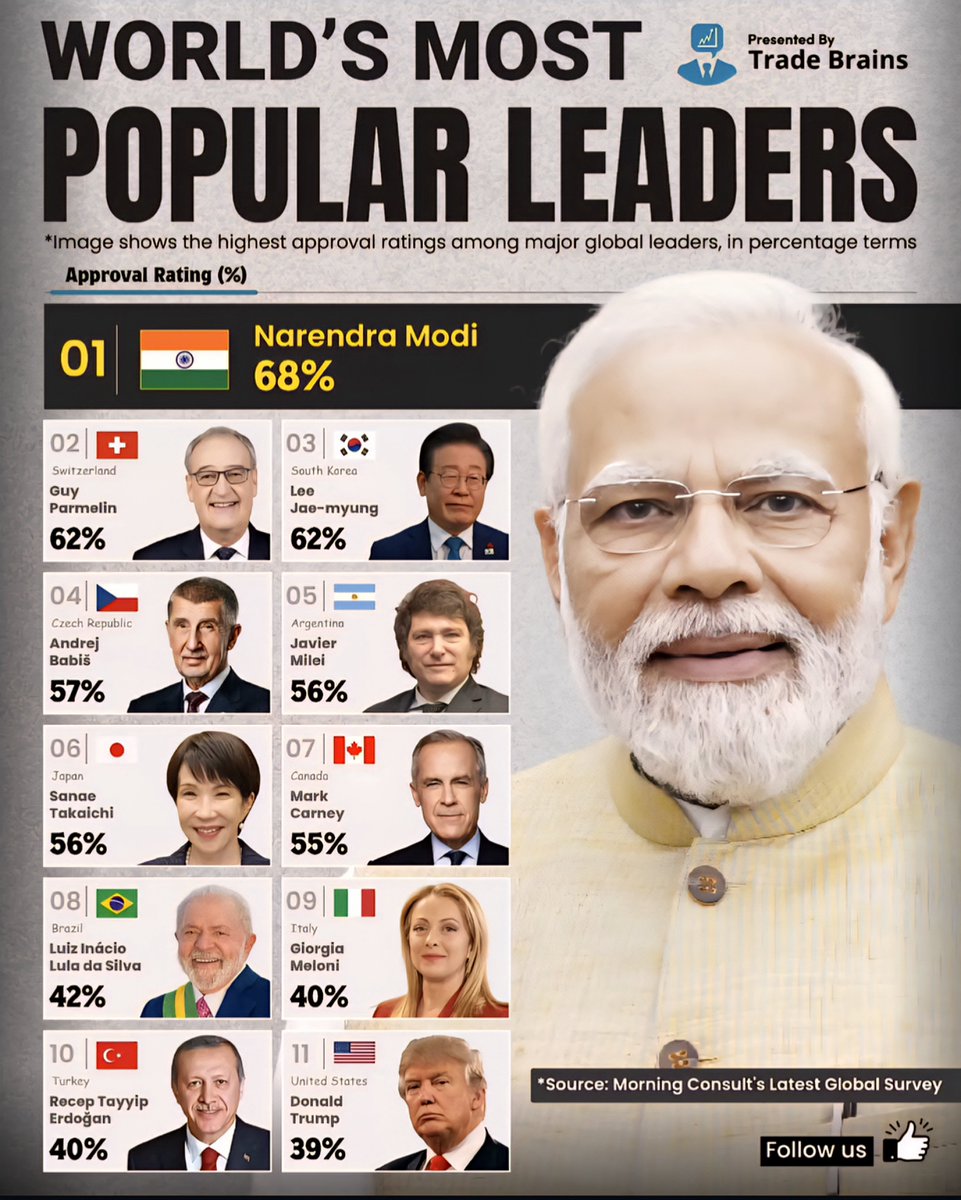
In recent global surveys, public approval ratings of international leaders reveal shifting political landscapes, alliances, and the influence of policy decisions. As of 2025, here’s a detailed overview of the most popular leaders worldwide, based on the latest Morning Consult Global Survey.
🌍 Narendra Modi Maintains the Lead with 68% Approval
India’s Prime Minister Narendra Modi continues to hold a commanding lead with an impressive 68% approval rating. His policies focusing on economic growth, infrastructure modernization, and foreign relations have resonated strongly with Indian voters amidst a rapidly changing geopolitical environment. Modi’s ability to maintain trust shows his influence over India’s national direction.
🇨🇭 Guy Parmelin and 🇰🇷 Lee Jae-myung Tie at 62%
Switzerland’s ex-President Guy Parmelin and South Korea’s political figure Lee Jae-myung share the second spot, each garnering 62%. Parmelin’s reputation for steering Switzerland through economic stability and neutrality remains solid. Meanwhile, Lee’s efforts to bolster South Korea’s technological surge and social reforms seem to have resonated well with the public.
🇨🇿 Andrej Babiš Closes the Top Five at 57%
Czech Republic’s former Prime Minister Andrej Babiš is also in the mix, with a 57% approval rate. His leadership during economic reforms and his stance on European Union policies have kept him popular domestically. Babiš continues to be a pivotal player in Czech politics.
🇦🇷 Javier Milei and Sanae Takaichi Close at 56%
Argentina’s Javier Milei, known for his outspoken economics-based reforms, impresses with a 56% approval. Similarly, Japan’s Sanae Takaichi is also at 56%, reflecting high approval in Japan for her conservative policies and efforts on economic rejuvenation and security reforms.
🇨🇦 Mark Carney Boasts 55%
While primarily recognized as a Canadian economist and former Bank of England Governor, Mark Carney has transitioned into a prominent political figure, enjoying a 55% approval rating. His focus on financial stability and climate policies has earned trust among progressives and moderates alike.
🇧🇷 Lula and Meloni Face Challenges
Brazil’s Luiz Inácio Lula da Silva remains relatively popular at 42%, following years of political turbulence. Meanwhile, Italy’s Giorgia Meloni and Turkey’s Recep Tayyip Erdoğan both sit at 40%, highlighting persistent national polarization. Erdoğan’s support has been steady, even amid regional tensions.
🤔 Former U.S. President Donald Trump Holds 39% Support
Former President Donald Trump continues to command a significant segment of American voters, with an approval rate of 39%. His influence remains palpable within the Republican base, suggesting he could still shape upcoming U.S. political trajectories.
What Does This Mean for Global Politics?
These approval ratings provide a snapshot into the current mood of the world’s populations. Leaders like Modi and Lee are enjoying high trust, possibly due to economic stability and proactive governance. Conversely, leaders with lower approval ratings face mounting pressure to address public concerns over policy, corruption, or regional stability.
Final Thoughts
As 2025 progresses, approval ratings serve as key indicators of a leader’s influence and the effectiveness of their policies. Countries are navigating economic challenges, geopolitical tensions, and internal social issues, which are reflected in these approval metrics. Leaders who adapt swiftly to their nations’ needs are likely to see continued support.
For more updates on global politics, stay tuned to our coverage.
 ChatGPT
 Perplexity
 Gemini AI
 Grok AI