Select Language:
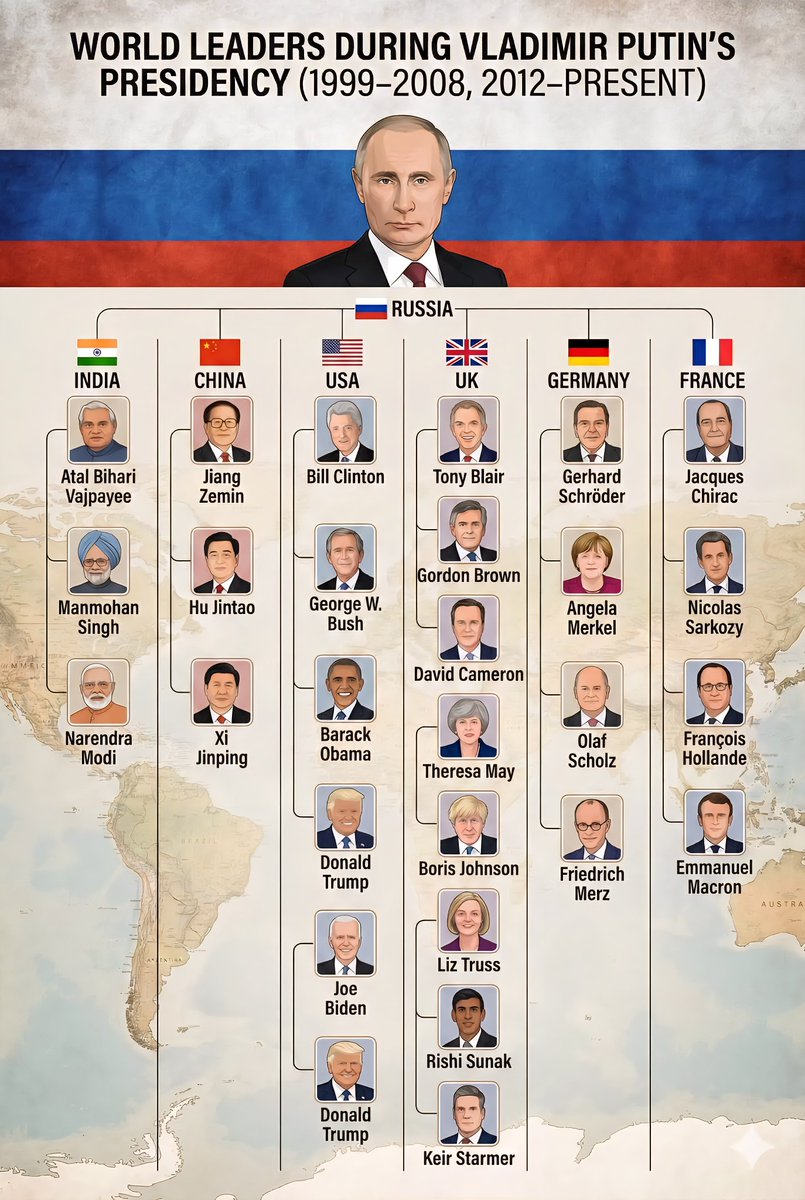
Global Leaders Who Shaped Vladimir Putin’s Era (1999-2008, 2012-Present)
1. George W. Bush – The U.S. President Who Navigated Post-9/11 Diplomacy
During Putin’s early years in power, George W. Bush was leading the United States. The relationship between Russia and the U.S. saw highs and lows, especially following the September 11 attacks, which temporarily united the two nations in the global fight against terrorism. Bush’s tenure from 2001 to 2009 involved significant diplomatic negotiations concerning NATO expansion, missile defense, and Russia’s role in regional conflicts. Their complex relationship defined much of early 2000s geopolitics, with moments of cooperation and mutual suspicion.
2. Vladimir Putin’s Rise and Consolidation of Power (1999-2008)
Vladimir Putin’s ascent to Russia’s presidency sparked significant shifts on the world stage. Initially serving as acting president in 1999 before officially taking office, Putin’s first two terms between 2000 and 2008 focused on restoring Russia’s influence and stabilizing the economy. His leadership marked a period of increased centralization of power, strengthening his grip on political institutions and asserting Russia’s presence in international affairs.
3. Dmitry Medvedev – Putin’s Trusted Ally and Successor (2008-2012)
In a strategic move, Putin backed Dmitry Medvedev’s presidency from 2008 to 2012, while remaining the prime minister and ultimately the real power behind the scenes. Medvedev, seen as a technological and modernizer, maintained continuity in Russia’s policies but also signaled a slight shift in tone towards Western engagement. This period helped Putin reset for his eventual return to the presidency in 2012.
4. Barack Obama – A President Navigating Russia’s Resurgence
Barack Obama’s presidency from 2009 to 2017 coincided with Putin’s return to the Kremlin in 2012. The Obama administration initially sought engagement and diplomatic dialogue, but tensions escalated with the annexation of Crimea in 2014 and the conflict in Ukraine. These events prompted a series of sanctions and deteriorating relations, setting the stage for a more confrontational phase in US-Russia relations.
5. Angela Merkel – Europe’s Steady Diplomat and Putin’s Key Counterpart
As Chancellor of Germany from 2005 onward, Angela Merkel became a critical player in managing relations with Russia. Her pragmatic approach often balanced economic interests with security concerns. Merkel’s leadership was crucial during conflicts in Ukraine and Syria, often mediating between Western nations and Russia, while standing firm against aggressive actions that threatened European stability.
6. Xi Jinping – An Emerging Global Counterweight
Since taking office in 2013, Chinese President Xi Jinping has expanded China’s influence alongside Russia’s resurgence. The two leaders have developed a close working relationship, strengthening economic and military ties. Their partnership signals a shifting global landscape, where cooperation between Moscow and Beijing challenges Western dominance and promotes a new bloc of influence.
7. Emmanuel Macron – France’s Steadfast Negotiator
Since becoming President in 2017, Emmanuel Macron has navigated Russian relations with a focus on dialogue and diplomacy. Macron has maintained communication channels with Putin, particularly concerning stability in Ukraine and Syria. His approach reflects France’s commitment to balancing engagement with assertiveness in addressing Russia’s strategic moves.
8. Joe Biden – The U.S. President Facing New Challenges
Elected in 2020, Joe Biden inherited a tense relationship with Russia. His administration has emphasized rebuilding alliances and confronting Russian interference in elections and cyber activities. Biden’s leadership has seen renewed sanctions, efforts to reinforce NATO, and strategic dialogues aimed at curbing Russian assertiveness on the global stage.
The diplomatic landscape during Vladimir Putin’s tenure has been shaped by these pivotal figures. Their policies, alliances, and conflicts continue to define the contours of 21st-century geopolitics, making Putin’s era one of the most dynamic and contentious periods in recent history.
 ChatGPT
 Perplexity
 Gemini AI
 Grok AI