Select Language:
Top 25 Video Game Consoles of All Time in 2025: A Look at Gaming’s Greatest Hits
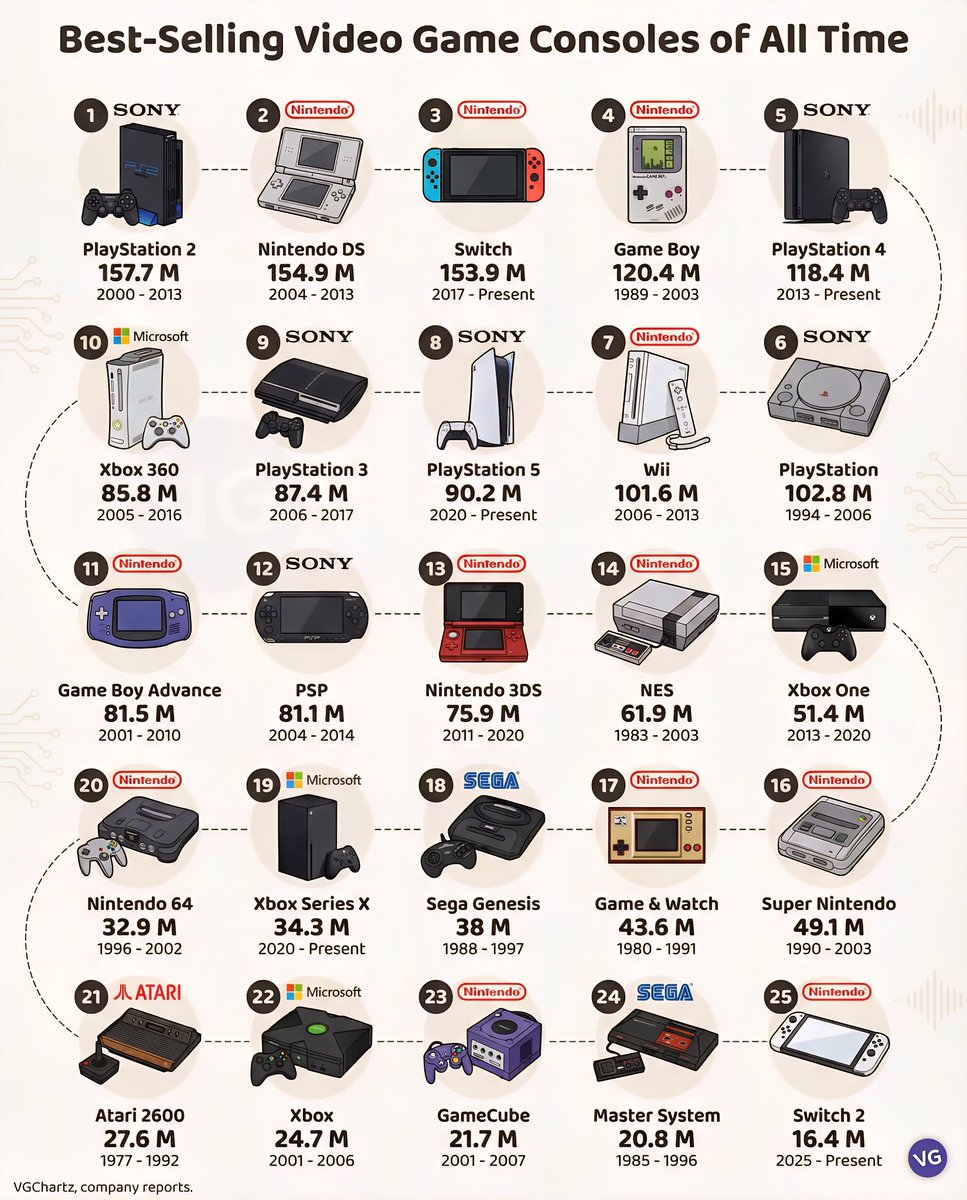
Across the decades, gaming consoles have evolved significantly, captivating millions of players worldwide. Here’s a comprehensive list of the top 25 best-selling gaming consoles as of 2025, showcasing the enduring popularity of certain systems and the dynamic shifts in gaming technology.
1. PlayStation 2 (2000–2013): Sony’s Iconic Entry Steadfast at the Top
Remaining unrivaled for over two decades, the PlayStation 2 continues to hold the title as the best-selling console of all time, with an impressive 157.7 million units sold. Its extensive game library, backward compatibility, and affordability have cemented its legacy in gaming history.
2. Nintendo DS (2004–2013): Handheld Gaming Revolution
Next is Nintendo’s groundbreaking handheld, the Nintendo DS, with 154.9 million units sold. Its dual screens, innovative touch controls, and vast game library made it a portable staple for gamers worldwide during the 2000s.
3. Nintendo Switch (2017–Present): Hybrid Gaming at Its Finest
With 153.9 million units sold, the Nintendo Switch has redefined gaming portability and versatility. Its ability to switch seamlessly between handheld and TV modes has kept it a favorite among casual and hardcore gamers alike.
4. Game Boy (1989–2003): Pioneer of Portable Gaming
The Game Boy’s legacy lives on with 120.4 million units sold. As Nintendo’s first major handheld device, it introduced gaming to a new generation, setting the foundation for future portable systems.
5. PlayStation 4 (2013–Present): Sony’s Powerhouse Console
With 118.4 million units, the PlayStation 4 has dominated the last decade thanks to its robust hardware, exclusive titles, and online services, maintaining Sony’s top spot in home-console sales.
6. PlayStation (1994–2006): The Original PlayStation Legacy
Sony’s PlayStation console sold 102.8 million units, revolutionizing gaming with CD-based media, a vast game lineup, and multimedia integration, positioning Sony as a household gaming brand.
7. Wii (2006–2013): Innovating with Motion Control
Nintendo’s Wii sold 101.6 million units thanks to its motion-controlled gameplay, attracting a broad demographic and making gaming more accessible to families and non-traditional gamers.
8. PlayStation 5 (2020–Present): Cutting-Edge Gaming Hardware
Been in the market for just five years, the PS5 has already moved 90.2 million units due to its high-performance specs, fast load times, and extensive exclusive titles, signaling Sony’s continued dominance.
9. PlayStation 3 (2006–2017): Sony’s Mature Platform
With 87.4 million units sold during its lifespan, the PS3 featured advanced graphics capabilities and a built-in Blu-ray player, securing its place in gaming history.
10. Xbox 360 (2005–2016): Microsoft’s Successful Entry
Microsoft’s Xbox 360 sold 85.8 million units, known for its online services like Xbox Live, diverse games, and a broad multiplayer community that helped define online console gaming.
11. Game Boy Advance (2001–2010): Portable Powerhouse
The Game Boy Advance achieved 81.5 million sales, offering improved graphics and gameplay, and expanding Nintendo’s handheld dominance into the early 2000s.
12. PlayStation Portable (2004–2014): Sony’s Portable Play
With 81.1 million units, the PSP brought PlayStation’s high-quality gaming experience on the go, fueling portable gaming during the mid-2000s.
13. Nintendo 3DS (2011–2020): 3D Gaming Innovation
Selling 75.9 million units, the 3DS’s glasses-free 3D display and library of popular franchise titles diversified Nintendo’s handheld offerings.
14. Nintendo Entertainment System (NES) (1983–2003): Restoring Console Confidence
The NES sold 61.9 million units, credited with reviving the gaming industry in the 80s with classics like Super Mario Bros.
15. Xbox One (2013–2020): Microsoft’s Multimedia Hub
Selling approximately 51.4 million units, the Xbox One focused on multimedia entertainment, exclusive titles, and online features before being phased out in favor of newer hardware.
16. Super Nintendo (SNES) (1990–2003): 16-Bit Classic
With 49.1 million units, the SNES delivered beloved franchises like Zelda and Mario, cementing its place in 90s gaming nostalgia.
17. Game & Watch (1980–1991): Handheld Simplicity
An early Nintendo device that sold 43.6 million units, laying the groundwork for portable LCD gaming.
18. Sega Genesis (1988–1997): Sega’s 16-Bit Challenger
Moving 38 million units, the Genesis was key in the 90s console wars, known for Sonic the Hedgehog and a strong library of arcade-style games.
19. Xbox Series X (2020–Present): Microsoft’s Latest Power Players
Having sold 34.3 million units so far, the Series X represents Microsoft’s commitment to high-end gaming with advanced graphics features and quick load times.
20. Nintendo 64 (1996–2002): 3D Gaming Pioneer
With 32.9 million units sold, it brought 3D gaming into mainstream with titles like Super Mario 64 and GoldenEye.
21. Atari 2600 (1977–1992): Atari’s Classic Era
Selling 27.6 million units, the Atari 2600 was the first successful home gaming console, introducing millions to video gaming.
22. Xbox (2001–2006): The Original Microsoft Console
With 24.7 million units, the Xbox established Microsoft’s presence in console gaming, with standout titles and online features.
23. Nintendo GameCube (2001–2007): Compact Power
Selling 21.7 million units, the GameCube is remembered for iconic titles like Super Smash Bros. Melee and its unique design.
24. Sega Master System (1985–1996): Sega’s Early Competition
With 20.8 million sales, it competed with NES but eventually faded in popularity, though it still holds nostalgic value.
25. Nintendo Switch 2 (2025–Present): The Latest in Hybrid Gaming
The newest entry on the list, the Nintendo Switch 2 has already sold 16.4 million units, building on Nintendo’s successful hybrid formula with innovative features and a strong game lineup.
The landscape of gaming consoles has shifted remarkably over the past 45 years, yet some systems remain iconic and influential. The combination of technological advancements, game libraries, and innovative features continue to shape the gaming industry as we move further into 2025.
Source: VGChartz, company reports 2025
 ChatGPT
 Perplexity
 Gemini AI
 Grok AI