Select Language:
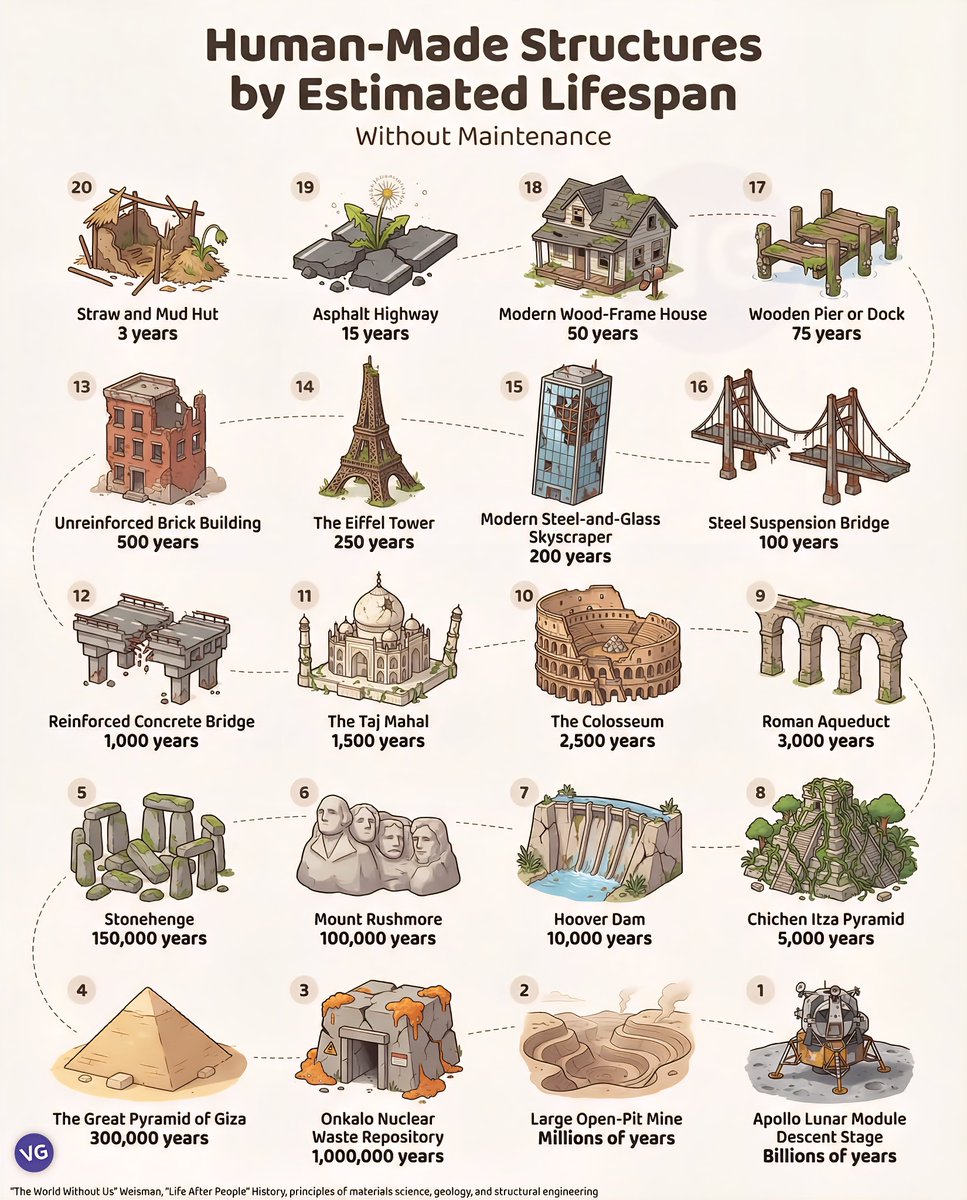
Top Human-Made Structures Ranked by How Long They Last
1. Apollo Lunar Module Descent Stage — Billions of Years
Topping the list is the Apollo Lunar Module descent stage, which is estimated to endure for billions of years. Since these modules were left on the Moon’s surface, they will likely remain preserved in near-perfect condition for eons, serving as historical markers of human achievement far into the future. Their resilience is primarily due to the Moon’s lack of atmosphere, weather, and tectonic activity.
2. Large Open-Pit Mine — Millions of Years
Next up are large open-pit mines, such as the Bingham Canyon Mine in Utah. Because of their immense scale and the ongoing natural processes of erosion, weathering, and tectonic shifts, these structures have the potential to stand for millions of years. Over such vast timescales, natural forces will gradually reshape and erode them, but remnants could still be recognizable for immense periods.
3. The Great Pyramid of Giza — 300,000 Years
Built approximately 4,500 years ago, the Great Pyramid stands as a testament to ancient engineering. It is estimated to withstand natural elements for about 300,000 years. Its sturdy limestone blocks and precise construction have allowed it to survive wars, earthquakes, and weathering for millennia, with only gradual degradation expected over extended periods.
4. Stonehenge — 150,000 Years
One of the most iconic prehistoric monuments, Stonehenge, has stood for approximately 5,000 years. Its massive stones and unique construction methods suggest it could survive natural processes for at least 150,000 years, although ongoing erosion and human activity continue to threaten its longevity. Its significance as a cultural landmark likely will persist long beyond its physical presence.
5. Mount Rushmore — 100,000 Years
Carved into the Black Hills of South Dakota, Mount Rushmore has been a symbol of American history since 1941. The granite sculpture could endure around 100,000 years, enduring the worst of natural weathering processes, though eventual erosion and tectonic shifts will modify its form over vast periods.
6. Hoover Dam — 10,000 Years
Constructed during the Great Depression era, the Hoover Dam’s reinforced concrete structure is designed for durability. It is expected to last around 10,000 years, barring significant natural disasters or human intervention. Its engineering marvel has withstood over 80 years and remains a vital part of U.S. infrastructure.
7. Chichen Itza Pyramid — 5,000 Years
Built by the ancient Maya civilization, the Chichen Itza pyramid has already endured for thousands of years. Its structural integrity is expected to hold for roughly 5,000 more years, although natural weathering and human activities like tourism and erosion pose ongoing threats.
8. Roman Aqueduct — 3,000 Years
Dating back to ancient Rome, these aqueducts exemplify enduring engineering. Many sections still survive after around 2,000 years and are expected to remain recognizable for at least another millennium, provided natural and human factors don’t accelerate their decay.
9. The Colosseum — 2,500 Years
Standing for nearly two and a half millennia, the Colosseum exemplifies ancient Roman architecture. Its robust stone structure has withstood time, but ongoing weathering, pollution, and earthquakes threaten its survival, which is projected to last a few thousand more years.
10. The Taj Mahal — 1,500 Years
A marvel of Mughal architecture, the Taj Mahal has been a symbol of love and artistry since the 17th century. Its white marble surface and intricate construction could survive for another 1,500 years with proper conservation efforts. However, pollution and environmental factors are gradual threats.
11. Reinforced Concrete Bridge — 1,000 Years
Modern reinforced concrete bridges, such as the Golden Gate or Brooklyn Bridge, are engineered to last around a millennium. Their resilience depends on maintenance; without it, corrosion of reinforcement steel can accelerate deterioration, diminishing their lifespan.
12. Unreinforced Brick Building — 500 Years
Traditional brick structures, lacking modern reinforcement, typically last about five centuries. Their durability depends heavily on environmental conditions, with seismic activity, weather, and human use influencing their preservation.
13. Modern Steel-and-Glass Skyscraper — 200 Years
Skyscrapers made of steel and glass are designed to last about two centuries. Advances in materials science aim to increase longevity, but ongoing maintenance is critical for ensuring these modern marvels remain standing for centuries to come.
14. Wooden Pier or Dock — 75 Years
Constructed mainly from wood, piers and docks tend to last around 75 years before rot, corrosion, and storms degrade them. Coastal environments accelerate decay, making longevity a challenge without consistent upkeep.
15. Modern Wood-Frame House — 50 Years
Average lifespan of a modern wooden house is approximately half a century, depending on the quality of materials and maintenance. These structures are particularly vulnerable to termites, weather, and shifting foundations over time.
16. Asphalt Highway — 15 Years
Highways paved with asphalt generally require resurfacing or repair around 15 years due to wear from traffic, weather, and temperature cycles. Innovations in materials are attempting to extend this timeframe.
17. Straw and Mud Hut — 3 Years
Traditional and eco-friendly, straw and mud huts typically last only about three years, especially under harsh weather conditions. These structures are often temporary or seasonal in nature.
As our understanding of material science and engineering advances, the lifespan of human-made structures will continue to increase, securing their place in both history and the environment for epochs to come.
 ChatGPT
 Perplexity
 Gemini AI
 Grok AI