Select Language:
Countries Spanning Two Continents: A Closer Look
1. Turkey: Bridging Europe and Asia
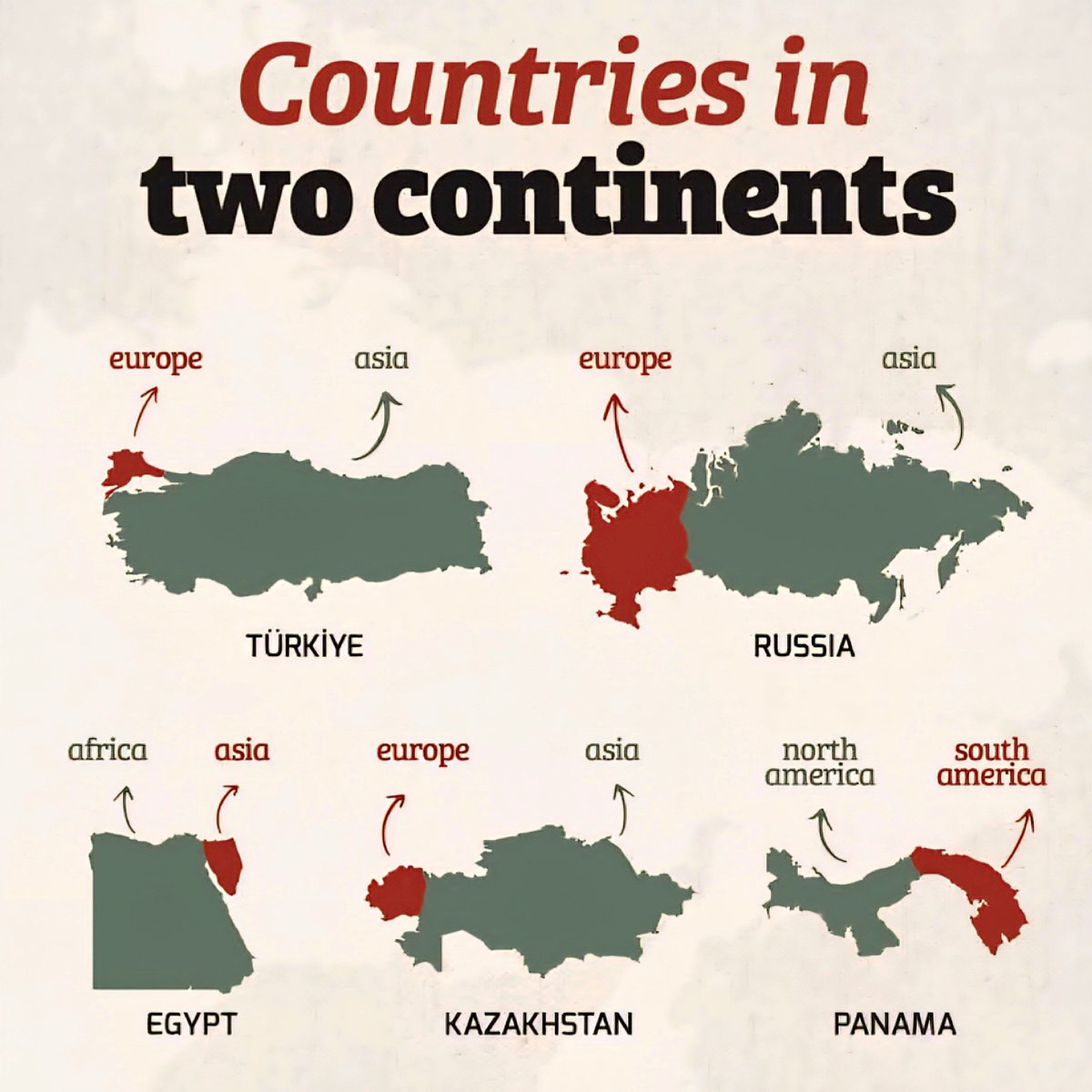
Turkey is perhaps the most iconic example of a transcontinental nation, straddling both Europe and Asia. The country’s unique position allows it to be a land of cultural crossroads, blending influences from both continents. The majority of Turkey’s landmass is situated in Anatolia (Asia), while a smaller portion, including Istanbul, lies in Southeastern Europe. Istanbul, formerly known as Byzantium and later Constantinople, remains a symbol of this geographical division and historical blending. Turkey’s strategic location has historically made it a vital hub for trade, diplomacy, and cultural exchange between civilizations.
2. Russia: A Vast Eurasian Power
Russia is the largest country in the world and also spans two continents—Europe and Asia. The Ural Mountains are considered the traditional boundary between the two. Western Russia, including cities like Moscow and Saint Petersburg, lies within Europe, while the eastern part extends into Asia, reaching as far as the Pacific Ocean. This vast territory influences Russia’s diverse cultures, languages, and climates, making it a truly Eurasian nation. Major economic and political hubs are primarily in the European part, but the Asian segment is crucial for natural resources like oil, gas, and minerals.
3. Egypt: A Crossroads of Continents
While geographically located in North Africa, Egypt also has a significant presence in the Middle East, and its Sinai Peninsula connects the continent to Asia. The Sinai Peninsula is a land bridge linking Africa and Asia, with the Suez Canal serving as an essential maritime route for global trade. Egypt’s strategic position has historically made it a nexus point for trade routes, military campaigns, and cultural exchanges between Africa, the Middle East, and the Mediterranean. Cairo, Egypt’s capital, symbolizes this cultural melting pot that reflects its continental crossroads.
4. Kazakhstan: An Asian-European Welcome
Kazakhstan is a Central Asian nation that stretches across the eastern part of Europe and most of Central Asia. The Ural River is often considered the dividing line separating the European and Asian parts of Kazakhstan. The country’s diverse terrain includes mountains, steppes, and deserts, and it possesses significant natural resources, including oil, coal, and minerals. Kazakhstan’s position makes it a key player in regional politics, especially in initiatives related to Eurasian cooperation and economic development.
5. Georgia: Between Europe and Asia
Nestled at the crossroads of Eastern Europe and Western Asia, Georgia is a small but strategically significant country. The Caucasus Mountain range runs through its northern territory, forming a natural boundary between the two continents. Tbilisi, its capital, showcases a blend of European and Asian architectural styles, reflecting its cultural diversity. Georgia plays an important role in regional diplomacy, especially with its proximity to Russia, Turkey, and the Middle East.
6. Azerbaijan: A Transcontinental Nation
Azerbaijan is situated at the crossroads of Eastern Europe and Western Asia, with the Caspian Sea to the east. The country’s western border with Armenia, Georgia, and Turkey further emphasizes its pivotal geographic location. Baku, its capital, is renowned for its modern skyline and oil industry, which has helped propel Azerbaijan onto the global energy stage. Azerbaijan’s unique position has historically made it a melting pot for different cultures, religions, and traditions.
7. Armenia: Between Continents and Cultures
Though often associated with Western Asia, Armenia also considers itself partly European. Located in the South Caucasus, it is a key cultural and historical bridge between these regions. The geographical boundary between Europe and Asia runs close to Armenia’s territory, but it often aligns with spiritual and cultural identities more than strict geographical lines. Armenia’s rich history as one of the world’s oldest civilizations continues to influence its modern identity.
8. Spain: Europe’s Atlantic Gateway and Africa’s Neighbor
While primarily a European country, Spain’s territories in North Africa—such as the Canary Islands—bring it close geographically to Africa. Though the mainland is entirely in Europe, the Canary Islands’ proximity to the African coast makes Spain a transcontinental nation when considering its territorial claims. Additionally, movements of people and trade routes across the Strait of Gibraltar have historically connected Spain with Africa, fostering cultural exchanges over centuries.
The world’s map isn’t always simple—many nations experience the thrill, challenge, and richness of belonging to two continents. Their unique positions shape their histories, economies, and cultures, giving diversity and depth to global geopolitics in 2025.
 ChatGPT
 Perplexity
 Gemini AI
 Grok AI