Select Language:
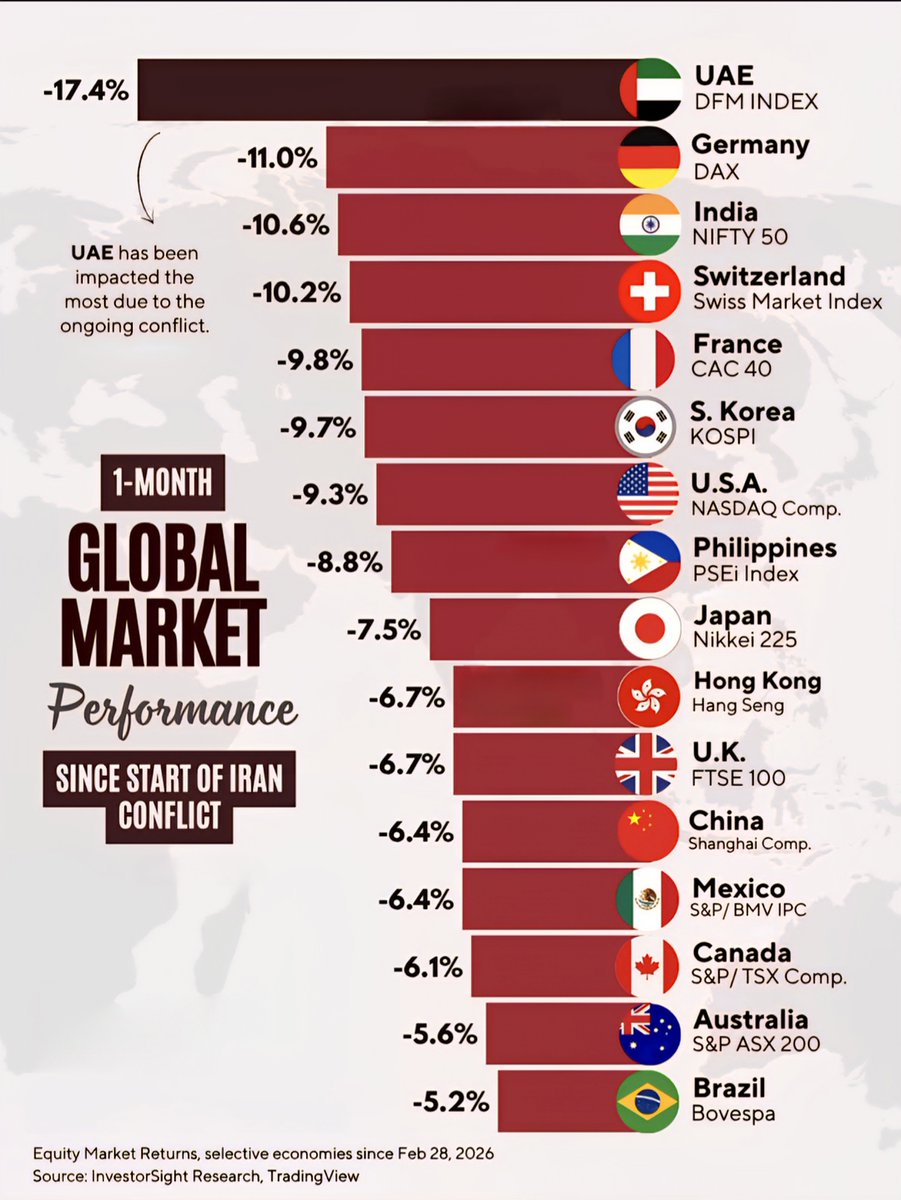
1. Dubai’s DFM Index Sees Largest Drop at -17.4%
The Dubai Financial Market (DFM) index experienced the most significant decline among major global markets, plummeting 17.4% since the outbreak of conflict in Iran. This sharp downturn reflects heightened investor concern over regional stability and economic uncertainty, impacting investor confidence across the Middle East.
2. Germany’s DAX Slips Over 11%, Reflecting European Turmoil
Germany’s DAX index declined by 11%, marking a substantial hit to Europe’s largest economy. The conflict in Iran has triggered volatility across European markets, with fears of disruption to international trade routes and energy supplies weighing heavily on investor sentiment throughout the continent.
3. India’s NIFTY 50 Fell Just Over 10%
India’s NIFTY 50 index has declined by approximately 10.6%, signaling a cautious approach by investors amid geopolitical tensions. The region’s emerging markets have felt the ripple effects, balancing economic growth prospects with global instability concerns.
4. Swiss Market Index and France’s CAC 40 Experience Nearly 10% Decrease
Switzerland’s Swiss Market Index dropped by 10.2%, while France’s CAC 40 declined by 9.8%. Both markets illustrate how European investor confidence is wavering due to ongoing conflicts, with uncertainties about regional security and energy supply stability.
5. South Korea and the U.S. See Nearly 10% Decline
South Korea’s KOSPI fell 9.7%, and the NASDAQ Composite in the U.S. dropped by 9.3%. These declines highlight the widespread global impact, with Asian manufacturing hubs and American tech giants feeling the squeeze of geopolitical tensions.
6. Southeast Asian and Asian Markets Show Varied Impact
The Philippine PSEi index declined 8.8%, Japan’s Nikkei 225 fell 7.5%, and Hong Kong’s Hang Seng dropped 6.7%. China’s Shanghai Composite and Mexico’s S&P/BMV IPC each saw reductions of around 6.4%, indicating a broad regional impact driven by geopolitical uncertainty and concerns about supply chains.
7. European and North American Indices Slump Moderately
The United Kingdom’s FTSE 100 recorded a 6.7% decrease, as did Hong Kong’s Hang Seng. Canada’s S&P/TSX Composite fell by 6.1%, and Australia’s S&P/ASX 200 slipped 5.6%. All exhibit moderate declines, underscoring cautious investor sentiment on the global stage.
8. Brazil’s Bovespa Faces the Smallest Decline at 5.2%
Brazil’s Bovespa index was relatively less affected, dropping only 5.2%. The Latin American market remains somewhat resilient amid broader geopolitical tensions, though still impacted by prevailing global uncertainties.
9. Market Volatility Highlights Global Economic Sensitivity
Since February 28, 2026, global markets have shown significant volatility, with the largest declines concentrated within the first month of the Iran conflict. The Dow Jones, FTSE, Nikkei, and other capital markets continue adjusting to the geopolitical landscape, reflecting investor uncertainty.
10. Why These Fluctuations Matter
The swift and broad declines across these major indices demonstrate how geopolitical crises can unsettle global markets and economic stability. Investors are closely monitoring diplomatic developments, energy prices, and regional security, which remain critical in shaping future market directions.
Source: TradingView March 28, 2026
 ChatGPT
 Perplexity
 Gemini AI
 Grok AI