
Select Language:
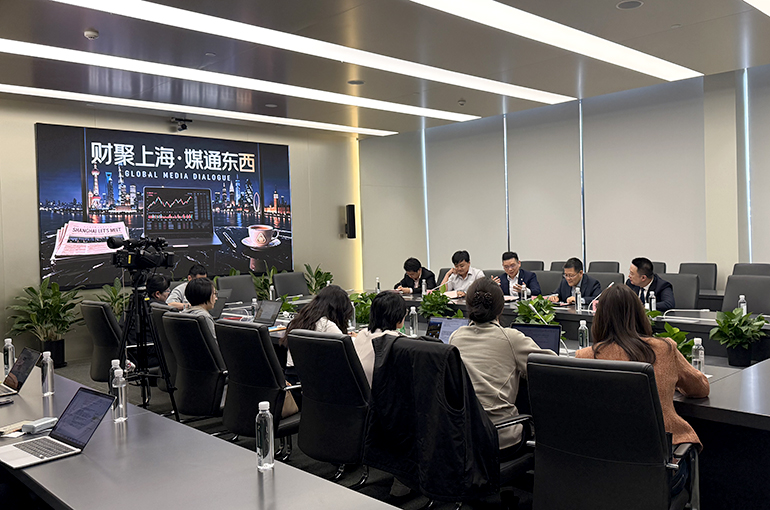
A comprehensive discussion on China’s consumer market wrapped up today at the Shanghai Urban Planning Exhibition Center. During the 2026 Global Media Dialogue focused on Chinese and international media, three top experts from industry and academia shared their latest insights on consumption trends with journalists from around the world. The event was centered around the theme “China’s Consumption Through a Global Lens: Divergence, Consensus, and Innovation.”
Qin Shuo, founder of Chin@Moments, challenged the prevailing narrative of “weak consumption” during his speech. While he acknowledged that K-shaped polarization is a genuine phenomenon, he argued it only tells part of the story. Based on extensive firsthand research, Qin showed that consumption of physical goods has not declined; in fact, it remains highly dynamic. He noted that Chinese consumption is shifting from a phase of “imitation and following” to one with a distinct “independent rhythm.” E-commerce has fundamentally transformed the landscape, allowing high-quality, cost-effective products to reach lower-tier markets at the same time. County-level markets are no longer trailing behind first-tier cities in a straight-line pattern but are being reached simultaneously, opening new avenues for consumption. Qin’s core message was clear: the Chinese market isn’t shrinking but is evolving rationally toward “higher quality, affordability, and good value.”
Liu Gongrun, vice president of the CEIBS Lujiazui International Financial Research Institute, discussed the fundamental change in consumer behavior—from “Can I afford it?” to “Is it worth it?” and “How can I buy better?” He emphasized that the main driver of innovation in Chinese consumption isn’t just online discounts or live-stream shopping, but rather the holistic overhaul of the “demand-supply chain-scenarios.” Regarding the rise of “Guochao” (China-chic) domestic brands, Liu argued that this trend does not signal a downgrade in consumption but represents a balance between “cost performance” and “emotional value.” He pointed out that Shanghai continues to attract global consumer attention partly because of its ability to showcase both an “innovative China” and a “culturally rich China” simultaneously.
Wu Mianqing, CEO of Baiguan Technology, offered a data-driven perspective on evolving consumer mindsets within China. He highlighted emerging technology-driven consumption patterns, from AI services to robotics, and analyzed the structural factors contributing to the market’s warming trend since late last year. Taking into account the significant wealth impacts from capital markets on household spending, Wu provided forward-looking, data-supported forecasts for Chinese consumption over the next five to ten years.
During the follow-up discussion, journalists from both China and abroad engaged with the panelists on topics such as the factors driving inbound consumption growth in Shanghai, the momentum behind innovative consumption, and how to effectively communicate China’s consumption story globally. Participants observed that as international viewpoints on Chinese consumption become increasingly polarized, conversations rooted in on-the-ground research, solid data, and rigorous academic analysis are essential for understanding the market’s complex realities beyond overly simplistic narratives.
 ChatGPT
 Perplexity
 Gemini AI
 Grok AI