
Select Language:
Robots and embodied intelligence are revolutionizing factories across China by freeing workers from filthy, hazardous, and monotonous tasks, often referred to as the 3Ds. Industry insiders observe that these automation advances are transforming the manufacturing landscape.
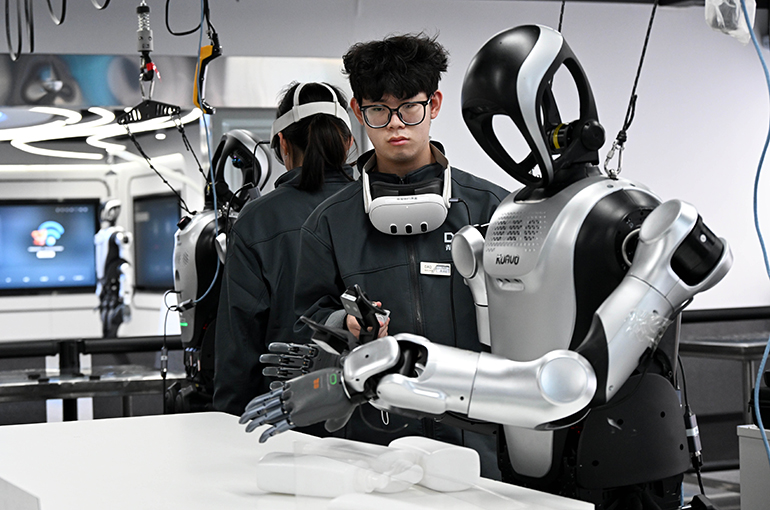
The tasks assigned to robots tend to be physically demanding and labor-intensive for humans. For example, during an inspection at a tablet manufacturing plant in Nanchang, the Genie G2 robots from a Chinese robotics startup demonstrated remarkable precision on the assembly line, showcasing how automation can liberate human workers. This operation was streamed live for eight hours, marking the first large-scale production at a facility powered entirely by embodied intelligence in static electronics manufacturing.
While humans possess greater intelligence, they are also more prone to mistakes. Deploying robots for taxing, repetitive activities enhances production stability and uniformity. Robots don’t experience emotional fluctuations, which helps maintain consistent output. Currently, several Genie G2 robots are operating reliably on production lines, and plans are underway to increase their fleet to 100 units by the third quarter, with applications expanding into industries like automotive, semiconductors, and energy.
The adoption of intelligent devices isn’t confined to electronics manufacturing. Want Group’s factory in Hunan employs robotic dogs to perform daily inspections. These robots can operate around the clock, taking over high-risk and tedious patrols, thus freeing human workers and enhancing safety and efficiency. Likewise, a French waste management company’s Chinese branch has developed an intelligent inspection system where drones equipped with thermal imaging perform real-time checks of industrial boilers and chimneys, reducing inspection times from days to hours. The integration of sensor-rich robotic dogs has improved site safety and operational productivity.
The progression of robotics reflects a broader evolution in human-machine relationships. Industry leaders explain that robotics has moved beyond the initial phases of replacing humans and collaborating closely, toward a phase of co-creation. Robots are transitioning from simple tools to partners capable of understanding work environments and generating shared value with human workers. As robotic capabilities advance, frontline workers won’t be replaced but will instead evolve into skilled operators and managers of these intelligent systems.
 ChatGPT
 Perplexity
 Gemini AI
 Grok AI