Select Language:
Recently, Chinese hydrogen companies have secured several international deals to provide hydrogen energy solutions and equipment as they expand into Southeast Asia, Africa, the Middle East, and Central Asia, supporting worldwide efforts to reduce carbon emissions and enhance energy security.
A firm specializing in environmental solutions in Vietnam has signed an agreement to receive magnesium-based solid-state hydrogen storage tanks and hydrogen refueling station equipment. The hydrogen will be produced at a plant in Kuching, Malaysia, operated jointly by a Chinese company and Malaysia’s SEDC Energy, with transport facilitated through advanced magnesium-based solid-state hydrogen storage technology.
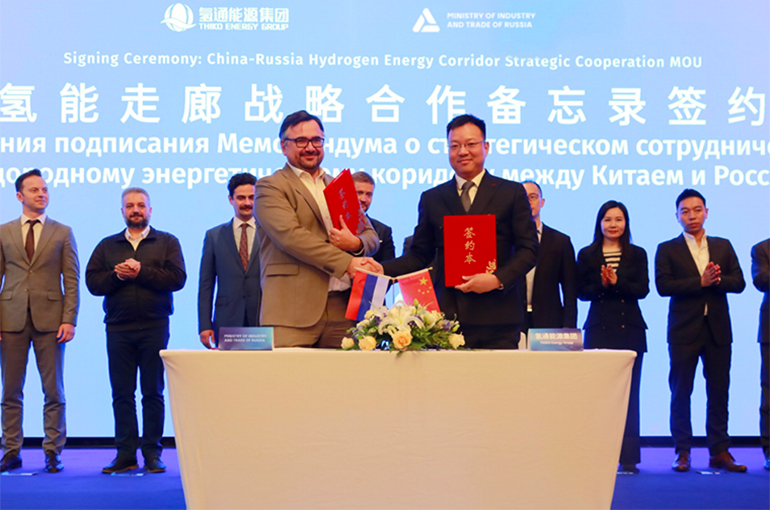
Meanwhile, a Chinese energy group is collaborating with Russia’s Ministry of Industry and Trade to establish a cross-border hydrogen corridor between the two countries. This initiative aims to deploy hydrogen-fueled heavy-duty trucks along key transport routes connecting China and Russia, as outlined in a recent memorandum of understanding.
In Africa, a Chinese hydrogen equipment manufacturer tied to a local affiliate has signed a $6.2 million deal to supply a 20-megawatt hydrogen production system to Morocco. Additionally, Chinese companies have shipped electrolysis systems to Oman for a national green ammonia project led by a regional industrial group.
Experts believe that exports of electrolyzers are expected to surge in the current year, particularly to regions such as the Middle East and Europe. Large-scale green hydrogen projects in the Middle East continue to drive demand, with project developers focusing on overall operational costs rather than just machinery expenses. This shift favors the competitive advantages of Chinese manufacturers.
Projections indicate that the Middle East and North Africa aim to reach a green hydrogen production capacity of 7.8 million tons by 2030. Achieving this target will require approximately 78 gigawatts of electrolyzers, yet as of early last year, only about 3 to 4 gigawatts have been installed, signaling a significant gap to fill.
Energy security concerns are also fueling demand for green hydrogen. Ongoing conflicts in the Middle East have caused oil and gas prices to rise, impacting downstream products like urea and fertilizers. Since liquid ammonia, a key ingredient in urea production, is usually derived from natural gas, shifting to hydrogen produced via electrolysis could decrease dependence on gas. This transition has led to increased inquiries from European clients interested in Chinese electrolyzer technology.
In early 2023, China’s National Energy Administration announced plans to bolster support for the hydrogen industry during the 15th Five-Year Plan, aiming to develop related sectors through 2030. One of the targets is to reduce the average cost of hydrogen to below $3.60 per kilogram by that time.
 ChatGPT
 Perplexity
 Gemini AI
 Grok AI