Select Language:
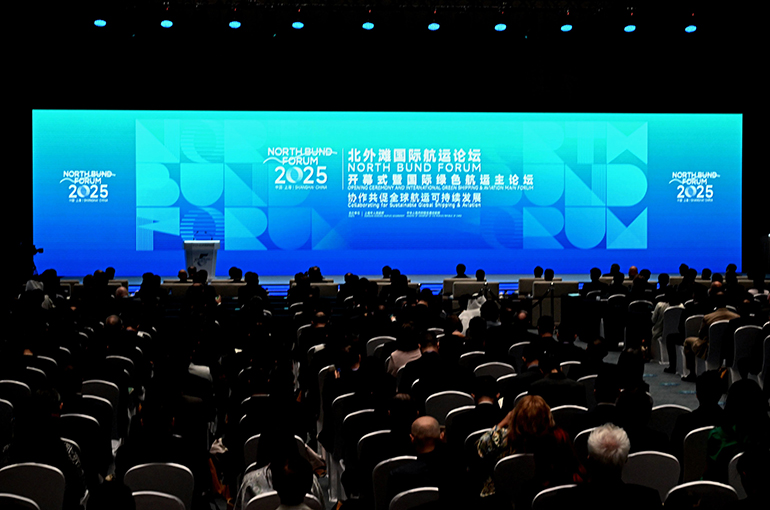
Over 50 accomplishments in the shipping industry will be showcased at this year’s North Bund Forum, setting a new record for the event. During the opening ceremony, 30 domestic achievements and several international port and shipping cooperation projects aimed at advancing green shipping corridors were announced, with the forum continuing in Shanghai through tomorrow.
In China, Pudong International Airport has successfully integrated multimodal transportation, including air-to-air, air-to-land, air-to-sea, and air-to-rail options, according to Tang Yingzhao, executive vice president of Shanghai Airport Group Logistics Development. Since last year, China Eastern Airlines has introduced 23 medium- and long-haul international routes connecting 21 Belt and Road Initiative countries, adding cargo capacity equivalent to the holds of 800 passenger aircraft, boosting shipping capacity between these nations and China, said Gao Fei, the airline’s general manager.
The Chinese shipping industry has made significant strides in its green transformation. Wan Min, chairman of China Cosco Shipping Group, highlighted efforts to promote full-channel transportation, incorporating road-to-sea and rail-sea intermodal transport to reduce freight carbon emissions. China is also rapidly developing environmentally friendly ships, with Cosco Shipping’s orders for clean fuel vessels representing over a third of the total. Many ports have established a green energy infrastructure, including widespread liquefied natural gas and methanol refueling facilities. Notably, the Port of Dalian in Liaoning province completed the world’s first green ammonia vessel refueling.
On the international front, the Port of Shanghai has established eco-friendly roll-on-roll-off shipping routes with Barcelona in Spain and Antwerp-Bruges in Belgium. The Port of Qingdao, along with ports in Hamburg and Wilhelmshaven in Germany and various shipping companies, jointly launched a green shipping corridor to enhance port and shipping cooperation between China and Germany. Additionally, the Shanghai Municipal Transportation Commission collaborated with the Port of Melbourne and various industry players to promote a green shipping corridor connecting Shanghai and Melbourne, focusing on environmentally sustainable practices.
Global collaborations include Cosco Shipping Lines, Maersk from Denmark, and CMA CGM from France deploying low-carbon vessels along the Los Angeles/Long Beach-Shanghai route, marking the initial milestone for this tiered corridor project. Singapore is working with Chinese provinces Shandong and Tianjin to establish green and digital shipping corridors, emphasizing cooperation in green fuels and digital innovations.
Turkey’s role as a key transportation hub along the China-Europe freight train route involves completing 1,000 cargo train trips along the middle corridor and developing digital and green infrastructure, according to Deputy Minister Enver İskurt. Globally, approximately 200 zero-emission fuel vessels are currently operating, with expectations to surpass 1,000 vessels by 2030, backed by over $150 billion in industry investments, said Joseph Edward Kramek, president of the World Shipping Council.
 ChatGPT
 Perplexity
 Gemini AI
 Grok AI