Select Language:
- Trump declares a naval blockade of the Strait of Hormuz.
- A Democratic senator criticizes the U.S. president’s current approach.
- Since initiating conflict with Iran, Trump’s approval ratings have declined.
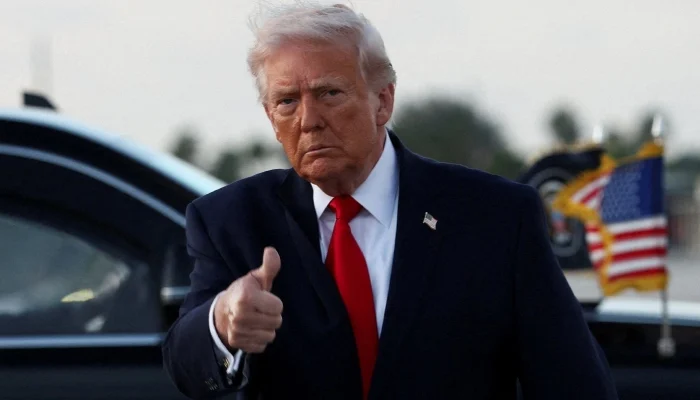
On Sunday, President Donald Trump indicated that fuel prices, including oil and gasoline, are likely to stay high until after the November midterm elections. This acknowledgment is uncommon and suggests the potential political consequences of his recent decision to strike Iran six weeks prior.
When asked during an interview on Fox News’s “Sunday Morning Futures with Maria Bartiromo” if fuel prices would decrease by the fall, Trump replied, “It could stay the same, or maybe even get a little higher, but mostly it should be about the same.”
Data from GasBuddy shows that regular gasoline at U.S. service stations has topped $4 per gallon for much of April. Trump’s comments follow weeks of insisting that the price surge is temporary, though his top advisors are aware of the economic impacts of the ongoing conflict.
Earlier Sunday, Trump announced on social media that the U.S. Navy would impose a blockade of the Strait of Hormuz, targeting any ships paying tolls to Iran. This move comes after prolonged talks between the U.S. and Iran in Pakistan failed to produce a peace agreement.
“No one paying an illegal toll will be allowed safe passage on the high seas,” he posted on Truth Social.
Any U.S. blockade complicates efforts to resolve the crisis, which is currently under a fragile two-week ceasefire. This tactical shift responds to Iran’s own restrictions on critical shipping lanes, which have caused global oil prices to jump roughly 50%.
Unpopular Conflict and Its Impact on Trump’s Support
The conflict with Iran, initiated on February 28 through coordinated U.S. and Israeli airstrikes, has escalated as Iran and its allies launched attacks on neighboring nations, with Israel targeting Hezbollah in Lebanon.
The war has shaken global markets and resulted in thousands of civilian casualties, primarily in Iran and Lebanon.
Back home, Trump’s approval ratings have taken a hit, with many Americans unhappy about rising fuel costs and the ongoing hostilities. This decline has fueled fears among Republicans that the party might lose control of Congress in the upcoming midterms. A Democratic majority could investigate the Trump administration and prevent much of his legislative agenda from advancing.
Senator Mark Warner from Virginia, the top Democrat on the Senate Intelligence Committee, expressed skepticism about Trump’s proposed blockade strategy.
“I don’t see how blockading the strait will pressure Iran to open it,” Warner said on CNN’s “State of the Union.”
On CBS’s “Face the Nation,” Warner added, “Iran could still mine the strait or deploy bombs against ships, so how exactly will this lower gas prices?”
While Trump has claimed the conflict would end soon, Senator Ron Johnson of Wisconsin told ABC’s “This Week” that achieving U.S. objectives could be a lengthy process.
“It’s going to be a long-term effort,” Johnson said. “I never expected this to be a quick or easy fix.”
 ChatGPT
 Perplexity
 Gemini AI
 Grok AI