Select Language:
- Claims Christians are being murdered in record numbers in Nigeria.
- Promises US intervention to end the violence.
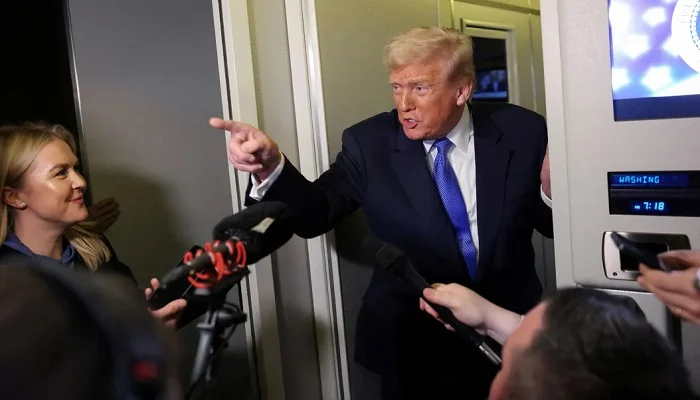
On Sunday, US President Donald Trump announced that the US military may send troops to Nigeria or conduct air strikes to stop what he described as the mass killing of Christians in the West African country.
When asked about deploying ground troops or launching airstrikes in Nigeria, Trump told reporters on Air Force One, “It could be. I mean, other options. I foresee many possibilities.”
“They’re killing record numbers of Christians in Nigeria… They’re targeting Christians in huge quantities. We will not let this continue.”
Trump made this statement Sunday evening while returning to Washington after spending the weekend at his Florida vacation home.
The previous day, he threatened military action if Nigeria, Africa’s most populous nation, failed to suppress the violence against Christians.
This threat came shortly after his administration re-listed Nigeria as a “Country of Particular Concern” for violating religious freedoms. Countries on this list include China, Myanmar, North Korea, Russia, and Pakistan.
No Tomahawk Missiles for Ukraine
Regarding Ukraine, Trump stated he is not seriously considering supplying long-range Tomahawk missiles. When asked during a flight on Air Force One if weapon provision was on the table, Trump responded, “No, not really.”
Previously, on October 12, Trump mentioned the possibility of sending long-range Tomahawk missiles to Ukraine if Russian President Vladimir Putin does not end the conflict.
He added that he discussed Ukraine’s request for weapons, including Tomahawks, with President Zelensky during the flight to Israel.
Tomahawk missiles can travel up to 2,500 km (about 1,550 miles), sufficient to reach deep into Russia, including Moscow.
The Kremlin has warned against supplying such missiles to Ukraine, with Trump warning that doing so would constitute a “new act of aggression.”
Trump Skips Supreme Court Tariffs Argument
He also said he would not attend the Supreme Court’s upcoming hearing on the legality of his global tariffs. The court will hear arguments on Wednesday concerning whether Trump exceeded his authority in imposing most of his tariffs under the 1977 International Emergency Economic Powers Act.
Trump explained that although he wanted to be present, he preferred not to distract from the importance of the case. “It’s about the future of our country, not about me,” he stated.
The case is a significant test of Trump’s assertions of executive power, challenging his use of tariffs to influence trade and raise revenue, which had helped push stock markets to record highs. Various businesses and 12 states had challenged his authority.
Trump defended his tariffs, citing longstanding high duties imposed by other countries and stating they enhanced US national security. He argued, “Without tariffs, we risk losing our security and sovereignty, as other nations have exploited us for years. Tariffs have strengthened our position.”
 ChatGPT
 Perplexity
 Gemini AI
 Grok AI