Select Language:
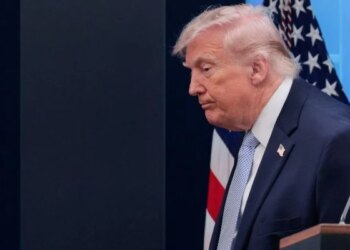
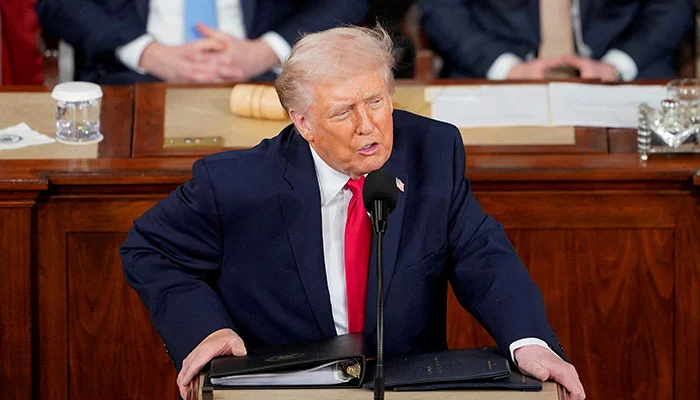
WASHINGTON — President Donald Trump delivered his State of the Union speech to a joint Congress on Wednesday, a key moment as the White House aims to strengthen support among Republicans ahead of the midterm elections in November.
Amid rising tensions with Iran and widespread voter concern over high living costs, Trump addressed several pressing issues.
Economy
Trump’s speech focused heavily on economic topics, showing that his advisors, who have been pushing for more emphasis on the economy, have succeeded for now. He covered issues like housing, healthcare, utility bills, crime, and retirement, yet he stopped short of acknowledging that many Americans still face financial hardships, including soaring food and housing prices.
He claimed that his healthcare plans to lower drug costs and provide direct payments to individuals would save money. He also insisted that the tariffs struck down by the Supreme Court are generating revenue and are being reinstated legally.
Some Republican strategists have warned that without a stronger stance on inflation, the party risks losing control of Congress in the upcoming elections.
Trump asserts that inflation, mortgage rates, and gas prices are decreasing, while the stock market, oil output, and foreign investments are thriving, alongside growth in construction and manufacturing jobs.
However, government data shows inflation increased last year, factory jobs declined, and overall job creation was sluggish. Although prices for some items like eggs have dropped since Trump returned to office, overall food and other prices have risen.
Polls suggest voters are worried about the economy and dissatisfied with Trump’s management, with 56% disapproving of his handling of economic issues, according to Reuters/Ipsos.
Politics
Even with a more disciplined tone, Trump used his speech for theatrical flair—handing out medals, introducing surprise guests, and clashing with Democrats.
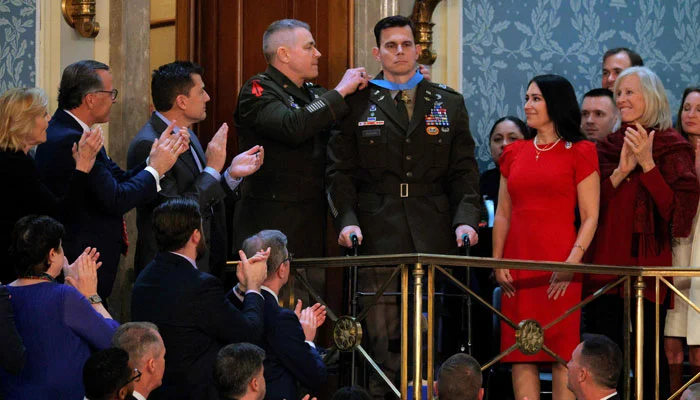
Trump awarded Army Chief Warrant Officer Eric Slover, injured during a mission against Venezuela’s former leader Nicolas Maduro, a Medal of Honor. The speech itself has become a form of political spectacle, blending policy with showmanship—a tradition Trump continues through patriotic displays, such as a military parade on his 79th birthday and partisan speeches to service members.
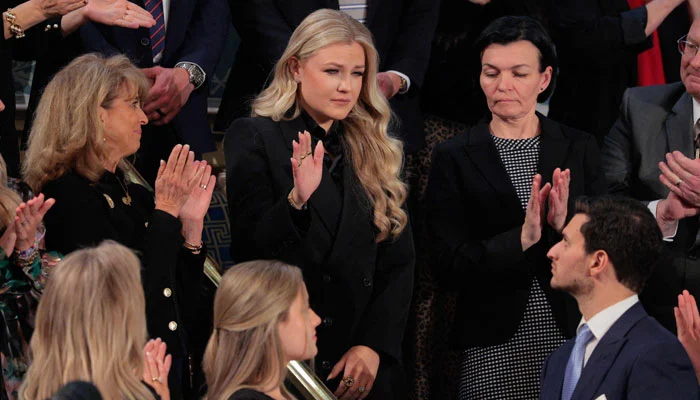
Trump highlighted members of the U.S. men’s ice hockey team, fresh off their Olympic gold, as proof of America’s renewed success under his leadership. He also drew contrasts by criticizing immigration and education policies—using stories like that of seven-year-old Dalilah Coleman, injured in a crash, as a cautionary tale, while also criticizing transgender policies at schools.
Iran and Foreign Policy
A major question beforehand was whether Trump would clearly detail a plan to confront Iran militarily. He waited over an hour in his speech to mention Iran, and when he did, he mostly reiterated familiar talking points about preventing Tehran from acquiring nuclear weapons, blaming Iran for regional terror activities, and citing recent protests as evidence of Iranian leadership’s brutality.
He did not specify urgent military moves or clarify his current stance on action, nor did he delve into issues regarding Venezuela, Russia, Ukraine, or Greenland—topics he had previously shown interest in.
While discussing ongoing diplomatic efforts, such as negotiations with Ukraine and Iran, and efforts in Venezuela, Trump’s foreign policy focus appeared less front and center during his address.
Immigration
Trump aimed to reshape the immigration narrative, emphasizing crime linked to immigrants and criticizing Democrats for perceived negligence on border security. He did not mention agencies like the Border Patrol or ICE directly but highlighted violent crimes by undocumented immigrants and accused Democrats of failing to protect Americans.
This approach harked back to his campaign style, focusing on fears about immigration while avoiding detailed discussions of recent enforcement tactics.
Shift in Priorities
Compared to his last joint session speech, Trump’s current address reflected shifted priorities:
- Dropped extensive references to China, Greenland, and plans to regain control of the Panama Canal.
- Reduced praise for Elon Musk and government efficiency efforts.
- Introduced new initiatives on voting laws and election reforms for the upcoming elections.
Partisan Attacks
Trump argued that Republicans deserve extra years in power due to their handling of key issues. He sharply criticized Democrats, implying they are anti-American and dangerous to national well-being, calling their actions “destroying this country” but asserting Republicans have halted this decline just in time.
Many Democrats in the chamber reacted viscerally—some shouting, others remaining seated in irritation—highlighting the increasing polarization of the speech.
 ChatGPT
 Perplexity
 Gemini AI
 Grok AI