Select Language:
A powerful earthquake struck northern Japan, resulting in injuries to at least six individuals reported by Tuesday. The tremor also generated tsunami waves reaching up to 31 inches (80 centimeters). Fortunately, there was no significant structural damage observed.
The Japan Meteorological Agency (JMA) issued a warning about a heightened chance of a megaquake—an earthquake with a magnitude of 8.0 or higher—following Monday’s 7.7 magnitude quake offshore in Iwate Prefecture. The quake was strong enough to shake large buildings in Tokyo, hundreds of miles away from the epicenter.
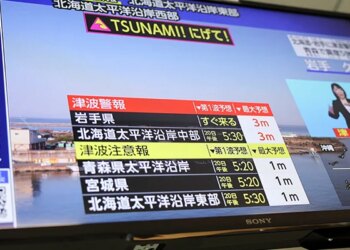
By 8 a.m. local time (11 p.m. GMT Monday), the Fire and Disaster Management Agency confirmed six injuries, with two categorized as severe. No fires or critical facility damages were reported. A tsunami warning for waves up to three meters (10 feet) was issued but was lifted after an 80-centimeter wave struck the port of Kuji in Iwate, along with a series of minor waves in the region.
The JMA indicated that the likelihood of a major earthquake occurring soon has increased compared to normal times. Local authorities advised non-mandatory evacuations for over 182,000 residents in affected areas.
Japan, situated atop four significant tectonic plates along the Pacific “Ring of Fire,” remains one of the world’s most seismically active nations. The country, home to approximately 125 million people, experiences around 1,500 earthquakes annually, accounting for nearly 20% of the world’s seismic activity. Most quakes are minor, but their impacts depend heavily on location and depth beneath the Earth’s surface.
The memory of the catastrophic 9.0 magnitude undersea earthquake in 2011 still lingers. That disaster triggered a tsunami that claimed or left missing about 18,500 people and caused a severe meltdown at the Fukushima nuclear plant.
 ChatGPT
 Perplexity
 Gemini AI
 Grok AI