Select Language:
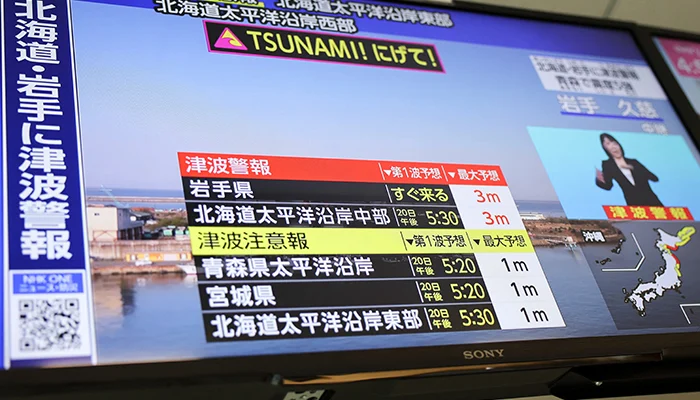
An earthquake with a magnitude of 7.5 struck off Japan’s northeastern coast on Monday, prompting authorities to advise residents to avoid coastal zones, as tsunami waves of up to 3 meters (around 10 feet) are anticipated. The epicenter was located in the Pacific Ocean, about 10 kilometers deep, according to the Japan Meteorological Agency. The most significant waves are predicted to impact Iwate, Aomori, and Hokkaido prefectures.
Prime Minister Sanae Takaichi addressed the public, stating that a state of emergency has been declared with an emergency task force in place, urging those in vulnerable areas to evacuate immediately. Japanese broadcaster NHK showed ships leaving Hachinohe port in Hokkaido to escape the incoming waves, with emergency alerts warning, “Tsunami! Evacuate!”
Train services in Aomori, at the northern tip of Japan’s Honshu island, have been halted following the quake, as reported by Kyodo News. The earthquake registered as a level “upper 5” on Japan’s seismic intensity scale, indicating strong shaking that can hinder mobility and cause unreinforced concrete walls to collapse.
Japan is notorious for its seismic activity, experiencing quakes approximately every five minutes due to its location within the Pacific “Ring of Fire,” which encircles the Pacific Basin with active volcanoes and oceanic trenches. The country accounts for roughly 20% of all earthquakes worldwide measuring magnitude 6.0 or greater.
While no nuclear power plants are currently operational in Hokkaido and Tohoku, some facilities have been shut down for safety reasons. Hokkaido Electric Power and Tohoku Electric Power are assessing the earthquake and tsunami’s impact on their nuclear installations, including the Onagawa plant operated by Tohoku Electric.
 ChatGPT
 Perplexity
 Gemini AI
 Grok AI