Select Language:
- In-orbit testing expected to last up to two months, according to Suparco.
- HS-1 will become fully operational after testing concludes.
- Third satellite launched this year following EO-1 and KS-1.
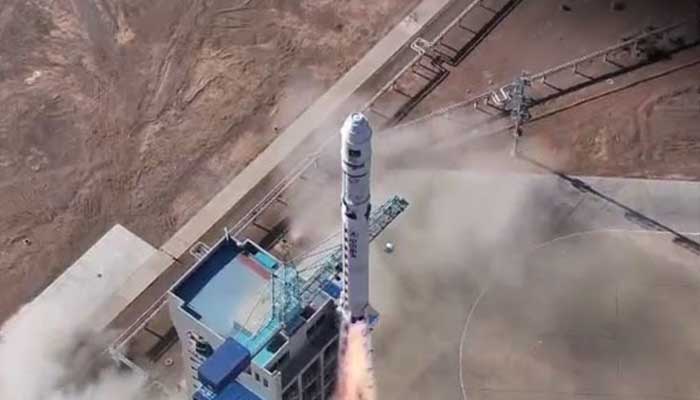
KARACHI: Pakistan has successfully launched its first Hyperspectral Satellite, HS-1, from China’s Jiuquan Satellite Launch Centre (JSLC). The launch was broadcast live from the Space and Upper Atmosphere Research Commission’s (Suparco) Karachi office, the space agency reported.
Pakistani scientists and engineers completed all preparations for the launch.
A Suparco representative confirmed that the satellite has successfully entered orbit. They stated that the in-orbit testing could take as long as two months; after this period, HS-1 will be fully operational, the official added.
The agency’s spokesperson explained that HS-1 will conduct detailed analyses of land, vegetation, water bodies, and urban areas. Equipped with advanced imaging technology, the satellite can capture high-resolution images across hundreds of spectral bands, promising to revolutionize agriculture planning and environmental assessments.
The satellite will aid in monitoring deforestation, pollution levels, glacier melting, and will help identify geological risks associated with China-Pakistan Economic Corridor (CPEC) projects, the spokesperson said.
Chairman Muhammad Yousuf Khan congratulated the nation on this achievement, emphasizing that the project was made possible with government support.
This launch signifies a significant step toward Pakistan achieving greater independence in space technology. HS-1 positions the country among emerging space leaders committed to sustainable development, the spokesperson highlighted.
The mission aligns with Pakistan’s National Space Policy and Vision 2047.
The Foreign Office issued a statement affirming that launching HS-1 from China’s JSLC represents a major milestone and underscores the long-standing collaboration between Pakistan and China in space exploration for peaceful purposes.
The statement noted that HS-1 features cutting-edge hyperspectral imaging capabilities that will support development initiatives, including CPEC, by identifying geo-hazard risks and promoting sustainable infrastructure development.
Deputy Prime Minister and Foreign Minister Ishaq Dar praised the Pakistan and China teams responsible for HS-1, recognizing their dedication, expertise, and cooperation, according to the Ministry of Foreign Affairs.
Pakistan has now launched three satellites this year, with EO-1 and KS-1 also successfully entering orbit and becoming operational.
The space program is entering a new phase of technological advancement and practical applications.
The agency described this mission as a major advancement for Pakistan’s space endeavors, opening new opportunities in agriculture, disaster response, urban planning, and environmental protection.
In agriculture, HS-1’s hyperspectral data will enable precision farming by providing detailed insights into crop conditions, soil moisture, and irrigation. This is expected to improve yield estimates by 15–20%, strengthening food security.
For urban development, HS-1 will help monitor environmental changes, map infrastructure, and analyze growth patterns. Its ability to identify spectral signatures of structures will support sustainable urban planning and effective resource management.
In environmental monitoring and disaster response, HS-1 will enhance early warning systems for floods, landslides, and geo-disasters—particularly along the Karakoram Highway and in northern regions. The data will also facilitate post-disaster assessments and improve water resource modeling.
HS-1 will work alongside Pakistan’s existing satellites—PRSS-1 (launched in July 2018), EO-1 (January 2025), and KS-1 (July 2025)—to strengthen the country’s space infrastructure and data capabilities.
This initiative supports Pakistan’s National Space Policy and its Vision 2047, aiming to position the nation among leading space-faring countries and foster sustainable growth through science and innovation.
 ChatGPT
 Perplexity
 Gemini AI
 Grok AI