Select Language:
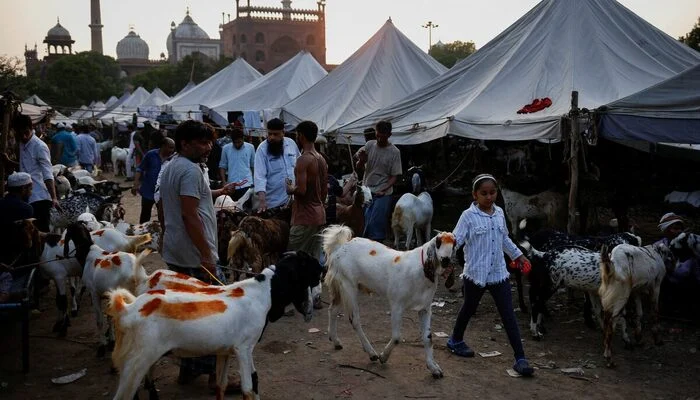
A young girl walks alongside a goat after purchasing it at a livestock market in the old quarters of Delhi, India, on July 6, 2022, ahead of Eid ul Adha. — Reuters
Authorities in India have implemented new restrictions in advance of Eid ul Adha, including a ban on slaughtering cows, calves, and camels. This move highlights escalating concerns over religious freedoms and restrictions on Muslim religious practices in various states.
As Muslims across India prepare to observe Eid ul Adha on Wednesday, Uttar Pradesh’s Chief Minister Yogi Adityanath instructed officials to enforce specific religious observance rules, such as banning animal sacrifices in public areas and prohibiting road closures for Eid prayers, according to local media reports.
During a high-level law and order meeting held via video conference, Adityanath directed district officials to allow sacrifices only at designated sites and emphasized that no new traditions should be introduced during the festival. He also mandated that Eid prayers be conducted only at traditional locations and explicitly stated no permissions should be granted for prayers on roads under any circumstances.
The Uttar Pradesh government further ordered a strict oversight of slaughter activities, including maintaining bans on open meat sales and cracking down on illegal slaughterhouses. Officials were also instructed to conduct patrols and marches around religious sites throughout the festival.
Meanwhile, in Delhi, Minister Kapil Mishra issued a warning of strict enforcement against illegal animal transport, unauthorized slaughter, and acts of cruelty prior to Eid ul Adha. He instructed authorities to permit animal sacrifices only at authorized, designated locations to ensure hygiene and legal compliance.
Worldwide, Muslims observe Eid ul Adha by sacrificing goats, cows, camels, and sheep annually, aligning with the Hajj pilgrimage in Saudi Arabia. The festival, known as the “Feast of Sacrifice,” honors the Quranic story of Prophet Ibrahim (AS), who was willing to sacrifice his son in obedience to Allah. This divine test was halted at the last moment when a ram was provided as a substitute.
The celebration also features prayers, family gatherings, and acts of charity, including the ritual slaughter of livestock. The meat from these sacrifices is shared among relatives, friends, and those in need.
 ChatGPT
 Perplexity
 Gemini AI
 Grok AI