
Select Language:
A novel approach to tackling America’s alarming school shooting crisis involves deploying an unarmed drone to confront the shooter, resembling a giant, buzzing insect. This idea comes from Campus Guardian Angel, a company currently running pilot programs with this technology in Georgia and Florida, with increasing interest in Texas. These drones have yet to undergo real-world combat testing.
This strategy seems to align with a segment of American thinking that believes the solution to ongoing school shootings—part of the wider gun violence problem—does not lie in stricter gun laws but rather in arming staff members, such as teachers, with weapons.
The company envisions this process functioning as follows: when a shooter enters a school, a teacher immediately triggers an alarm on their phone to alert law enforcement. While officers respond, a drone from a pre-set position inside the school is activated to serve as an initial line of defense.
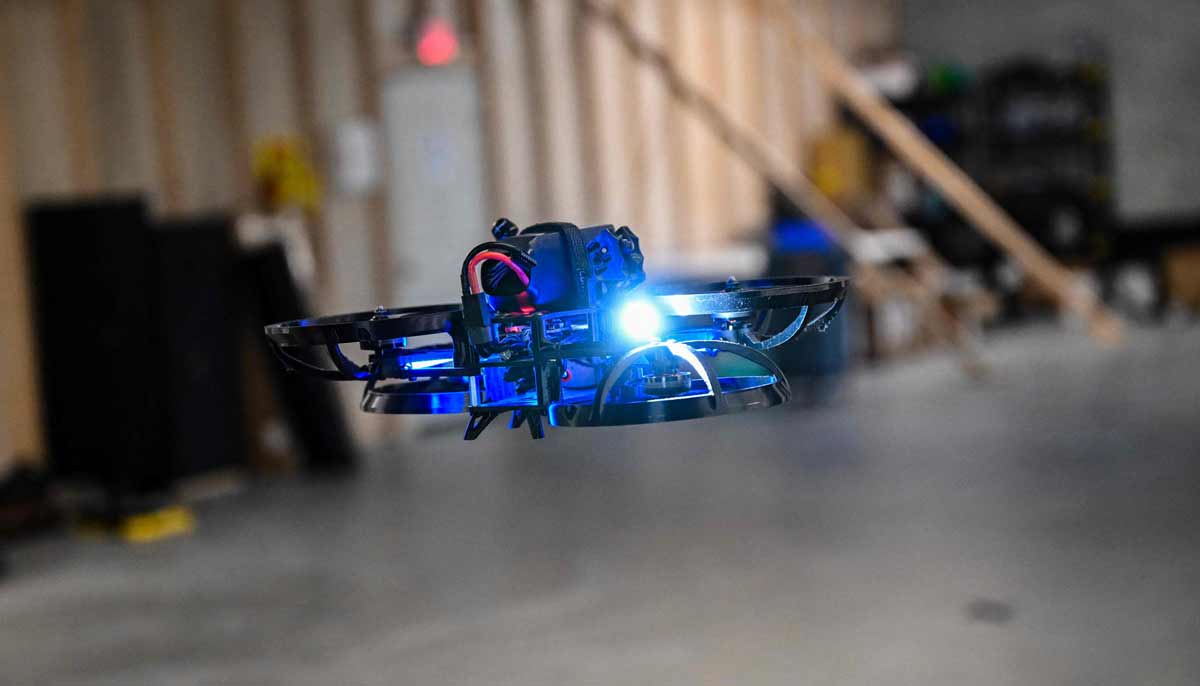
These small, roughly square, black drones weigh about two pounds and are remotely operated by personnel in Austin, Texas. They are capable of navigating within the school environment using pre-programmed 3D maps created beforehand. The drones do not fire bullets or projectiles but are designed to disable the attacker by flying into them or spraying pepper gel.
Khristof Oborski, the tactical operations director at Campus Guardian Angel, explained that the drones’ operations depend on the shooter’s actions. For instance, if an armed child is wandering the hallways, the drone’s two-way radio allows human operators to communicate and attempt to persuade the individual to surrender their weapon. If the attacker starts shooting, the drone can respond with kinetic impacts or deploy less-lethal measures like JPX pepper gel.
The inspiration for this concept came from observing how small drones proved effective in combat zones, such as Ukraine. CEO Bill King considered how this technology might be adapted to address the increasing problem of school shootings in the U.S.
Oborski noted that the drone’s response varies based on circumstances — if the shooter is unarmed or attempting to flee, efforts focus on persuasion and communication. However, if shots are being fired, the drone can switch to kinetic or chemical deployment to neutralize the threat. Operators stay in constant contact with police to coordinate responses and guide officers directly to the threat’s location.
In 2025, there were 233 incidents involving firearms at U.S. schools, according to the IntelliSee database. One of the most tragic recent shootings occurred in Uvalde, Texas, in 2022, where 19 children and two teachers lost their lives. It took police 77 minutes to approach and stop the attacker.
Campus Guardian Angel offers its services through annual contracts, with pricing depending on the school’s size and layout. Beyond the current programs in Georgia and Florida, some Houston parents are expressing interest in installing these drones in their children’s schools.
CEO King envisions a future where every school in America is equipped with this technology—a deterrent to potential shooters, even if not used actively. He often clarifies that the drones are not operated by artificial intelligence, which many find reassuring.
Alex Campbell, a 30-year-old operator and professional drone-racing enthusiast working within the system, describes himself as more of a tech nerd than a soldier. He finds fulfillment in supporting educators and first responders in protecting students, seeing his role as vital behind the scenes.
 ChatGPT
 Perplexity
 Gemini AI
 Grok AI