Select Language:
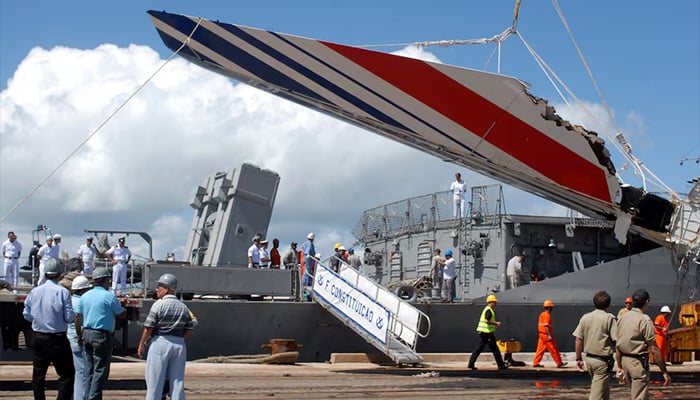
A court in France has ruled that Airbus and Air France are responsible for the Rio-Paris plane crash, convicting both of corporate manslaughter. However, a lengthy legal battle that has lasted 17 years over what is considered France’s worst aviation disaster is expected to persist.
Daniele Lamy, president of the victims’ association for AF447 and whose son was among the 228 lives lost, expressed satisfaction outside the courtroom, stating, “Justice has been absolutely done.” Family members of those who died when the Airbus A330 fell into the Atlantic during a storm on June 1, 2009, sat silently as the verdict was announced.
Previously, in 2023, a lower court had cleared both companies, which have consistently denied any wrongdoing. The recent verdict marks a significant milestone in the ongoing legal process involving relatives of mostly French, Brazilian, and German victims, alongside two prominent French companies. The court ordered them to pay the maximum fine for corporate manslaughter, €225,000 ($261,720), a penalty prosecutors proposed during last year’s eight-week trial. Though this fine is a small fraction of each company’s revenue, many families believe the real impact lies in the reputation damage for the corporations.
Both Airbus and Air France announced plans to appeal to France’s highest court, despite objections from the victims’ families. Lamy criticized this move, urging both companies to cease what she called “procedural harassment,” and emphasized that continued legal proceedings lack moral, human, and legal justification.
Legal experts expect further appeals on specific points of law, potentially dragging the case out for years. If the Court of Cassation overturns Thursday’s verdict, a full re-trial including reexamination of evidence might be possible.
The courtroom where the verdict was read has been the site of some of France’s most historic trials, with many family members sharing the same surnames in attendance.
The investigation retrieved the aircraft’s black boxes in 2011 after a complex, near-abandoned deep-sea search. The trial uncovered deep divisions between the airline and the aircraft manufacturer regarding the causes of the crash—a dispute between the civil accident report, which emphasized pilot actions, and the court’s broader analysis pointing to a chain of causative factors.
Regulators’ assessment is unlikely to change based on the ruling, as the accident’s technical causes primarily involved the pilots’ mishandling of icing sensor issues, which led the plane into a stall and caused a loss of lift under the wings. Prosecutors, on the other hand, focused on alleged systemic failures within both the airline and manufacturer, including inadequate training and neglecting prior sensor issues.
To establish manslaughter, prosecutors needed to demonstrate negligence directly linked to the crash, but their efforts failed to persuade the court on that point in earlier proceedings. Lamy remarked that the pilots, once blamed, have since been “rehabilitated.”
 ChatGPT
 Perplexity
 Gemini AI
 Grok AI